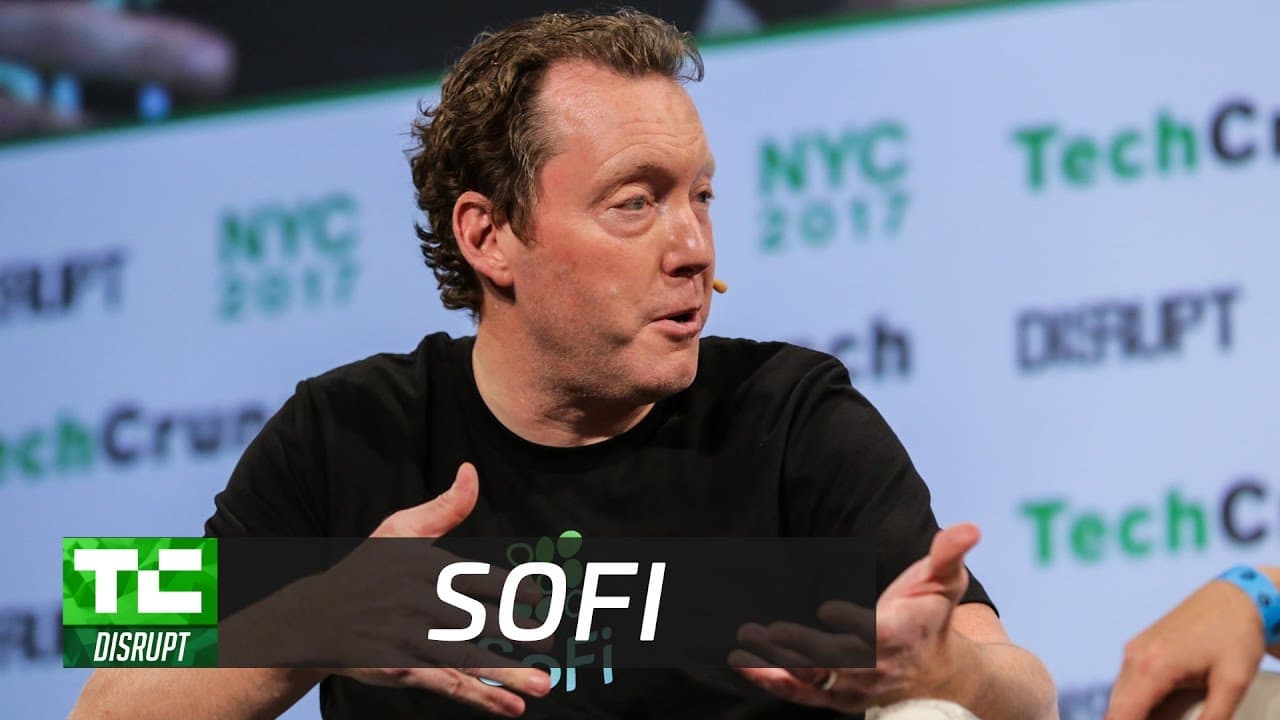
Shooting for $16B with SoFi's Michael Cagney | Disrupt NY 2017
TL;DR
SoFi differentiates by emphasizing speed, transparency, and community alignment rather than competing on rates alone. It pioneered student loan refinancing, saving borrowers over $1.5 billion in interest, and underwrites on free cash flow instead of FICO scores. Delivered through mobile as a 24/7 branch, it runs Net Promoter scores between 70 and 90.
Transcript
hi everybody hi Mike hi aria I'm doing alright you good good um let's go right into it shall we okay you guys are a lending company a financing company I think I read that you guys are on track to loan something like 16 billion this year that's the aim right 16 billion that's right okay that's pretty cool right god but there's like many many other ... Read More
Key Insights
- SoFi is on track to loan roughly $16 billion in a single year, positioning itself against traditional banks and other lending startups by focusing on speed, transparency, and alignment with the consumer.
- Student loan refinancing was created by SoFi and did not exist before the company launched it; to date the product has saved borrowers over $1.5 billion in interest.
- SoFi treats mobile as a ubiquitous 24/7 branch that replaces physical brick-and-mortar interaction, and it runs Net Promoter scores between 70 and 90 across its products.
- SoFi's underwriting moves away from FICO scores and debt-to-income ratios, instead assessing free cash flow by looking at income, taxes, bills, and where a borrower lives; more cash flow means lower rates.
- SoFi began at Stanford as Social Finance after noticing graduate students paid 6.8 to 7.9 percent loan rates despite no one defaulting in 35 years, revealing rates not commensurate with the actual risk.
- SoFi builds a community where customers become members, offering raise week, networking events three times a week, dating events, and an entrepreneur program that helps people start companies.
- SoFi targets 25 to 45 year olds it calls HENRYs, High Earners Not Rich Yet, betting that people around 35 are unhappy with their bank, broker, and insurance provider.
- A core lending system shortcoming is that no one explains borrowing limits or repayment ability to students, creating a perception of free money that basic financial literacy could counter.
Install to Summarize YouTube Videos and Get Transcripts
Explore YouTube Video Summarizer or Get YouTube Transcript Extractor
Questions & Answers
Q: How does SoFi differentiate itself from banks and other lending startups?
SoFi differentiates by putting an emphasis on the consumer through speed, transparency, and alignment, and by building products people want. It created student loan refinancing, delivers through mobile as a ubiquitous 24/7 branch, runs Net Promoter scores between 70 and 90, and builds a true community where customers become members with networking, dating, and entrepreneur events.
Q: How much has SoFi saved borrowers through student loan refinancing?
SoFi has saved people over $1.5 billion in interest to date through its student loan refinancing product, which the company says did not exist before it launched it. The company is also on track to loan roughly $16 billion in the year discussed, and it continues lowering its cost of financing while increasing the number of people it can impact over time.
Q: How does SoFi decide who qualifies for a loan?
SoFi moves away from traditional underwriting that relies on FICO scores and debt-to-income ratios. Instead it cares first about whether you have free cash flow, meaning you make more money than you spend. It assesses this by looking at your income, your taxes, the bills you have, and where you live, and the more cash flow you have, the lower your rates.
Q: Why did SoFi start by focusing on students?
At Stanford, the founders learned that no one in the graduate business school had defaulted on a loan in 35 years, yet borrowers were paying 6.8 to 7.9 percent loan rates. The rate did not seem commensurate with the risk, creating a clear opportunity to deliver a better value proposition. SoFi, originally Social Finance, therefore started focused very much on students.
Q: What does SoFi think about the student debt crisis?
Michael Cagney calls the level of student debt unfortunate and says he wishes there were far less of it, even though SoFi refinances student loans. He argues a key shortcoming is that when students borrow, no one explains their borrowing limits or ability to repay, creating a perception of free money. Basic financial literacy, which he considers empowering, is something the university system fails to provide.
Q: Who is SoFi's target customer?
SoFi targets people roughly 25 to 45 years old, whom it describes with the acronym HENRY, meaning High Earner Not Rich Yet. The premise is that if you are around 35 you are probably unhappy with what you get from your bank, broker, and insurance provider. SoFi sees an enormous opportunity to close that gap for these younger, largely Millennial customers.
Q: What is SoFi planning for foreign students and H-1B borrowers?
SoFi identifies a lack of credit for foreign students as a major challenge in the US. One of the first things it plans to do is student loan refinancing for H-1B visa holders, a market it says is in desperate need. From there the company intends to work on solutions for foreign nationals studying, potentially partnering with mission-driven organizations to offer lower rates.
Q: How does SoFi support entrepreneurs and mission-driven borrowers?
For entrepreneurs who want to start a company, SoFi puts their loan into forbearance, helps them raise capital, and helps pull their business plan together because it wants them to succeed. Cagney also sees an opportunity over time for a nonprofit function to provide debt relief to people pursuing socially worthy paths like public education, potentially teaming with mission-driven organizations.
Summary
In this video, Mike Cagney and Aria Burrows from SoFi discuss the unique approach of their lending and financing company. They emphasize their focus on the consumer, offering products that people want and delivering through mobile platforms. They also highlight the importance of building a true community and providing services beyond just loans, such as networking events and dating programs. The conversation also touches on student loan debt, financial literacy, algorithmic lending, and the possibility of obtaining a banking license. The video ends with a discussion about the departure of a key executive and the future plans of SoFi, including a potential IPO.
Questions & Answers
Q: What sets SoFi apart from other lending and financing companies?
SoFi differentiates itself by putting an emphasis on the consumer and focusing on speed, transparency, and alignment. They create products that people want, such as student loan refinancing, and deliver them through mobile platforms. SoFi also prioritizes customer service and community-building, offering networking events, dating programs, and an entrepreneur program to help individuals succeed.
Q: How did SoFi start and what was its initial focus?
SoFi was started out of Stanford and initially focused on addressing the issue of high student loan debt. They noticed that graduate business school students, despite having a low default rate, were still paying high loan rates. This prompted them to create a better value proposition for students by offering student loan refinancing. While they initially focused on students, they expanded their reach to the wider millennial market.
Q: Is the student debt issue a crisis or an opportunity?
While the student debt issue is unfortunate, SoFi sees it as an opportunity to provide a better solution. They believe that there is a lack of financial literacy in the lending system, with students often not understanding the implications of the debt they are taking on. SoFi aims to address this by providing financial education and empowerment. They also mentioned the possibility of working with universities to provide financial literacy from the start.
Q: Does SoFi's algorithmic lending model cater to a specific type of borrower?
SoFi's lending model moves away from traditional underwriting methods like FICO scores and debt-to-income ratios. They take into account free cash flow and assess applicants based on their income, taxes, bills, and living situation. This approach allows them to provide better rates to those with higher cash flow. SoFi has expanded beyond Stanford to other universities and regardless of the school, the same process is applied.
Q: Are there plans to expand lending to other demographic profiles, such as public educators?
SoFi sees an opportunity to do more for professions like public education, which may not be high-earning but are socially important. They mentioned the possibility of providing debt relief or lower rates for such professions. They are also exploring partnerships with mission-driven organizations to offer innovative solutions and lower rates for segments like foreign students.
Q: How does SoFi balance its online-only approach with the need for human interaction?
While SoFi allows customers to complete processes online without talking to anyone, they also recognize the importance of personal interaction. They receive thousands of inbound calls daily and have a call center to provide assistance. SoFi believes in offering the option to interact offline and organizes networking events, dating programs, and other offline activities. They view themselves as a combination of money, career, and relationship services.
Q: Will SoFi become a bank in the future?
SoFi is considering applying for a banking license, specifically an industrial loan bank license, to provide deposit accounts, debit and credit cards, and other banking services. However, they also mentioned exploring alternatives to the traditional banking system. They aim to deliver the services and products to their members without having to go through the traditional banking process.
Q: Is SoFi planning to raise more funding or go public?
SoFi has raised $1.9 billion and is valued at over $4.3 billion. They are currently profitable and have no immediate plans to raise more capital. The possibility of going public exists, but they will assess the market and the right timing before making a decision.
Q: How does SoFi approach risk-taking and discomfort in their business?
SoFi believes in taking risks and embracing discomfort. They aim to do what is right for the consumer and are willing to be wrong in the process. They view being uncomfortable as a sign of growth and progress. They see the banking industry as resistant to change but believe that they will lead the industry into the next generation.
Q: Does SoFi have plans to expand on their investment vehicles and securitizations?
SoFi's investment vehicles and securitizations have been successful, but there is a current supply constraint in meeting investor demand. They plan to do more but will need to overcome this supply limitation. They have no immediate plans to raise more capital.
Q: How does the departure of a key executive impact SoFi and its future plans?
The departure of Nino Fanlo, who played a significant role in SoFi's growth and strategy, leaves a vacancy that will be filled through a regular search process. Steve Fryburg has stepped in temporarily to handle the finance side of the company. SoFi plans to find a world-class CFO to help them reach the next stage, potentially as a public company.
Takeaways
SoFi differentiates itself in the lending and financing industry by focusing on the consumer, providing innovative products, and building a strong community. They are committed to empowering individuals through financial literacy and offering services beyond traditional loans. While addressing the student debt crisis is a priority, they see it as an opportunity to make a positive impact. SoFi's algorithmic lending approach and emphasis on cash flow allow them to offer better rates to a wider range of borrowers. They are considering obtaining a banking license to expand their services, but are also exploring alternatives. SoFi is profitable and not currently raising capital, with potential plans for an IPO in the future.
Summary & Key Takeaways
-
SoFi, led by Michael Cagney, aims to loan around $16 billion in a year by emphasizing speed, transparency, and alignment. It builds products people want, pioneered student loan refinancing, and has saved borrowers over $1.5 billion in interest to date through mobile delivery.
-
Started at Stanford as Social Finance, SoFi focused on students after seeing graduate borrowers pay 6.8 to 7.9 percent despite no defaults in 35 years. It expanded from five MBA programs to twenty, then to all title three schools, applying the same process regardless of school.
-
SoFi underwrites on free cash flow rather than FICO scores, plans H-1B student loan refinancing, and envisions a nonprofit arm to provide debt relief. It stresses financial literacy, ran a 'know before you owe' campaign, and adds wealth management and community events.
Read in Other Languages (beta)
Share This Summary 📚
Summarize YouTube Videos and Get Video Transcripts with 1-Click
Try YouTube Summary with ChatGPT & Claude or YouTube Transcript Generator
Explore More Summaries from TechCrunch 📚


Summarize YouTube Videos and Get Video Transcripts with 1-Click
Try YouTube Summary with ChatGPT & Claude or YouTube Transcript Generator