What Are Bidirectional Path Tracing and Multiple Importance Sampling in TU Wien Rendering #32?
TL;DR
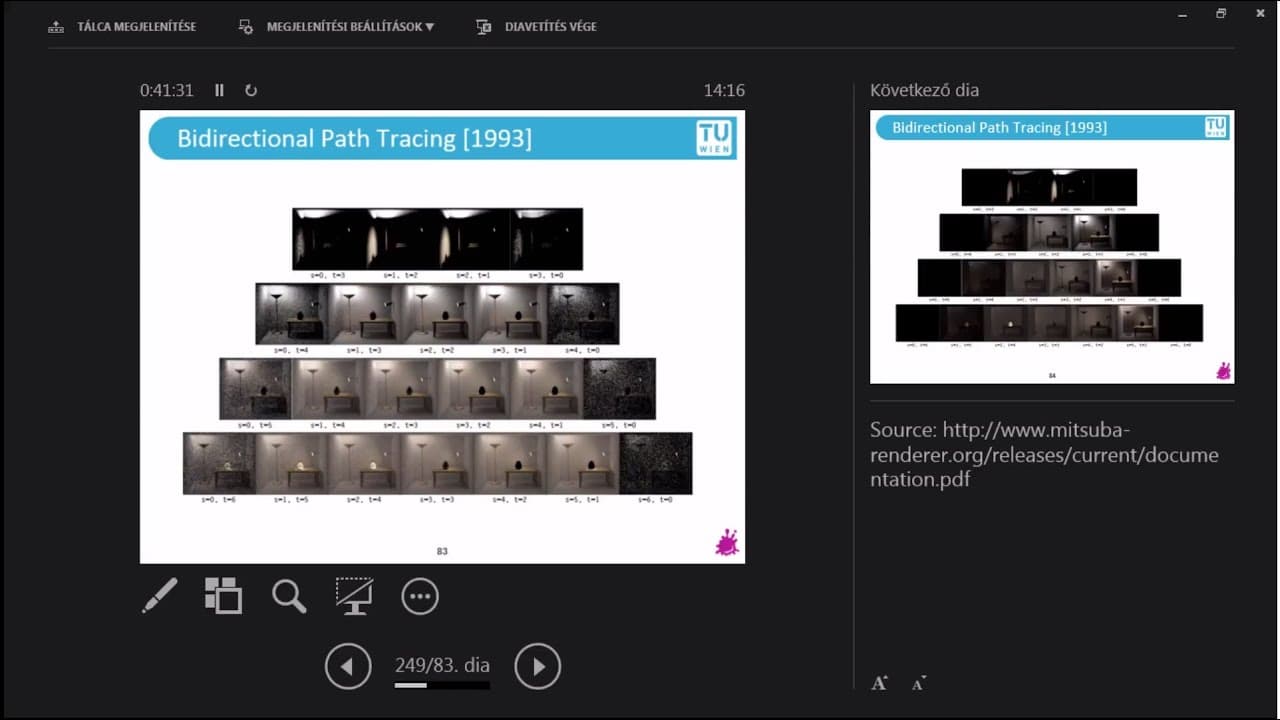
Multiple importance sampling combines multiple sampling strategies and selectively weights samples based on their quality, helping bidirectional path tracing converge faster and produce better results. Bidirectional path tracing connects paths from the camera and light source, improving the chance of sampling difficult lighting, particularly in indoor scenes and caustics. Read on to understand its motivation, advantages, limitations, and relationship to regular path tracing.
Transcript
now before we start the algorithms one more time a disclaimer these results are coming from scientific papers and if you come up with a new method you want to show that this method outperforms existing methods in the scenes or in the setups that you have tried and some people are very open about the limitations of the techniques because if i have a... Read More
Key Insights
- 😃 Bi-directional path tracing is a powerful rendering algorithm that improves convergence speed and captures difficult lighting situations.
- 🙂 The algorithm combines light tracing and path tracing techniques to sample the scene more efficiently.
- 😃 Multiple important sampling is a key technique in bi-directional path tracing that allows for selective weighting of samples based on their quality.
- 😃 Implementing and understanding bi-directional path tracing can be challenging, but the results are often worth the effort.
- 😃 Bi-directional path tracing is particularly effective in indoor scenes and for capturing caustics.
- 🙂 The algorithm is unbiased and consistent since it samples all possible light paths.
- 🛀 Comparison with regular path tracing shows significant improvements in convergence and quality of rendered images.
Install to Summarize YouTube Videos and Get Transcripts
Explore YouTube Video Summarizer or Get YouTube Transcript Extractor
Questions & Answers
Q: What is multiple importance sampling?
Multiple importance sampling, or MIS, combines multiple sampling strategies in a mathematically sound way. It selectively weights samples based on their quality, leading to faster convergence and better results in bidirectional path tracing.
Q: What is bidirectional path tracing?
Bidirectional path tracing starts one light path from the eye or camera and another from the light source. It connects these paths to build complete light paths and improve scene sampling.
Q: How does bidirectional path tracing differ from regular path tracing?
Regular path tracing starts rays from the camera and bounces them through the scene. Bidirectional path tracing also starts paths from light sources, then connects the camera and light paths to increase the chance of sampling difficult illumination.
Q: Why can regular path tracing struggle with caustics?
Caustics can converge very slowly because their contributing light paths are extremely improbable to sample. Many samples may be required to hit those paths often enough to clean up the result.
Q: Why can next event estimation fail in difficult indoor lighting?
Next event estimation sends shadow rays toward a light source after each bounce, which usually lowers variance. In the described indoor setup, most attempted connections are obstructed by the object enclosing the light, so many samples are wasted.
Q: How does bidirectional path tracing reach difficult light sources?
It traces a given number of bounces from both the eye and the light source, then connects the resulting paths. Starting from the light allows the path to escape a small region that would otherwise be difficult to hit from the eye.
Q: What are the main advantages of bidirectional path tracing?
It improves convergence speed and handles difficult lighting situations more effectively than regular path tracing in the examples discussed. It is particularly effective for indoor scenes and for capturing caustics.
Q: What limitations should be considered when evaluating bidirectional path tracing?
Strong results in one scene do not prove that an algorithm will perform best in every scene or setup. Corner cases and difficult conditions can emerge as more people use an algorithm, so its robustness and limitations should be evaluated carefully.
Summary & Key Takeaways
-
Bi-directional Path Tracing is a rendering algorithm that combines light tracing and path tracing techniques.
-
It improves convergence speed, especially in indoor scenes and for capturing caustics.
-
The algorithm requires careful implementation and understanding of multiple important sampling.
Read in Other Languages (beta)
Share This Summary 📚
Summarize YouTube Videos and Get Video Transcripts with 1-Click
Try YouTube Summary with ChatGPT & Claude or YouTube Transcript Generator
Explore More Summaries from Two Minute Papers 📚




Summarize YouTube Videos and Get Video Transcripts with 1-Click
Try YouTube Summary with ChatGPT & Claude or YouTube Transcript Generator