Why are Smokestacks So Tall?
TL;DR
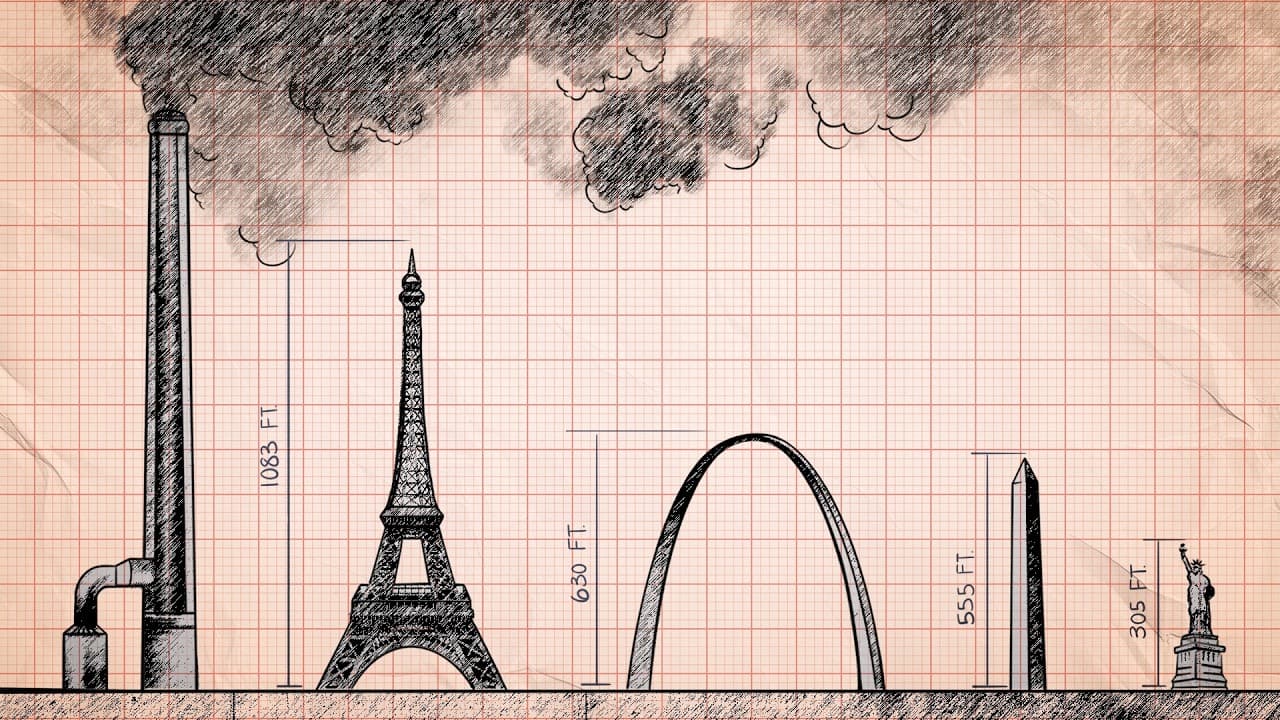
Tall smokestacks help disperse pollutants to minimize public health impact.
Transcript
That’s the first line of one of my favorite short stories, written by Kurt Vonnegut in 1955. It paints a picture of a dystopian future that, thankfully, didn’t really come to be, in part because of those stacks. In some ways, air pollution is kind of a part of life. I’d love to live in a world where the systems, materials and processes that mak... Read More
Key Insights
- Smokestacks are engineered to disperse pollutants by increasing airflow and elevating emissions, reducing their concentration at ground level.
- Primary emission controls like scrubbers and precipitators are crucial but not always 100% effective, necessitating additional dispersion strategies.
- The stack effect utilizes differences in air pressure and temperature to enhance the upward movement of emissions.
- Atmospheric conditions like stability and temperature inversions significantly influence the dispersion of pollutants from smokestacks.
- Complex factors like advection, diffusion, and atmospheric stability are considered in smokestack design to ensure compliance with air quality standards.
- The historical use of smokestacks was initially for improving combustion efficiency rather than air quality.
- Modern regulations limit the reliance on tall smokestacks for dispersion, encouraging more effective emission control technologies.
- The field of environmental engineering continuously evolves to address air pollution challenges through scientific research and technological advancements.
Install to Summarize YouTube Videos and Get Transcripts
Explore YouTube Video Summarizer or Get YouTube Transcript Extractor
Questions & Answers
Q: Why are smokestacks designed to be so tall?
Smokestacks are designed to be tall to help disperse pollutants over a larger area, reducing their concentration at ground level. The height allows emissions to rise higher into the atmosphere, where they can be diluted and dispersed by wind, minimizing their impact on human health and the environment.
Q: What is the stack effect and how does it work?
The stack effect is a phenomenon where differences in air pressure and temperature between the inside and outside of a smokestack create a natural upward airflow. Hot air inside the stack is less dense, causing it to rise and draw more air through the system, enhancing the dispersion of pollutants.
Q: How do atmospheric conditions affect pollutant dispersion from smokestacks?
Atmospheric conditions, such as stability and temperature inversions, significantly influence how pollutants disperse from smokestacks. Stable conditions can lead to coning plumes, while unstable conditions promote mixing and looping plumes. Temperature inversions can trap emissions near the ground, affecting air quality.
Q: What are the primary emission control technologies used in conjunction with smokestacks?
Primary emission control technologies include scrubbers, which remove sulfur dioxide, catalytic reactors for nitrous oxides, and electrostatic precipitators for particulates. These systems aim to reduce pollutants at the source before they are released into the atmosphere, complementing the dispersion function of smokestacks.
Q: Why is it challenging to design smokestacks that meet air quality standards?
Designing smokestacks to meet air quality standards is challenging due to the need to account for numerous factors, such as wind speed, atmospheric stability, and existing pollutant levels. Engineers must ensure that emissions do not exceed concentration limits at any time or location, requiring complex modeling and simulations.
Q: How has the role of smokestacks evolved over time?
Historically, smokestacks were used to improve combustion efficiency in industrial processes. Over time, their role evolved to focus on air quality, as environmental regulations became stricter, requiring smokestacks to aid in dispersing pollutants to protect public health.
Q: What limitations exist in relying solely on tall smokestacks for pollution control?
Relying solely on tall smokestacks for pollution control is limited by the need for effective primary emission controls. Regulations restrict using height as the primary solution, encouraging the adoption of more effective technologies to reduce emissions at the source, as dispersion alone cannot address all pollutants.
Q: What role do environmental engineers play in air quality management?
Environmental engineers play a crucial role in air quality management by developing emission control technologies, designing effective smokestacks, and conducting research to understand pollutant behavior. They work to ensure compliance with air quality standards, protecting public health and the environment through scientific and engineering advancements.
Summary & Key Takeaways
-
Smokestacks are designed to disperse pollutants by utilizing the stack effect, which increases airflow and elevates emissions to minimize their impact on human health. This engineering solution is complemented by various emission control technologies.
-
The effectiveness of smokestacks in dispersing pollutants is influenced by atmospheric conditions, including stability and temperature inversions, which can alter the behavior of emission plumes and their concentration at ground level.
-
Environmental engineers consider numerous factors, such as wind patterns and existing pollutant levels, to ensure that new sources of pollution comply with air quality standards, highlighting the complexity of designing effective smokestacks.
Read in Other Languages (beta)
Share This Summary 📚
Summarize YouTube Videos and Get Video Transcripts with 1-Click
Try YouTube Summary with ChatGPT & Claude or YouTube Transcript Generator
Explore More Summaries from Practical Engineering 📚

Summarize YouTube Videos and Get Video Transcripts with 1-Click
Try YouTube Summary with ChatGPT & Claude or YouTube Transcript Generator