What Really Happened at the Arecibo Telescope?
TL;DR
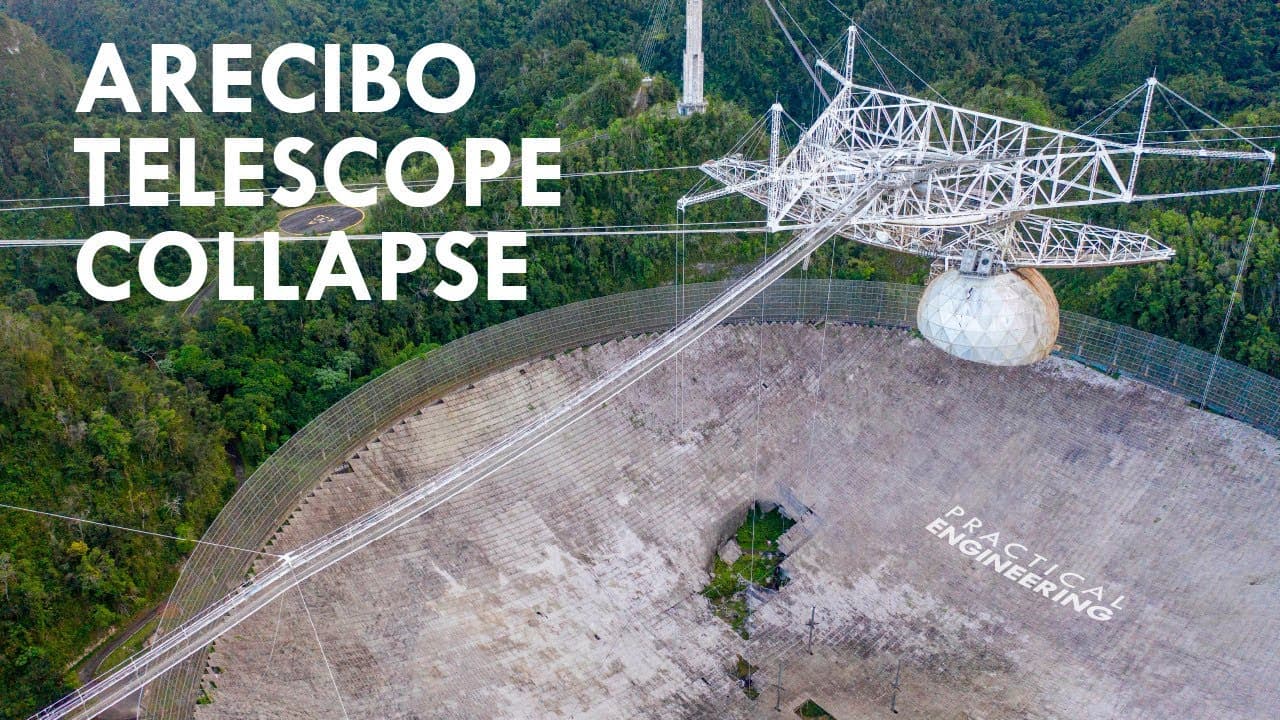
The Arecibo Telescope collapsed due to structural failures and funding issues.
Transcript
In December of 2020, the Arecibo telescope
- one of the largest and most iconic astronomical instruments in the world - collapsed. This 57-year-old megastructure not only made many incredible scientific discoveries over its lifetime, it was also an emblem of humanity’s interest and curiosity about our place in the universe. Its loss was felt across... Read More
Key Insights
- The Arecibo Telescope was a pivotal astronomical instrument, known for its large 305-meter dish and contributions to radio astronomy.
- Originally a Department of Defense project, it transitioned to scientific use under the National Science Foundation in 1969.
- The telescope's design allowed it to focus on various celestial objects by adjusting the position of the receiver above its spherical dish.
- Upgrades in 1997 added a Gregorian dome, increasing the telescope's capacity but also its structural load.
- Hurricanes Irma and Maria in 2017 caused significant damage, exacerbating existing structural issues and funding challenges.
- A series of cable failures in 2020 led to the eventual collapse of the telescope, highlighting potential issues in cable fabrication and maintenance.
- The National Science Foundation is exploring future possibilities for the site, emphasizing its continued scientific importance.
- The collapse underscores the challenges and importance of maintaining aging infrastructure, especially in harsh environmental conditions.
Install to Summarize YouTube Videos and Get Transcripts
Explore YouTube Video Summarizer or Get YouTube Transcript Extractor
Questions & Answers
Q: What was the original purpose of the Arecibo Telescope?
The Arecibo Telescope was originally designed as a Department of Defense project to detect nuclear warheads in the upper atmosphere. It was later transitioned to scientific use under the National Science Foundation in 1969, where it became a pivotal instrument in radio astronomy.
Q: How did the design of the Arecibo Telescope allow it to focus on different celestial objects?
The Arecibo Telescope used a spherical dish design, which allowed it to steer by changing the position of the receiver above the dish. This enabled it to focus on different parts of the sky and track celestial objects as the Earth rotated, unlike fixed parabolic dishes.
Q: What upgrades were made to the Arecibo Telescope in 1997?
In 1997, the Arecibo Telescope was upgraded with the addition of a Gregorian dome, which used two additional reflectors to focus radio waves. This upgrade expanded the telescope's capability to observe a wider range of radio frequencies, although it also increased the structural load.
Q: What were the main challenges faced by the Arecibo Telescope in recent years?
The Arecibo Telescope faced several challenges, including significant structural damage from hurricanes Irma and Maria in 2017, funding cuts from the National Science Foundation, and eventual structural failures, particularly cable failures, which led to its collapse in December 2020.
Q: What led to the collapse of the Arecibo Telescope?
The collapse of the Arecibo Telescope was primarily due to a series of cable failures. The first cable failure occurred in August 2020, followed by another in November. These failures were attributed to potential fabrication issues and environmental factors. The final collapse occurred after a third cable failure in December 2020.
Q: What are the potential reasons for the cable failures at Arecibo?
The cable failures at Arecibo were likely due to a combination of factors, including potential fabrication errors in the spelter sockets, corrosion from exposure to the salty sea air, and the dynamic loads experienced during previous cable failures. These issues compromised the structural integrity of the telescope.
Q: How has the scientific community responded to the loss of the Arecibo Telescope?
The scientific community has expressed significant loss over the collapse of the Arecibo Telescope, given its contributions to radio astronomy and education. The National Science Foundation is exploring future possibilities for the site, emphasizing the continued importance of scientific research and public engagement.
Q: What lessons can be learned from the Arecibo Telescope's collapse?
The collapse of the Arecibo Telescope highlights the importance of maintaining aging infrastructure, especially in challenging environmental conditions. It underscores the need for rigorous structural testing, adequate safety margins, and proactive maintenance to prevent catastrophic failures in critical scientific facilities.
Summary & Key Takeaways
-
The Arecibo Telescope, a landmark in radio astronomy, collapsed in December 2020 due to structural failures and funding issues. Its unique design and significant scientific contributions made it an iconic facility.
-
Originally built for defense purposes, the telescope transitioned to scientific use, playing a crucial role in discoveries like the evidence of gravitational waves. It faced challenges from environmental damage and funding cuts.
-
The collapse was precipitated by a series of cable failures, highlighting potential issues in maintenance and structural integrity. The National Science Foundation is considering future uses for the site, maintaining its scientific legacy.
Read in Other Languages (beta)
Share This Summary 📚
Summarize YouTube Videos and Get Video Transcripts with 1-Click
Try YouTube Summary with ChatGPT & Claude or YouTube Transcript Generator
Explore More Summaries from Practical Engineering 📚




Summarize YouTube Videos and Get Video Transcripts with 1-Click
Try YouTube Summary with ChatGPT & Claude or YouTube Transcript Generator