Why Retaining Walls Collapse
TL;DR
Retaining walls fail due to design flaws, surcharge loads, and water pressure.
Transcript
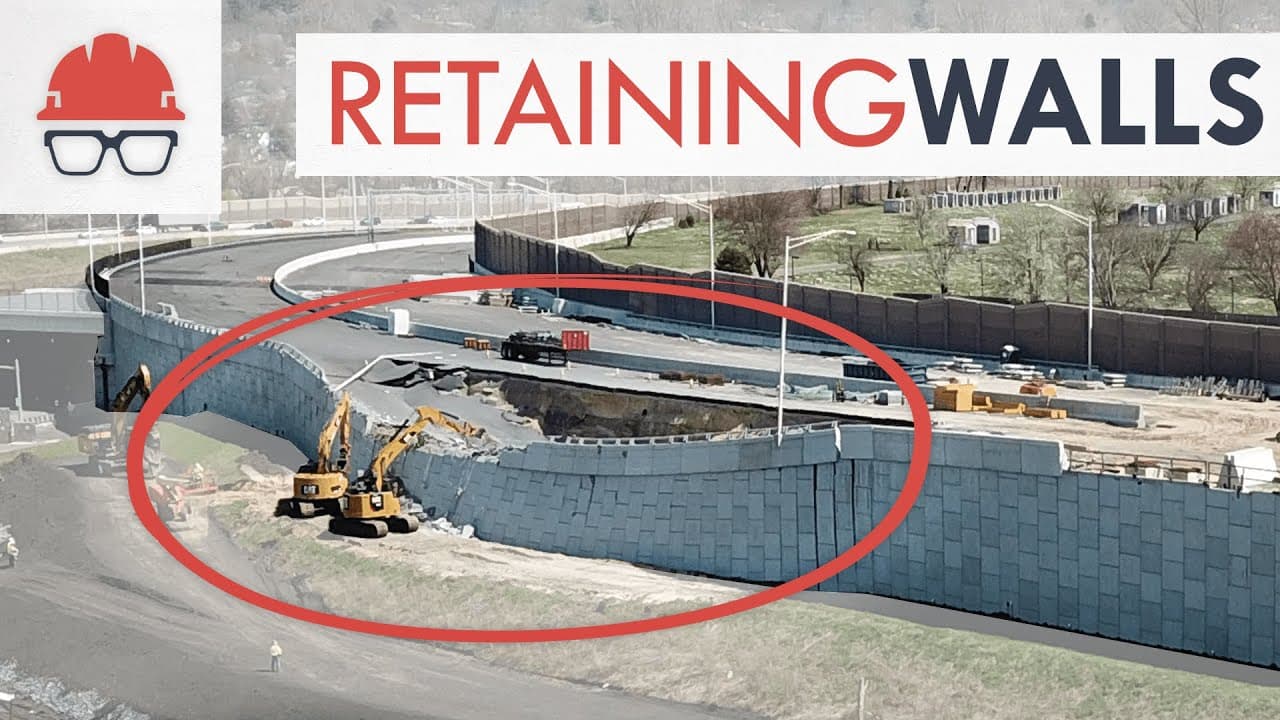
Why Retaining Walls Fail In March of 2021, a long-running construction project on a New Jersey highway interchange ground to halt when one of the retaining walls along the roadway collapsed. This project in Camden County, called the Direct Connection, was already 4 years behind schedule, and this failure set it back even further. As of this wri... Read More
Key Insights
- Retaining walls are crucial for creating space in construction by holding back soil, especially in urban areas where land is scarce.
- The stability of a slope is influenced by soil type and loading, necessitating retaining walls for steeper angles.
- Gravity walls rely on their weight and the weight of the soil above them for stability, often using a cantilever design.
- Mechanically stabilized earth uses reinforcements like steel strips or geotextiles to bind soil layers, enhancing stability.
- Soil nailing involves inserting steel bars into drilled holes to stabilize slopes, often used in roadway projects.
- Anchors or tiebacks are tensioned steel bars that provide active support, reducing the number of required installations.
- Pile walls use vertical members driven into the ground, offering support for temporary excavations and resisting lateral earth pressure.
- Retaining walls fail due to underestimated earth pressure, unanticipated surcharge loads, and water pressure, highlighting the need for professional design.
Install to Summarize YouTube Videos and Get Transcripts
Explore YouTube Video Summarizer or Get YouTube Transcript Extractor
Questions & Answers
Q: Why are retaining walls important in construction?
Retaining walls are critical in construction for creating usable space by holding back soil, especially in urban areas where land is limited. They allow for the construction of roads, buildings, and other structures on slopes by providing stability and preventing soil erosion.
Q: What are the main types of retaining walls discussed?
The main types of retaining walls discussed include gravity walls, mechanically stabilized earth, soil nailing, anchors or tiebacks, and pile walls. Each type has a unique design and mechanism for providing stability and resisting lateral earth pressure.
Q: What causes retaining walls to fail?
Retaining walls fail due to several reasons, including underestimating lateral earth pressure, unanticipated surcharge loads from heavy structures or vehicles, and water pressure. Poor drainage systems and lack of professional engineering design also contribute to failures.
Q: How do gravity walls maintain their stability?
Gravity walls maintain stability by relying on their own weight and the weight of the soil above them. They often use a cantilever design, where the footing extends into the retained soil, acting as a lever to counteract lateral forces and keep the wall upright.
Q: What is mechanically stabilized earth?
Mechanically stabilized earth involves reinforcing soil layers with elements like steel strips or geotextiles. This technique binds the soil mass together, enhancing its stability and allowing it to act as its own retaining wall, effectively supporting unreinforced soil beyond.
Q: What role do anchors or tiebacks play in retaining walls?
Anchors or tiebacks provide active support to retaining walls by tensioning steel bars installed in drilled holes. Unlike soil nails, they are not fully grouted, allowing for tension storage. This tension force is distributed across the wall face, enhancing stability.
Q: How do pile walls function in construction?
Pile walls use vertical members driven or drilled into the ground, providing support for temporary excavations. They resist lateral earth pressure by cantilevering up vertically, with deeper installations offering greater resistance. Pile walls are often used in construction projects to ensure stability.
Q: What measures prevent water-related issues in retaining walls?
To prevent water-related issues, retaining walls are often equipped with drainage systems to manage water pressure. Features like weepholes or pipes allow water to escape, reducing the risk of pressure buildup. Proper drainage is crucial to prevent water from freezing and expanding, which can damage the wall.
Summary & Key Takeaways
-
Retaining walls are essential for holding back soil in construction, especially in space-constrained urban areas. They come in various designs, including gravity walls and mechanically stabilized earth, each with unique stability mechanisms.
-
Failures in retaining walls often result from underestimating lateral earth pressure, unexpected surcharge loads, and water pressure. Professional engineering design is crucial to prevent such failures and ensure structural integrity.
-
Techniques like soil nailing and pile walls offer additional support for slopes and excavations, with each method tailored to specific construction needs. Proper drainage systems are also vital to prevent water-related issues.
Read in Other Languages (beta)
Share This Summary 📚
Summarize YouTube Videos and Get Video Transcripts with 1-Click
Try YouTube Summary with ChatGPT & Claude or YouTube Transcript Generator
Explore More Summaries from Practical Engineering 📚



Summarize YouTube Videos and Get Video Transcripts with 1-Click
Try YouTube Summary with ChatGPT & Claude or YouTube Transcript Generator