How Engineers Straightened the Leaning Tower of Pisa
TL;DR
Engineers stabilized the Leaning Tower of Pisa using innovative methods.
Transcript
Long ago, maybe upwards of 1-2 million years ago, a river in the central part of what’s now Italy, emptied into what’s now the Ligurian Sea. It still does, by the way, but it did back then too. As the sea rose and fell from the tides and the river moved sediment downstream, silt and soil were deposited across the landscape. In one little spot, ... Read More
Key Insights
- The Leaning Tower of Pisa's tilt was caused by uneven soil composition, with more sand to the north and more clay to the south.
- Construction of the tower began in 1173, but interruptions due to medieval battles allowed the tilt to worsen over time.
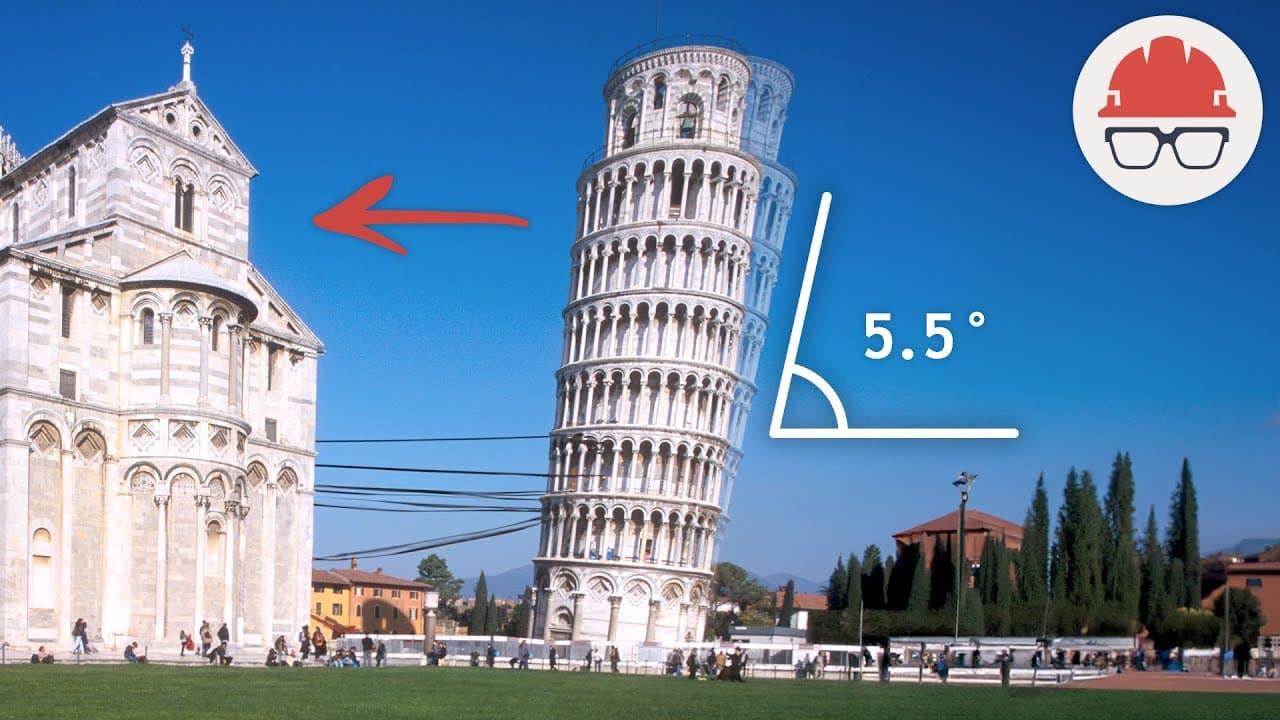
- By 1990, the tower's tilt reached an average of 5.5 degrees, prompting closure and a call for stabilization efforts.
- Initial stabilization involved adding lead counterweights and building a concrete ring around the base to counteract the tilt.
- Various methods like electroosmosis and groundwater pumping were considered but ultimately abandoned due to ineffectiveness.
- Underexcavation was successfully used to remove soil from beneath the north side, effectively reducing the tilt.
- The final stabilization project reduced the tilt by about half a degree, restoring the tower's stability to its 1800s state.
- The project maintained the tower's historical lean, preserving its iconic character while ensuring safety for future generations.
Install to Summarize YouTube Videos and Get Transcripts
Explore YouTube Video Summarizer or Get YouTube Transcript Extractor
Questions & Answers
Q: Why did the Leaning Tower of Pisa start tilting?
The Leaning Tower of Pisa began tilting due to the uneven soil composition where it was built. The construction site had more sand to the north and more clay to the south, causing differential settlement as the tower was constructed. Over time, this uneven settlement led to the characteristic tilt.
Q: What initial measures were taken to stabilize the tower in 1990?
In 1990, engineers took initial measures to stabilize the Leaning Tower of Pisa by installing a modern monitoring system to track its movement. They also constructed a concrete ring around the base and added lead counterweights on the north side to counteract the tilt. These efforts were temporary but successfully reduced the tilt slightly.
Q: Why was electroosmosis considered for stabilizing the tower?
Electroosmosis was considered as a stabilization method because it involves applying an electric current to soil, causing water to migrate towards electrodes. This technique could have potentially consolidated the clay beneath the tower, reducing its tilt. However, due to the soil's conductivity, this method was ineffective for the Pisa tower.
Q: What is underexcavation and how was it used on the tower?
Underexcavation involves removing soil from beneath a structure to correct its tilt. For the Leaning Tower of Pisa, engineers carefully bored holes under the north side and removed soil to gradually reduce the tilt. This method allowed precise control over the tower's movement, ultimately stabilizing it without compromising its historical lean.
Q: How did engineers ensure the tower's safety during the stabilization process?
To ensure safety during the stabilization process, engineers designed a safeguard system with cable stays attached to the tower and anchoring frames. These cables could be tightened individually to stop unwanted movement. This precaution allowed engineers to carefully monitor and control the tower's position during the underexcavation process.
Q: What was the final outcome of the stabilization project?
The final outcome of the stabilization project was a successful reduction of the tower's tilt by about half a degree, effectively reversing its condition to its early 1800s state. The project maintained the tower's historical lean, preserving its iconic character while ensuring its structural stability for future generations.
Q: Why is the Leaning Tower's tilt considered integral to its character?
The Leaning Tower's tilt is integral to its character because it is a unique and historical feature that distinguishes it from other towers. The tilt has become an iconic symbol of Pisa and a significant tourist attraction. Maintaining the lean was essential to preserving the tower's historical and cultural significance.
Q: What challenges did engineers face during the stabilization project?
Engineers faced several challenges during the stabilization project, including maintaining the tower's historical appearance while reducing its tilt, ensuring the tower's safety during the process, and dealing with ineffective initial methods like electroosmosis. The complexity of the soil conditions and the need to preserve the tower's iconic lean added to the project's difficulties.
Summary & Key Takeaways
-
The Leaning Tower of Pisa's tilt was a result of uneven soil composition, and construction interruptions allowed the problem to worsen over centuries. In 1990, the tilt reached a critical point, prompting a stabilization project.
-
Engineers initially used lead counterweights and a concrete ring to stabilize the tower, but more innovative methods like electroosmosis and groundwater pumping were considered but ultimately proved ineffective.
-
Underexcavation was the successful method used to stabilize the tower, reducing the tilt by about half a degree, thus preserving its iconic lean while ensuring its safety for future generations.
Read in Other Languages (beta)
Share This Summary 📚
Summarize YouTube Videos and Get Video Transcripts with 1-Click
Try YouTube Summary with ChatGPT & Claude or YouTube Transcript Generator
Explore More Summaries from Practical Engineering 📚






Summarize YouTube Videos and Get Video Transcripts with 1-Click
Try YouTube Summary with ChatGPT & Claude or YouTube Transcript Generator