What Are Different Modes of Operation in Encryption?
TL;DR
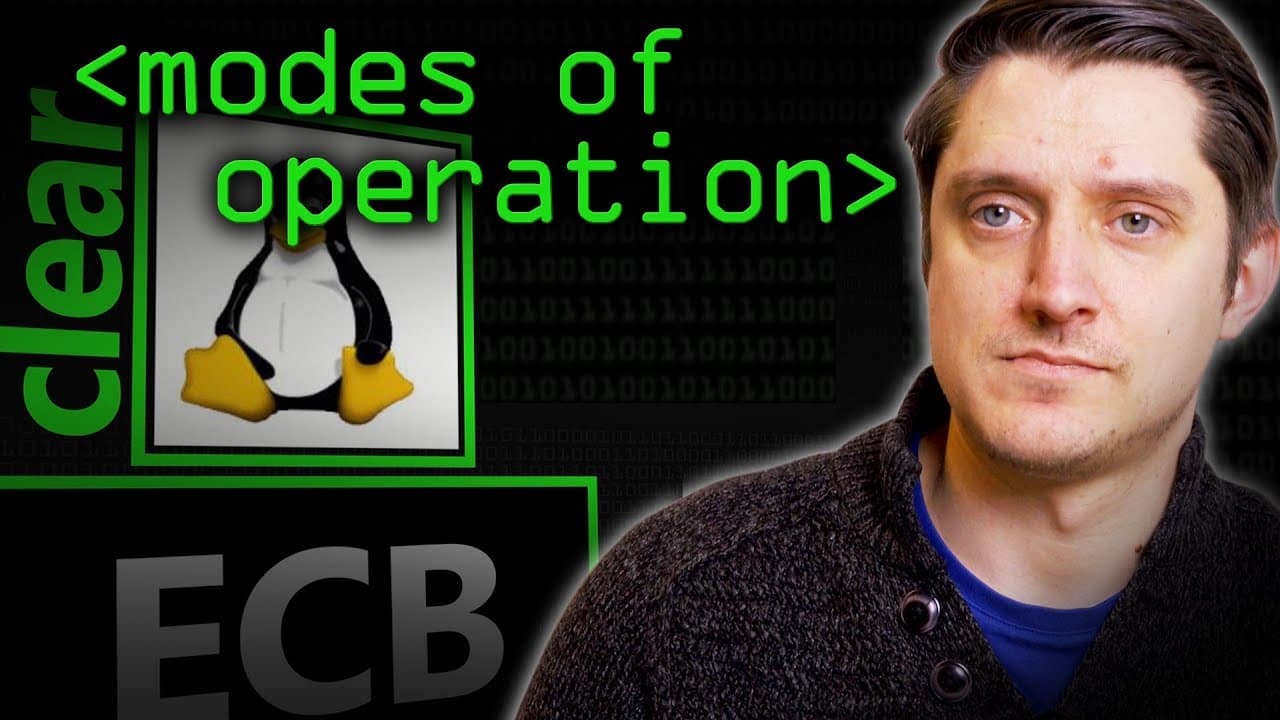
Different modes of operation in encryption handle varying message lengths. Electronic Code Book (ECB) is fast but lacks security as identical messages yield identical ciphertexts. Cipher Block Chaining (CBC) enhances security by linking block encryptions but is slower, while Counter Mode (CTR) converts block ciphers to stream ciphers, offering better security and efficiency.
Transcript
well we did a video on the fiesta cipher and you know hopefully people enjoyed learning about what i think is a really cool method of encryption now i actually wrote some code for this which we didn't end up putting in a video just because of time um but i did put it on github and you know people as soon as you put things on github people go oh i c... Read More
Key Insights
- 🍵 Modes of operation in encryption algorithms are essential to handle messages of varying lengths.
- 💨 Electronic Code Book (ECB) mode is fast but insecure due to patterns in the ciphertext.
- 👊 Cipher Block Chaining (CBC) mode provides better security but is slower and vulnerable to specific attacks.
- 🎏 Counter Mode (CTR) transforms block ciphers into stream ciphers, offering improved security and parallelization.
- 🤩 Nonce and initialization vectors play a crucial role in ensuring unique encryption keys.
- 👊 Reusing nonces compromises the security of encryption and enables attacks like crib dragging.
Install to Summarize YouTube Videos and Get Transcripts
Explore YouTube Video Summarizer or Get YouTube Transcript Extractor
Questions & Answers
Q: What is the difference between Electronic Code Book (ECB) mode and Cipher Block Chaining (CBC) mode?
ECB mode encrypts each message block individually, making it faster, but it reveals patterns in the ciphertext. In CBC mode, each message block is XORed with the previous ciphertext, preventing pattern detection and increasing security.
Q: How does Counter Mode (CTR) differ from other modes of operation?
CTR mode transforms block ciphers into stream ciphers by encrypting a counter and XORing it with the message. It provides better security, parallelization, and allows for efficient random access decryption.
Q: What are the drawbacks of using Electronic Code Book (ECB) mode?
ECB mode lacks security because identical messages produce identical ciphertexts. It also reveals patterns in the plaintext, making it easy for attackers to learn information about the messages.
Q: Why is Cipher Block Chaining (CBC) mode slower compared to other modes?
CBC mode requires sequential encryption and decryption, making it less parallelizable and slower compared to other modes like ECB and CTR. It also introduces security vulnerabilities with bit-flipping attacks.
Key Insights:
- Modes of operation in encryption algorithms are essential to handle messages of varying lengths.
- Electronic Code Book (ECB) mode is fast but insecure due to patterns in the ciphertext.
- Cipher Block Chaining (CBC) mode provides better security but is slower and vulnerable to specific attacks.
- Counter Mode (CTR) transforms block ciphers into stream ciphers, offering improved security and parallelization.
- Nonce and initialization vectors play a crucial role in ensuring unique encryption keys.
- Reusing nonces compromises the security of encryption and enables attacks like crib dragging.
- Counter Mode (CTR) eliminates the need for separate encryption and decryption functions, simplifying implementation.
Summary & Key Takeaways
-
The video discusses the need for different modes of operation in encryption algorithms to handle messages of varying lengths.
-
Electronic Code Book (ECB) mode splits the message into fixed-sized blocks and encrypts each block individually. However, it lacks security due to identical messages producing identical ciphertexts.
-
Cipher Block Chaining (CBC) mode addresses ECB's security issue by XORing the previous ciphertext with the current message block, but it is slower and vulnerable to certain attacks.
-
Counter Mode (CTR) converts block ciphers into stream ciphers by encrypting a counter and XORing the output with the message, providing better security and parallelization.
Read in Other Languages (beta)
Share This Summary 📚
Summarize YouTube Videos and Get Video Transcripts with 1-Click
Try YouTube Summary with ChatGPT & Claude or YouTube Transcript Generator
Explore More Summaries from Computerphile 📚



Summarize YouTube Videos and Get Video Transcripts with 1-Click
Try YouTube Summary with ChatGPT & Claude or YouTube Transcript Generator