What Is Consideration in Contract Law and Why Is It Important?
TL;DR
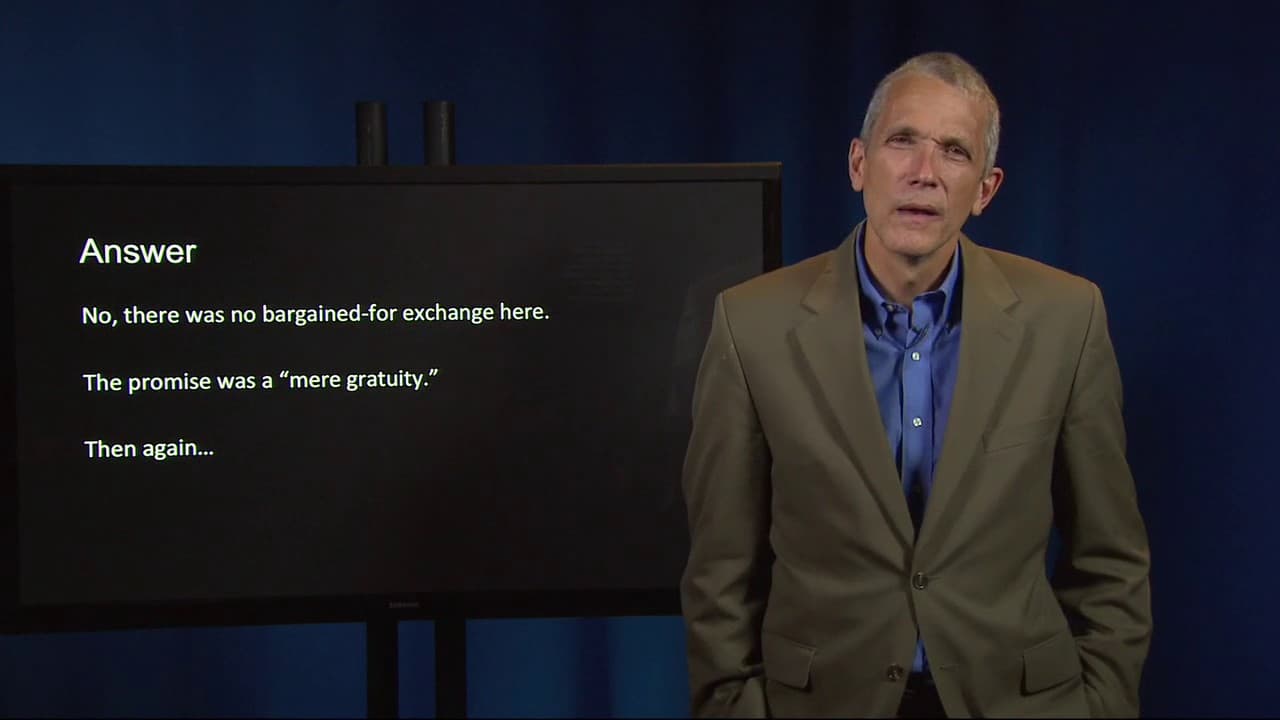
Consideration in contract law refers to the exchange of value or promises between parties, and it's essential for forming enforceable contracts. In the case of Kirksey v. Kirksey, the court determined that the promise made was a mere gratuity and lacked consideration, leading to its unenforceability. This highlights the critical distinction between enforceable promises and gratuitous ones.
Transcript
if you've been watching these modules in the suggested order we have now finished the introductory part of the course we've covered cases on how to form an enforceable promise we've been introduced to a few cases on defenses to enforcement and a couple cases having to do with remedies now we're going to go back and take up in more depth how to crea... Read More
Key Insights
- 🥳 Consideration is a fundamental concept in contract law, requiring an exchange of value or promises between parties.
- 💼 The case of Kirksey v. Kirksey illustrates the difference between a promise with consideration and a gratuitous promise without consideration.
- 😘 The court in Kirksey held that the promise lacked consideration, leading to the reversal of the lower court's decision.
Install to Summarize YouTube Videos and Get Transcripts
Explore YouTube Video Summarizer or Get YouTube Transcript Extractor
Questions & Answers
Q: What is the importance of consideration in contract law?
Consideration is essential in forming a valid contract. It refers to something of value exchanged between the parties, either a benefit to the promisor or a detriment to the promisee. Without consideration, a promise may be seen as a mere gratuitous promise and not enforceable.
Q: How does the case of Kirksey v. Kirksey demonstrate the absence of consideration?
In Kirksey v. Kirksey, the defendant made a promise to provide the plaintiff with a place to raise her family. However, the court found that the promise was a mere gratuity without any exchange of value or consideration. Therefore, it was not enforceable.
Q: What is the difference between a conditional gratuitous promise and a bargain for promise?
A conditional gratuitous promise is made without seeking anything in return but is dependent on certain conditions being met. A bargain for promise, on the other hand, involves an exchange of value or consideration between the parties. The distinction lies in whether there is a quid pro quo or a mere conditional offer.
Q: Can a promise with reliance alone be considered as consideration?
No, reliance alone is not enough to establish consideration. While reliance may be one aspect of consideration, there must also be a bargaining process or a quid pro quo. Both parties need to provide something of value or exchange promises for the contract to be enforceable.
Summary & Key Takeaways
-
This content is an introduction to contract law, specifically focusing on the concept of consideration.
-
It explores the difference between a contract with consideration (such as in Hammer v. Sidway) and a gratuitous promise (as seen in Kirksey v. Kirksey).
-
The case of Kirksey v. Kirksey involves a promise made by the defendant to provide the plaintiff with a place to live, without any consideration.
-
The court rules that the promise in Kirksey was a mere gratuity and not supported by consideration.
Read in Other Languages (beta)
Share This Summary 📚
Summarize YouTube Videos and Get Video Transcripts with 1-Click
Try YouTube Summary with ChatGPT & Claude or YouTube Transcript Generator
Explore More Summaries from YaleCourses 📚






Summarize YouTube Videos and Get Video Transcripts with 1-Click
Try YouTube Summary with ChatGPT & Claude or YouTube Transcript Generator