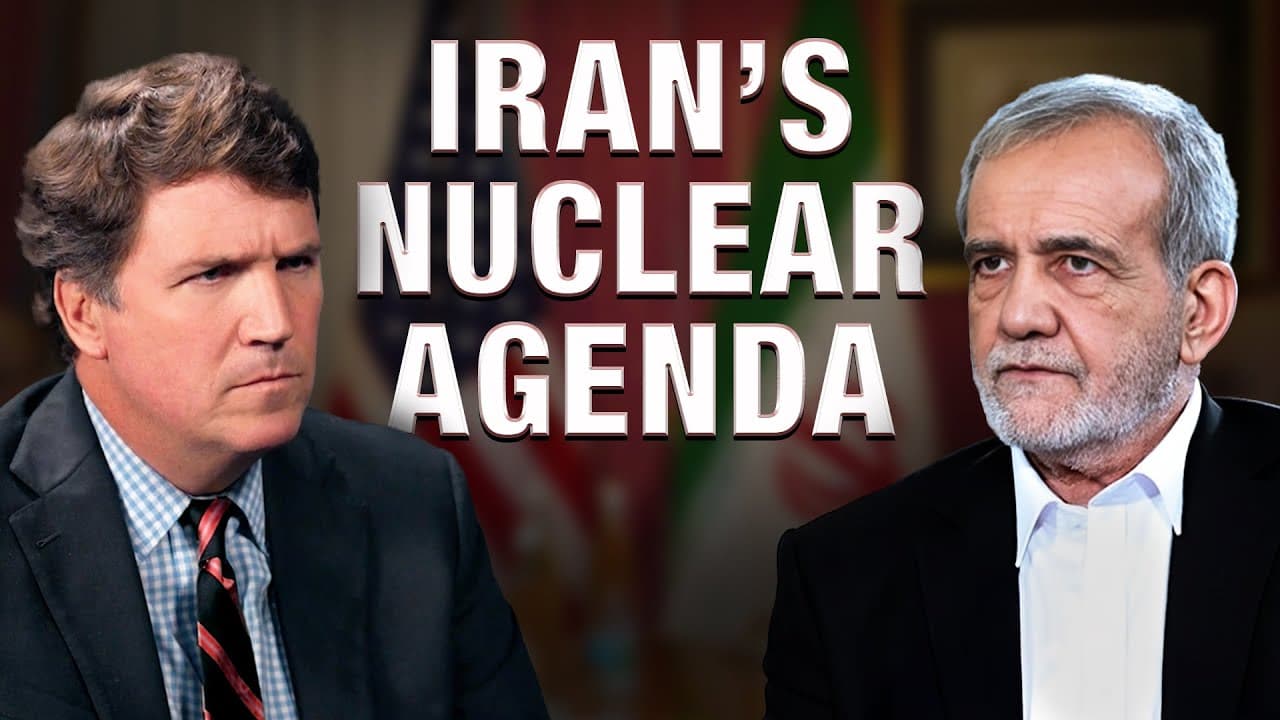
Tucker Carlson Interviews Iran's President on Nuclear Tensions
TL;DR
Iran's President Masoud Pezeshkian discusses the country's stance on nuclear weapons, asserting they have never pursued them due to a religious decree. He emphasizes Iran's readiness for diplomacy but blames Israel for derailing peace efforts. Pezeshkian refutes claims of aggression, stating Iran seeks peace and criticizes external influences for regional instability.
Transcript
Mr. President, thank you very much for doing this. There is a pause, or seems to be a pause in the war between the United States and Iran. How do you think this will end? How would you like to see it end? We were the initiators of the war. We did not start this war and we do not want this war to continue in any way. From the very beginning it was t... Read More
Key Insights
- Iran has never pursued nuclear weapons due to a religious decree forbidding it.
- The Iranian government is open to resuming diplomatic talks with the United States.
- Iran blames Israel for disrupting peace negotiations and escalating tensions.
- Iran's cooperation with the IAEA was disrupted due to attacks on its nuclear facilities.
- Iran views its nuclear program as peaceful and open to international verification.
- Iranian President Pezeshkian denies any assassination attempts against foreign leaders.
- Iranian citizens in the U.S. are portrayed as peaceful, countering claims of sleeper cells.
- Iran seeks economic ties with the U.S., hindered by sanctions, not by Iran's policies.
Install to Summarize YouTube Videos and Get Transcripts
Explore YouTube Video Summarizer or Get YouTube Transcript Extractor
Questions & Answers
Q: How does Iran justify its nuclear program as peaceful?
Iran asserts its nuclear program is peaceful, guided by a religious decree forbidding nuclear weapons. The government emphasizes cooperation with the IAEA for verification, although recent attacks on facilities have disrupted this. Iran maintains it has never pursued nuclear weapons and remains open to international oversight to confirm its peaceful intentions.
Q: Why does Iran blame Israel for disrupting peace efforts?
Iran accuses Israel of derailing peace negotiations by spreading false narratives about Iran's nuclear ambitions and instigating attacks on its facilities. President Pezeshkian claims Israel's actions, including alleged attempts to assassinate Iranian officials, have undermined diplomatic efforts and contributed to regional instability, hindering the path to peace.
Q: Is Iran open to resuming diplomatic talks with the United States?
Yes, Iran's President Pezeshkian expresses readiness to resume diplomatic discussions with the U.S., emphasizing dialogue and international law as the framework for resolving conflicts. He blames external influences, particularly Israel, for previous disruptions and stresses Iran's commitment to peaceful negotiations and respect for national rights.
Q: How does Iran view its relationship with the IAEA?
Iran views its relationship with the IAEA as a means to verify the peaceful nature of its nuclear program. Despite past cooperation, Iran claims recent attacks on its nuclear facilities have disrupted this relationship. The government expresses willingness to restore cooperation, provided its facilities are repaired and external aggression ceases.
Q: What is Iran's stance on economic relations with the United States?
Iran is open to economic relations with the U.S., seeing no barriers from its side. President Pezeshkian mentions that the Supreme Leader supports U.S. investments in Iran. However, he highlights that current sanctions imposed by the U.S. are the primary obstacle to economic collaboration, not Iranian policies.
Q: How does Iran respond to claims of sleeper cells in the United States?
Iran denies the existence of sleeper cells in the U.S., with President Pezeshkian asserting that Iranians are known for their peaceful and civilized nature. He attributes such claims to Israeli propaganda aimed at inciting fear and influencing U.S. policy decisions, emphasizing Iran's commitment to peace and stability.
Q: What is Iran's perspective on its historical relationship with Israel?
Iran attributes the deterioration of its relationship with Israel to Israel's actions in the region, particularly in Palestine and Gaza. President Pezeshkian criticizes Israel for alleged genocide and humanitarian violations, stating these actions have negatively impacted Iran's and the region's view of Israel, leading to strained relations.
Q: Could Iran expect support from Russia and China in a conflict?
Iran maintains its capability to defend itself independently, relying on its own resources and faith. While not explicitly seeking military support from Russia and China, Iran acknowledges its alliances but emphasizes self-reliance and a preference for peaceful resolutions over conflicts, seeking to avoid further regional instability.
Summary & Key Takeaways
-
Iran's President Masoud Pezeshkian claims Iran has never sought nuclear weapons, citing a religious decree against them. He expresses willingness to engage in diplomacy with the U.S., blaming Israel for hindering peace efforts. Pezeshkian denies allegations of aggression and emphasizes Iran's commitment to peace and regional stability.
-
Pezeshkian accuses Israel of spreading false narratives about Iran's nuclear ambitions and disrupting diplomatic efforts. He states Iran's nuclear program is peaceful and open to international verification, but attacks on facilities have impaired cooperation with the IAEA.
-
The interview highlights Iran's desire for peaceful relations and economic collaboration with the U.S., impeded by sanctions. Pezeshkian refutes claims of Iranian sleeper cells in the U.S. and assassination attempts against foreign leaders, stressing Iran's peaceful intentions.
Read in Other Languages (beta)
Share This Summary 📚
Summarize YouTube Videos and Get Video Transcripts with 1-Click
Try YouTube Summary with ChatGPT & Claude or YouTube Transcript Generator
Explore More Summaries from Tucker Carlson 📚






Summarize YouTube Videos and Get Video Transcripts with 1-Click
Try YouTube Summary with ChatGPT & Claude or YouTube Transcript Generator