How to Synthesize Trans-Cinnamic Acid Easily
TL;DR
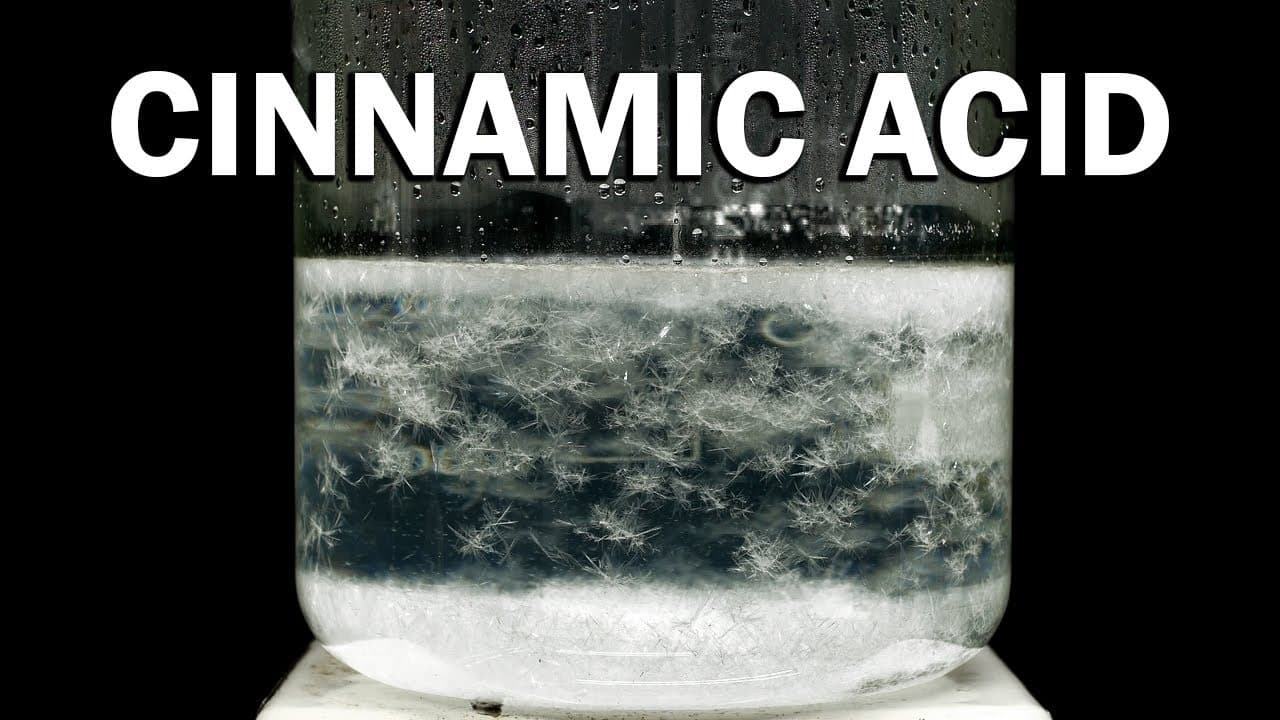
To synthesize trans-cinnamic acid, mix malonic acid, benzaldehyde, pyridine, and beta-alanine, then perform a reflux for 90 minutes. Use hydrochloric acid to precipitate the product, and recrystallize it for higher purity. The process yields around 12.6 grams of trans-cinnamic acid with an 87% yield, which can be used to produce styrene.
Transcript
Cinnamic acid is a naturally occurring chemical and it exists in two main forms. It's mostly used as a flavoring agent or in the perfume industry, but it's also used to make various pharmaceuticals. The most common form of cinnamic acid is the trans form and that's what we're going to be making today. We're going to be carrying out the Verley-Doebn... Read More
Key Insights
- ❓ Cinnamic acid is a naturally occurring chemical used in flavoring, perfume, and pharmaceutical industries.
- 👻 The Verley-Doebner modification allows for the synthesis of trans-cinnamic acid in one step, simplifying the process.
- 🥶 Beta alanine acts as a co-catalyst, facilitating the reaction between benzaldehyde and malonic acid.
- ❓ Trans-cinnamic acid can be used as a precursor to produce styrene and polystyrene.
- ⚧️ The final yield of trans-cinnamic acid in the synthesis was 12.6 grams, with a percent yield of 87%.
- ⚧️ Recrystallization can be used to purify the synthesized trans-cinnamic acid.
- ⚧️ The purity of trans-cinnamic acid can affect its suitability for certain applications.
Install to Summarize YouTube Videos and Get Transcripts
Explore YouTube Video Summarizer or Get YouTube Transcript Extractor
Questions & Answers
Q: What is the purpose of using the Verley-Doebner modification of the Knoevenagel Condensation?
The Verley-Doebner modification allows the synthesis of trans-cinnamic acid to be done in one step, instead of two steps as in the classic Knoevenagel condensation. This simplifies the process and increases efficiency.
Q: How does the Verley-Doebner modification work?
The Verley-Doebner modification involves the reaction of benzaldehyde with malonic acid, catalyzed by pyridine and beta alanine. This forms pyridinium trans-cinnamate, water, and CO2. The beta alanine is regenerated during the reaction, allowing it to continue the catalytic cycle.
Q: Why is trans-cinnamic acid precipitated from the reaction mixture using hydrochloric acid?
The addition of hydrochloric acid converts the pyridinium salt formed during the reaction into a pyridinium chloride salt, which is soluble in water. Trans-cinnamic acid, being insoluble, precipitates out of the solution.
Q: What is the significance of the recrystallization step?
The recrystallization step allows for the purification of trans-cinnamic acid by removing impurities. By dissolving the crude product in water and slowly cooling the solution, pure crystals of trans-cinnamic acid can be obtained.
Summary & Key Takeaways
-
Cinnamic acid exists in two main forms and is commonly used as a flavoring agent, in the perfume industry, and in pharmaceuticals.
-
The Verley-Doebner modification of the Knoevenagel Condensation is used to synthesize trans-cinnamic acid from malonic acid, benzaldehyde, pyridine, and beta alanine.
-
The reaction involves a catalytic cycle, with beta alanine acting as a co-catalyst and facilitating the reaction between benzaldehyde and malonic acid.
Read in Other Languages (beta)
Share This Summary 📚
Summarize YouTube Videos and Get Video Transcripts with 1-Click
Try YouTube Summary with ChatGPT & Claude or YouTube Transcript Generator
Explore More Summaries from NileRed 📚
Summarize YouTube Videos and Get Video Transcripts with 1-Click
Try YouTube Summary with ChatGPT & Claude or YouTube Transcript Generator