What Are the Key Lessons from The Lean Startup by Eric Ries?
TL;DR
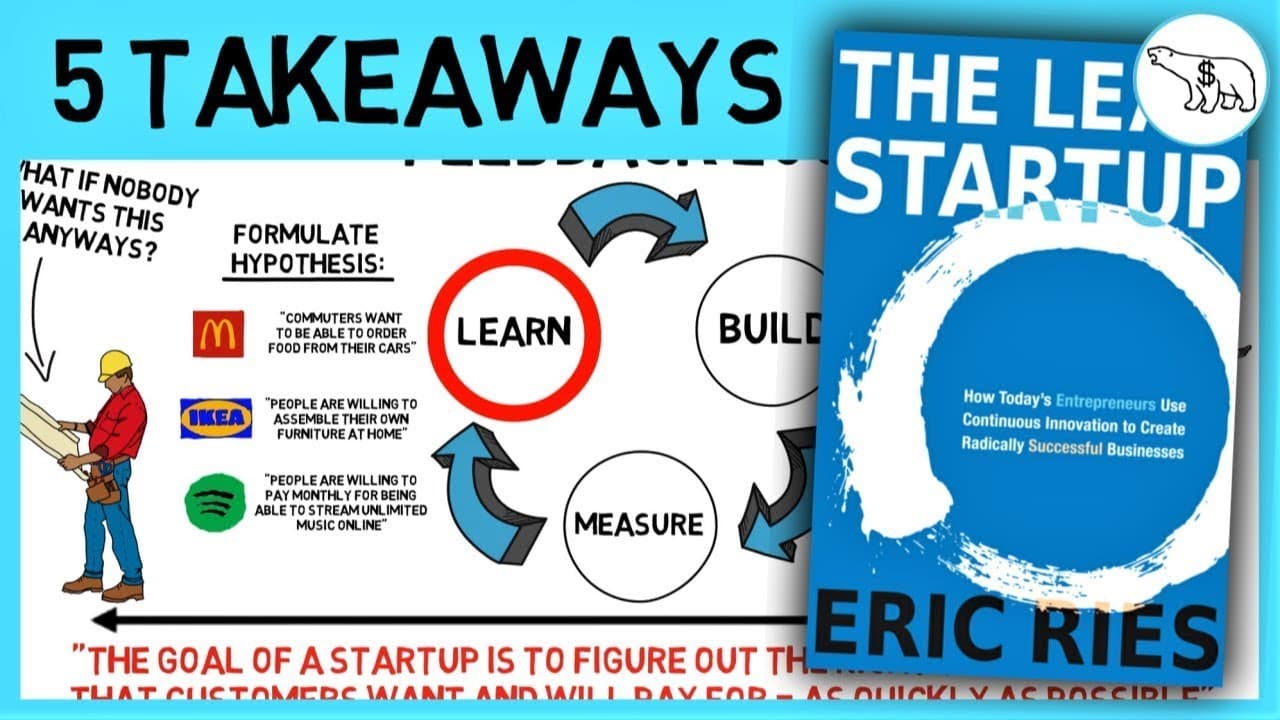
The Lean Startup by Eric Ries argues that startup success depends on effective execution and rapid learning through the build-measure-learn feedback loop. Entrepreneurs should test hypotheses with real or potential customers, using simple landing pages or minimum viable products before investing thousands of hours in development. The framework also covers validated learning, growth engines, and strategic pivots. Read on for practical ways to apply each idea.
Transcript
Here's the great startup myth of our time: "If you only have determination, brilliance, great timing, and above all, a great product, you too can achieve fame and fortune. A related misconception is that ideas are precious. Generally, people hesitate to reveal their ideas in public - even among friends! There's this nagging fear that someone can st... Read More
Key Insights
- 💡 Execution is more important than ideas in startup success.
- 🤩 Planning and forecasting are not effective for startups; quick iterations are key.
- 🉐 Validated learning is gained through experiments and developing minimum viable products.
- 🚒 Startups should focus on one engine of growth: sticky, viral, or paid.
- 💱 Pivoting, or changing strategies, is a normal part of the startup journey.
- ❓ Perseverance and flexibility are crucial for startup entrepreneurs.
- 😥 Most successful startups have made significant strategic changes at some point.
Install to Summarize YouTube Videos and Get Transcripts
Explore YouTube Video Summarizer or Get YouTube Transcript Extractor
Questions & Answers
Q: What are the key lessons from The Lean Startup by Eric Ries?
Startup success depends more on execution than on having a precious idea. Eric Ries recommends rapidly cycling through build, measure, and learn; testing hypotheses through experiments; using minimum viable products; focusing on one engine of growth; and changing strategy when evidence supports a pivot.
Q: What is the build-measure-learn feedback loop?
The build-measure-learn feedback loop is a process for building something, measuring customer behavior, and learning from the results. Startups should move through these cycles quickly so they can stop pursuing ideas that do not make sense and invest more heavily in those that do.
Q: Why are traditional planning and forecasting risky for startups?
Planning and forecasting work best when operations are stable and the environment is static, but startups have neither condition. Spending several months and thousands of hours perfecting a product is therefore risky because customers may not want it.
Q: How should a startup plan a build-measure-learn cycle?
Although the operational sequence is build, measure, and learn, planning begins in reverse by deciding what the startup needs to learn. The founders then formulate a hypothesis and design a product or experiment that can validate or reject it.
Q: What is validated learning in a startup?
Validated learning is evidence gained by observing how real or potential customers respond to an experiment. The transcript recommends observing behavior instead of merely asking customers what they want, because interest in an actual offering provides stronger evidence.
Q: What is a minimum viable product, or MVP?
An MVP is a product containing only the features essential to test whether a startup's hypothesis is correct. It should not be polished beyond what is necessary to prove or reject that hypothesis, because anything that does not produce validated learning is treated as waste.
Q: What types of MVP does The Lean Startup describe?
Eric Ries gives three MVP examples, including the video MVP and concierge MVP. A video MVP demonstrates a proposed product before it exists, while a concierge MVP serves one or a few customers closely and develops the solution around their needs.
Q: How did Dropbox use a video MVP?
Dropbox CEO Drew Houston published a video demonstrating an easy-to-use file-sharing tool to communities of tech-savvy people. Even though the demonstrated product did not yet exist, the signup list rose from 5,000 to 75,000 overnight.
Summary & Key Takeaways
-
The myth that success in startups is dependent on having great ideas is debunked, with emphasis placed on execution.
-
Planning and forecasting are not effective for startups, and instead, entrepreneurs should focus on quickly going through the build-measure-learn feedback loop.
-
Validated learning is gained through experiments, such as setting up landing pages or developing minimum viable products (MVPs), to test hypotheses and understand customer needs.
Read in Other Languages (beta)
Share This Summary 📚
Summarize YouTube Videos and Get Video Transcripts with 1-Click
Try YouTube Summary with ChatGPT & Claude or YouTube Transcript Generator
Explore More Summaries from The Swedish Investor 📚


Summarize YouTube Videos and Get Video Transcripts with 1-Click
Try YouTube Summary with ChatGPT & Claude or YouTube Transcript Generator