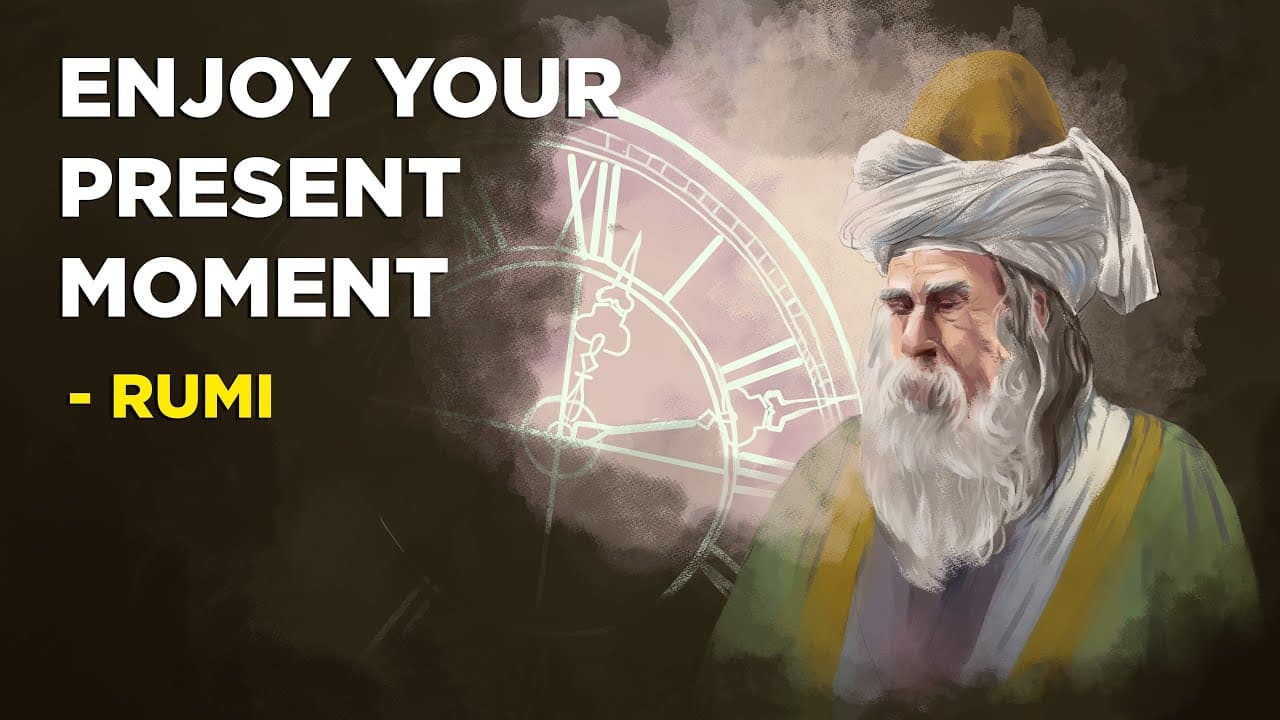
How to Enjoy the Present Moment According to Rumi?
TL;DR
To enjoy the present moment, Rumi teaches us to free ourselves from past burdens and future anxieties, focusing instead on what we have now. By quieting the mind, embracing our experiences, and cultivating gratitude, we unlock deeper joy and spiritual fulfillment in daily life.
Transcript
Rumi, also known as Jalal ad-Din Muhammad Rumi, was a 13th-century Persian poet, Islamic jurist, and theologian. His works, particularly his collection of mystical poetry known as the "Masnavi”, have had a profound influence on literature, spirituality, and the understanding of the human experience. Rumi's teachings are deeply rooted in Sufism, whi... Read More
Key Insights
- 😃 Being fully present in the moment unlocks spiritual potential and joy.
- 🤯 Quietening the mind allows for a deeper connection with the universe.
- 🥺 Embracing the present moment leads to a more fulfilling and engaged life.
- 🥹 Cultivating gratitude promotes a positive outlook and a sense of contentment.
- 🍝 Rumi's teachings emphasize the importance of focusing on the present rather than dwelling on the past or future.
- 🥺 Engaging fully in life's experiences leads to a more enriched and meaningful existence.
- 🛟 Rumi's stories and anecdotes serve as powerful metaphors for embracing the present moment.
Install to Summarize YouTube Videos and Get Transcripts
Explore YouTube Video Summarizer or Get YouTube Transcript Extractor
Questions & Answers
Q: What is the significance of being fully present in the present moment according to Rumi's teachings?
Rumi believed that embracing the present moment allows individuals to unlock their spiritual potential, experience joy, and connect with the divine. By being fully present, one can cultivate a deep connection with the present moment and find inner peace.
Q: How did Rumi use storytelling to convey the importance of living in the present moment?
Rumi often used anecdotes and stories to illustrate the significance of being present. One such story involved taking a man to a river to show him how the water flows without worrying about the past or future, emphasizing the value of being in the present moment.
Q: How can one quiet the mind and listen to the music of the universe, as Rumi suggested?
Rumi believed that by prioritizing stillness, focus, and calmness, individuals can quiet their minds and tune into the universal music that is always present. Practices like meditation, yoga, and journaling can help in achieving this state of inner peace and mindfulness.
Q: What role does gratitude play in Rumi's teachings on living in the present moment?
Gratitude is essential in Rumi's philosophy as it allows individuals to appreciate the blessings of the present moment. Cultivating gratitude helps in shifting one's mindset towards appreciation, contentment, and a positive outlook on life.
Summary & Key Takeaways
-
Rumi, a 13th-century Persian poet and theologian, stressed the importance of being fully present in the moment to unlock spiritual potential.
-
His teachings encourage freeing oneself from past burdens and future anxieties, focusing on the beauty of the present.
-
Rumi's guidance includes quieting the mind, engaging fully in life's experiences, and cultivating gratitude for present blessings.
Read in Other Languages (beta)
Share This Summary 📚
Summarize YouTube Videos and Get Video Transcripts with 1-Click
Try YouTube Summary with ChatGPT & Claude or YouTube Transcript Generator
Explore More Summaries from Philosophies for Life 📚



Summarize YouTube Videos and Get Video Transcripts with 1-Click
Try YouTube Summary with ChatGPT & Claude or YouTube Transcript Generator