How does 15 minutes replace 20 million years in learning?
TL;DR
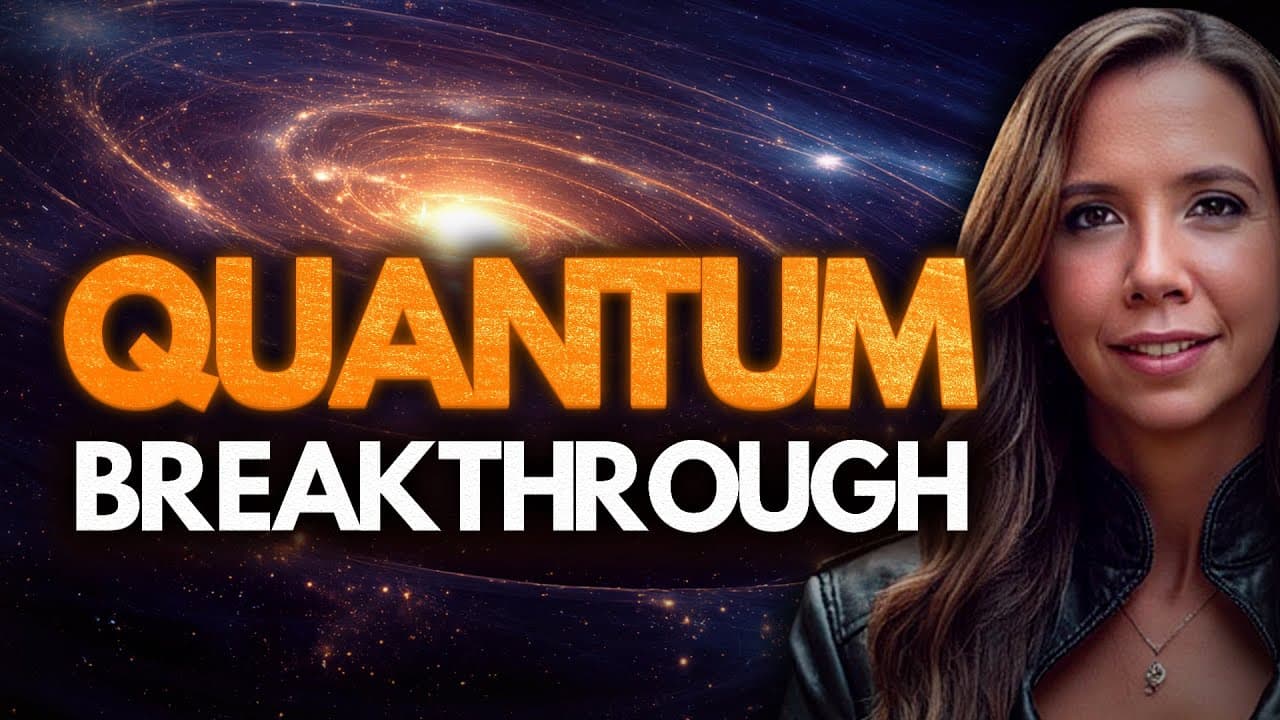
The breakthrough uses entangled light to solve a learning problem that would take classical systems 20 million years, in just 15 minutes. It demonstrates a quantum advantage in a photonic system and suggests new directions for learning, sensing, and biology, while raising questions about future ethics and applications.
Transcript
What if I told you that scientists just accomplished something that should have taken 20 million years in 15 minutes? This isn't science fiction. This is the first proven quantum advantage ever demonstrated with light, and it's about to change everything we know about computing, learning, and reality itself. What I'm about to share with you represe... Read More
Key Insights
- X is able to solve a learning problem in 15 minutes that would require 20 million years for a classical system, using entangled light to cancel noise and improve information extraction.
- The key to the breakthrough is entanglement, which links two light beams so that measuring one informs about the other, enabling faster, more information-rich measurements than classical methods.
- The work demonstrates a quantum advantage in a photonic system and uses standard optical equipment, illustrating that such capabilities may be accessible in common lab settings, not only in specialized facilities.
- The research contrasts learning in quantum systems with classical scaling, showing that quantum methods can drastically reduce data and time requirements for characterizing complex devices.
- Biological cubits built from jellyfish proteins allow quantum sensing inside living cells, bypassing some cooling and isolation requirements of traditional quantum hardware.
- Stability improvements extend qubit lifetimes from microseconds to hours, enabling more practical quantum computations and reducing the hardware burden necessary for error correction.
- There is a broader implication that quantum technology merging with biology could alter natural boundaries, demanding careful ethical, safety, and societal considerations about human-technology integration.
- The trajectory envisions 2030 goals of fault-tolerant quantum computers with 100 logical qubits, highlighting potential impacts on materials science, energy, and cryptography while flagging transhumanist concerns.
Install to Summarize YouTube Videos and Get Transcripts
Explore YouTube Video Summarizer or Get YouTube Transcript Extractor
Questions & Answers
Q: How does the 15 minute learning breakthrough compare to classical time scales for similar problems?
The breakthrough demonstrates that a learning problem which would take classical systems 20 million years to complete can be solved in 15 minutes using entangled light. This is achieved by measuring two entangled beams together to cancel noise and extract information far more efficiently than any classical approach could, representing a fundamental shift in information processing and problem solving.
Q: What is meant by quantum advantage in a photonic system, and how is it proven here?
Quantum advantage in this context means achieving a computational or learning task with less resource usage than any possible classical method. It is proven here by showing that entangled light can solve a specific learning problem much faster than classical approaches could, using two beams and a noiseless reference to dramatically increase information per measurement while staying within ordinary optical lab equipment.
Q: What role do biological cubits play in these developments?
Biological cubits are quantum sensors created inside living cells using jellyfish proteins, enabling nanoscale magnetic and electrical signal detection within cells without extreme cooling. This merges quantum sensing with biology, offering potential advances in medical diagnostics while raising questions about safety and ethics regarding integrating quantum technology with living systems.
Q: How do hour-long qubits change the practical landscape of quantum computing?
Hour-long qubits extend coherence times dramatically compared to microsecond lifespans, reducing the hardware burden for error correction and making large-scale, fault-tolerant quantum computing more feasible. This could lower costs and complexity, enabling broader applications in material science, cryptography, and drug discovery as part of a practical quantum computing pathway.
Q: What ethical concerns are raised by merging quantum tech with living cells?
Merging quantum technology with living cells crosses boundaries between technology and biology, potentially altering natural life and challenging concepts of humanity. It requires careful consideration of safety, consent, ecological impact, and philosophical questions about whether such integrations should be pursued, balanced against potential medical benefits and scientific progress.
Q: What does the 2030 goal of 100 logical qubits imply for industries?
The target of 100 logical qubits by 2030 suggests significant capabilities in materials science, energy storage, and cryptography. If achieved, quantum computers with that many fault-tolerant qubits could tackle problems beyond classical reach, accelerating innovations in batteries, solar energy, and drug discovery while reshaping computational strategies across sectors.
Q: Why is there caution about the line between technology and biology disappearing?
Caution arises because integrating quantum devices into living systems could redefine life itself and impact fundamental biology. It raises concerns about unintended consequences, governance, and societal values, and urges a balance between pursuing powerful technology and preserving ethical boundaries and human welfare.
Q: What does the video imply about the future of learning and sensing technologies?
The video implies that quantum learning and sensing could become dramatically faster and more powerful, enabling new capabilities across machine learning, diagnostics, and materials research. The combination of quantum advantages with stability and biology points toward a future where computation and life sciences increasingly intertwine, necessitating thoughtful innovation and governance.
Summary & Key Takeaways
-
A breakthrough shows entangled light solving a learning problem in 15 minutes that would take 20 million years classically, indicating a new category of computation. The experiment used two entangled light beams to cancel noise and extract information with unprecedented efficiency, all with ordinary optical equipment in a basement lab. This points to potential impacts on machine learning, sensing, and material science.
-
Biological cubits are created by using jellyfish proteins to turn living cells into quantum sensors, potentially enabling nanoscale measurements inside cells without extreme cooling. This development merges quantum technology with biology, raising ethical and safety questions about altering life and how it may affect medicine, diagnostics, and fundamental biology.
-
Hour-long cubits and stable qubits promise practical quantum computing by extending coherence times and reducing the number of components needed for fault tolerance, which could lower costs and complexity while expanding applications in cryptography, chemistry, and materials research. This combination of learning advantage, stability, and biology marks a new convergence of technologies.
Read in Other Languages (beta)
Share This Summary 📚
Summarize YouTube Videos and Get Video Transcripts with 1-Click
Try YouTube Summary with ChatGPT & Claude or YouTube Transcript Generator
Explore More Summaries from Julia McCoy 📚




Summarize YouTube Videos and Get Video Transcripts with 1-Click
Try YouTube Summary with ChatGPT & Claude or YouTube Transcript Generator