What Are Large Language Models and How Do They Work?
TL;DR
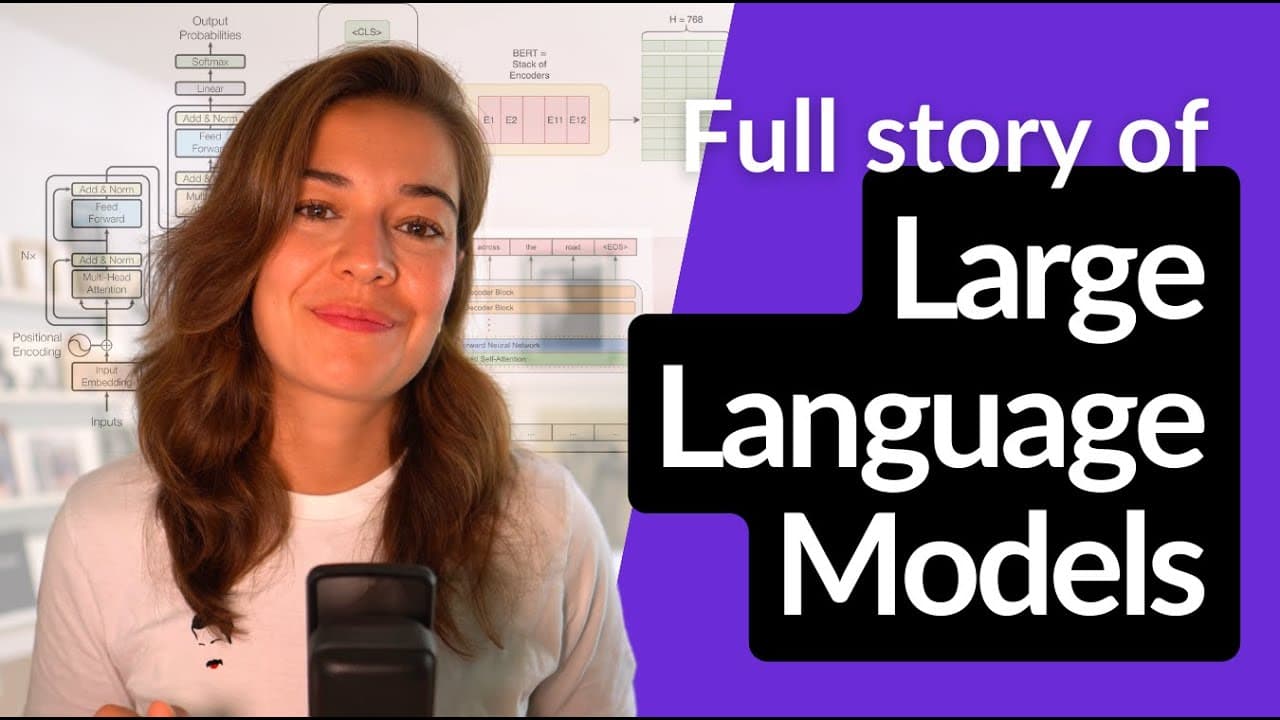
Large language models (LLMs) utilize self-supervised learning to understand and generate natural language, predicting the next word in sentences. They improve through fine-tuning for specific tasks and benefit from transfer learning, enabling adaptation to new domains with minimal additional training. The latest models leverage transformer architecture and attention mechanisms, significantly boosting their performance and capabilities.
Transcript
the question that started it all was can the processes of language and communication be reduced to computation language models or LMS are a class of probabilistic models explicitly tailored to identify and learn statistical patterns in natural language because of their current success they are seen commonly as models that comprehensively understand... Read More
Key Insights
- 😒 Language models use self-supervised learning to understand natural language and predict the next word in a sentence.
- 😑 Fine-tuning adapts pre-trained models for specific tasks or domains, enhancing their proficiency.
- 👻 Transfer learning allows models to leverage knowledge from one task for another, reducing the need for extensive training.
- 🛀 Larger language models have shown better performance but require more computational resources and data.
- ⚾ Transformer-based models, with attention mechanisms and word embeddings, have revolutionized natural language processing.
- 💗 Growing trends in language models show a dramatic increase in size, with models surpassing billions of parameters.
- 😫 The cost of training large language models is significant, and data set size is crucial for model performance.
Install to Summarize YouTube Videos and Get Transcripts
Explore YouTube Video Summarizer or Get YouTube Transcript Extractor
Questions & Answers
Q: How do language models learn from unannotated text?
Language models learn from unannotated text through self-supervised learning, predicting the next word in a sentence and internalizing linguistic patterns.
Q: What is fine-tuning in the context of language models?
Fine-tuning involves further training pre-trained models on task-specific data, adapting their non-specialized knowledge for specialized tasks or domains.
Q: How does transfer learning benefit language models?
Transfer learning enables language models to leverage knowledge from one task and apply it to another, reducing the need for extensive additional training.
Q: How do larger language models improve performance?
Larger language models with more parameters can internalize a greater variety of statistical patterns within language data, achieving better performance.
Summary & Key Takeaways
-
Language models learn from unannotated text through self-supervised learning.
-
Fine-tuning adapts pre-trained models for specific tasks or domains.
-
Transfer learning allows models to leverage knowledge from one task for another.
Read in Other Languages (beta)
Share This Summary 📚
Summarize YouTube Videos and Get Video Transcripts with 1-Click
Try YouTube Summary with ChatGPT & Claude or YouTube Transcript Generator
Explore More Summaries from AssemblyAI 📚



Summarize YouTube Videos and Get Video Transcripts with 1-Click
Try YouTube Summary with ChatGPT & Claude or YouTube Transcript Generator