Why Is Software Testing So Challenging?
TL;DR
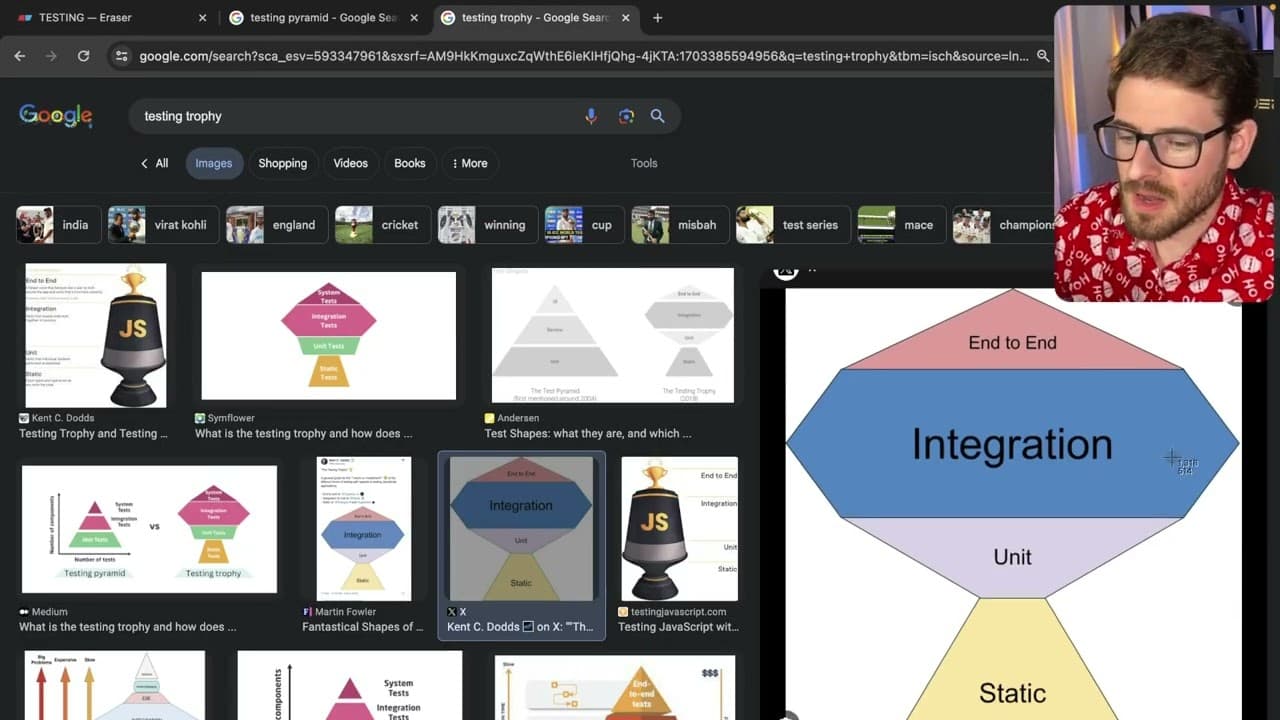
Software testing is challenging due to varying opinions on approaches, particularly around unit tests and integration tests. While unit tests are effective for isolated functions, they become complex when involving external services. A balanced testing strategy utilizes unit tests for business logic, integration tests for system interactions, and end-to-end tests for overall functionality, ensuring tests are resilient to changes.
Transcript
so testing is one of those subjects that I often hear very opposing opinions on how test should be written and what type of tests should be written I've heard um arguments that unit tests are kind of a waste of time it's just kind of busy work and it makes your code a little bit more brittle to refactor and I've heard opinions that unit tests are r... Read More
Key Insights
- 🏆 The testing pyramid advocates for a greater number of unit tests and fewer integration tests, while the testing trophy suggests a balanced focus on integration testing for validating overall system functionality.
- 👨💻 Properly structuring code to clearly define dependencies can alleviate brittle testing and ease the process of code refactoring by improving test maintainability.
- 🥺 Mocking external dependencies is essential in unit tests but demands careful consideration as excessive mocking can lead to a misleading representation of genuine system behavior.
- 👻 Integration testing allows developers to catch integration failures that unit tests may overlook by verifying that the entire system operates cohesively.
- ❤️🩹 End-to-end testing simulates real-world usage, providing confidence in application behavior across all layers while potentially increasing test execution time and maintenance complexity.
- 💪 Establishing strong CI/CD practices improves the effectiveness of testing by enabling rapid feedback and facilitating error detection early in the development cycle.
- 🏆 It's crucial to ensure that tests are resilient to small code changes; tests that fail due to minor alterations suggest a poorly defined scope or overly dependent structure.
Install to Summarize YouTube Videos and Get Transcripts
Explore YouTube Video Summarizer or Get YouTube Transcript Extractor
Questions & Answers
Q: What is the main difference between unit tests and integration tests?
Unit tests focus on verifying the functionality of individual components, such as single functions or methods, without examining their interactions with other parts of the system. Integration tests, however, assess how these components work together in a complete system, verifying that data is properly passed and processed among various services and layers of the application.
Q: Why is defining a 'unit' important when writing unit tests?
Defining what constitutes a 'unit' is crucial because it dictates how isolated and focused the tests can be. If a unit is poorly defined—such as encompassing too many interdependent components—then the tests may become brittle, difficult to maintain, and less effective at catching errors, leading to increased debugging challenges as system complexity grows.
Q: What are the challenges associated with unit testing when external dependencies are involved?
When unit testing involves external dependencies like databases or third-party APIs, it complicates the testing process as these services can introduce variability and side effects that make tests unreliable. Developers often need to employ mocks or stubs to simulate these interactions, which can obscure the true behavior of the code under test and complicate the verification of branching logic and error handling.
Q: How do integration tests provide value in a CI/CD pipeline?
Integration tests are integral in a CI/CD pipeline because they help ensure that code changes do not break existing functionality. By testing how different components work together in a real or simulated environment, developers can quickly identify integration issues before deploying the software to production, thereby maintaining higher confidence in code stability and quality.
Q: What role do end-to-end tests play in the testing strategy?
End-to-end testing serves to simulate real user experiences by testing the entire application flow from the user interface to the backend and databases. This holistic approach helps ensure that all components of the system work together as intended, validating that user interactions yield the expected outcomes and that data integrity is maintained throughout the process.
Q: Why might developers prefer the testing trophy over the testing pyramid?
Developers might prefer the testing trophy because it emphasizes fewer unit tests in favor of more comprehensive integration tests, which can provide greater confidence that the system operates correctly as a whole. This approach seeks to mitigate concerns about the limitations of unit tests, particularly in complex systems where integration dynamics play a more significant role in overall functionality.
Summary & Key Takeaways
-
The content highlights two main testing philosophies: the testing pyramid, which emphasizes a large number of unit tests, and the testing trophy that favors integration tests over unit tests, stressing the importance of defining what constitutes a unit.
-
It suggests that while unit tests can efficiently verify small, isolated functions, they become complex and less effective when involving external services, necessitating the use of mocks or stubs for proper testing.
-
The document advocates for a balanced approach to testing, utilizing unit tests for business logic, integration tests for verifying interactions, and end-to-end tests for the complete workflow, while emphasizing the importance of writing tests that are resilient to code changes.
Read in Other Languages (beta)
Share This Summary 📚
Summarize YouTube Videos and Get Video Transcripts with 1-Click
Try YouTube Summary with ChatGPT & Claude or YouTube Transcript Generator
Explore More Summaries from Web Dev Cody 📚
Summarize YouTube Videos and Get Video Transcripts with 1-Click
Try YouTube Summary with ChatGPT & Claude or YouTube Transcript Generator