Which Testosterone Supplements Actually Work?
TL;DR
Betaine and fenugreek have the most encouraging evidence among the supplements fully discussed, but neither offers a simple, risk-free solution. Evidence for L-arginine, D-aspartic acid, and Tongkat Ali is inconsistent, while DHEA does not appear to raise testosterone in men or improve exercise performance. Supplement decisions should account for study quality, conflicting results, dose-related concerns, and measurable clinical benefits beyond a laboratory result.
Transcript
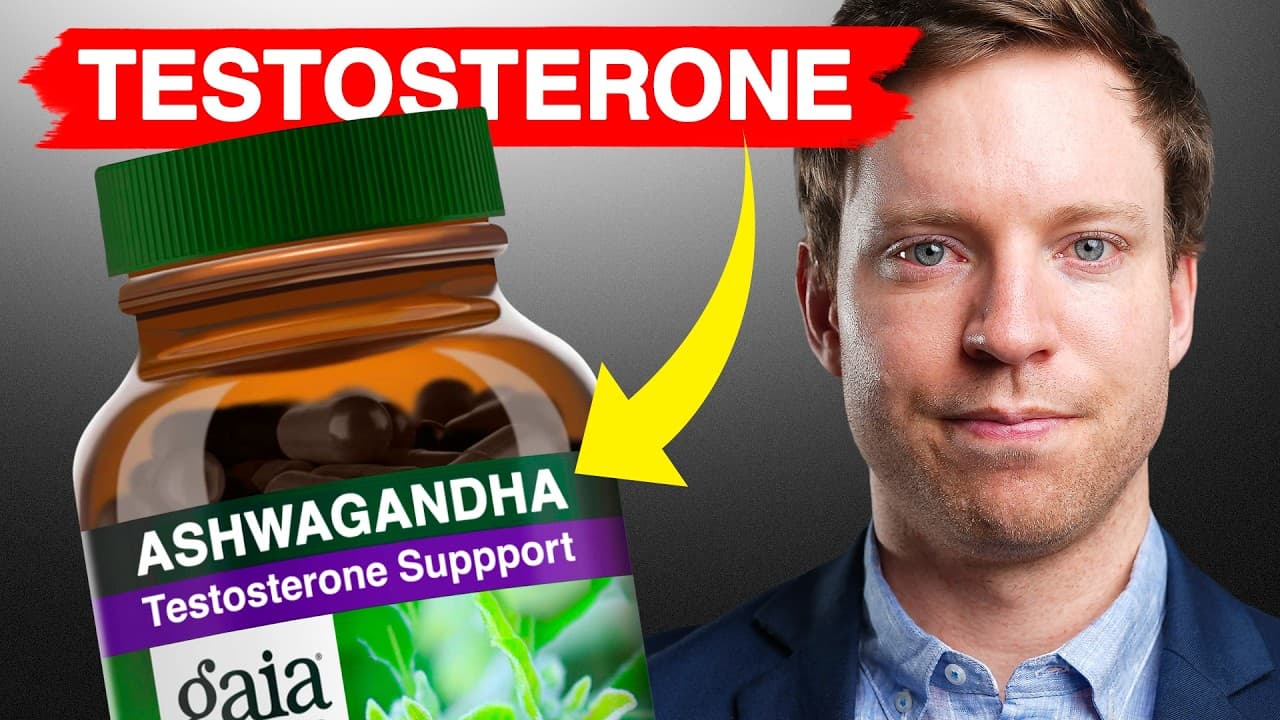
after 35 male testosterone drops by 1% every single year and that decline is linked to losing muscle mass and strength lower energy weaker bones and even depression so it's no surprise that we see tons of supplements like ashwag gandha and tonat Ali claiming to boost testosterone but do these supplements really work or are they just a waste of mone... Read More
Key Insights
- Male testosterone is described as declining by 1% per year after age 35, with the decline linked to lower muscle mass, strength, energy, and bone strength, as well as depression. These associations help explain the popularity of supplements marketed as testosterone boosters.
- L-arginine produced conflicting testosterone findings across human research. One study of 108 diabetic men with erectile dysfunction reported a 60% increase with L-arginine and a 144% increase when combined with tadalafil, but broader reviews did not establish a consistent testosterone benefit.
- D-aspartic acid has promising animal evidence but mixed human results. A study using 3 grams daily reported a 42% testosterone increase, while a separate 28-day study in resistance-trained men found no effect, leaving its usefulness uncertain.
- Tongkat Ali has insufficient evidence for a confident recommendation. A meta-analysis of five randomized controlled trials found positive results in three trials and no difference in two, while evidence of publication bias and concerns about potential DNA damage further weakened the case for use.
- Betaine is supported by several exercise studies showing performance and testosterone improvements. Professional soccer players improved strength, oxygen-use capacity, sprinting, and testosterone after 14 weeks, while a CrossFit study reported about an 8% performance improvement and a 7% testosterone increase.
- High-dose betaine is associated with a potential tradeoff because doses between 2 and 4 grams can increase LDL cholesterol. The presenter uses 500 milligrams in a multivitamin formulation, but explicitly states that his personal supplement choice is not a recommendation for others.
- DHEA can raise testosterone more noticeably in women than men, with stronger effects in younger than older people. Studies discussed in the transcript found no clear improvement in general well-being, muscle mass, mental function, or exercise performance, and male testosterone generally did not increase.
- Fenugreek increased free and total testosterone in studies using 500 milligrams daily for eight weeks and 600 milligrams daily for 12 weeks. However, strength did not improve relative to placebo in one trial, and estradiol increased by 26%, showing that hormonal changes may not translate into clear benefits.
Install to Summarize YouTube Videos and Get Transcripts
Explore YouTube Video Summarizer or Get YouTube Transcript Extractor
Questions & Answers
Q: How much does male testosterone decline after age 35?
Male testosterone is described as declining by 1% every year after age 35. The transcript links this decline with loss of muscle mass and strength, lower energy, weaker bones, and depression. These possible consequences make testosterone supplements attractive, but the discussion emphasizes that marketing claims should be evaluated against the complete research record, including negative and conflicting studies.
Q: Does L-arginine increase testosterone in men?
L-arginine has inconsistent evidence for increasing testosterone. In a study of 108 diabetic men with erectile dysfunction, testosterone increased by 60% with L-arginine and by 144% when L-arginine was combined with tadalafil, compared with 1.5% in the placebo group. However, larger reviews found little performance benefit and no reliable testosterone increase, so its true effect remains unclear.
Q: How might L-arginine affect testosterone production?
L-arginine may increase nitric oxide, relax blood vessels, and improve blood flow, potentially including blood flow to the testes where testosterone is produced. Another proposed explanation is indirect: improved erectile function could increase confidence and positive feelings, which might encourage testosterone release. These explanations remain hypotheses because broader reviews did not confirm a consistent testosterone-boosting effect from L-arginine.
Q: Does D-aspartic acid work as a testosterone booster?
D-aspartic acid may affect the system controlling testosterone production, but human evidence is mixed. One study using 3 grams per day reported a 42% increase in testosterone compared with placebo. A separate 2013 study found no testosterone effect after resistance-trained men used it for 28 days. The conflicting results mean more human research is needed before its usefulness can be established.
Q: Is Tongkat Ali effective and safe for raising testosterone?
Tongkat Ali may raise testosterone, but the available evidence is not strong enough for a confident recommendation. In a meta-analysis of five randomized controlled trials, three found an increase and two found no difference. The combined result was positive, but publication bias was detected. The European Food Safety Authority also raised concerns about potential DNA damage, adding an important safety uncertainty.
Q: What are the testosterone and performance benefits of betaine?
Betaine, also called TMG or trimethylglycine, produced encouraging results in several studies. Professional soccer players taking it for 14 weeks improved their one-repetition maximum, VO2 max, sprinting performance, and testosterone. Another study reported improved leg and bench press performance, while a CrossFit study found about an 8% performance improvement and a 7% testosterone increase compared with placebo.
Q: What are the risks of taking betaine for testosterone?
The main concern identified for betaine is that high doses between 2 and 4 grams can increase LDL cholesterol. The presenter chose a 500-milligram dose in his multivitamin formulation because of the emerging testosterone and exercise findings, along with betaine's ability to lower homocysteine. He also stresses that his personal use does not mean other people should take it.
Q: Does fenugreek raise testosterone and improve strength?
Fenugreek increased free and total testosterone in studies discussed in the transcript. Healthy young men took 500 milligrams daily for eight weeks during resistance training, while older men took 600 milligrams daily for 12 weeks. However, the younger group did not gain more strength than placebo, and estradiol rose by 26%. The older group reported improvements in weakness, joint complaints, and low libido.
Summary & Key Takeaways
-
Testosterone decline after age 35 is associated with reduced muscle mass, strength, energy, and bone health, as well as depression. Although many supplements promise to reverse that decline, their evidence varies substantially. Positive individual trials must be considered alongside conflicting studies, publication bias, safety concerns, and whether higher testosterone produces meaningful physical improvements.
-
L-arginine, D-aspartic acid, and Tongkat Ali have produced some favorable results, but the findings are inconsistent or limited. L-arginine showed a large increase in one study of diabetic men with erectile dysfunction, D-aspartic acid worked in one trial but not another, and Tongkat Ali evidence may be distorted by publication bias.
-
Betaine and fenugreek have more encouraging human findings. Betaine improved several exercise measures and modestly increased testosterone, although doses between 2 and 4 grams may raise LDL cholesterol. Fenugreek increased free and total testosterone in studied men, but it did not consistently improve strength and also increased estradiol in one trial.
Read in Other Languages (beta)
Share This Summary 📚
Summarize YouTube Videos and Get Video Transcripts with 1-Click
Try YouTube Summary with ChatGPT & Claude or YouTube Transcript Generator
Explore More Summaries from Dr Brad Stanfield 📚


Summarize YouTube Videos and Get Video Transcripts with 1-Click
Try YouTube Summary with ChatGPT & Claude or YouTube Transcript Generator