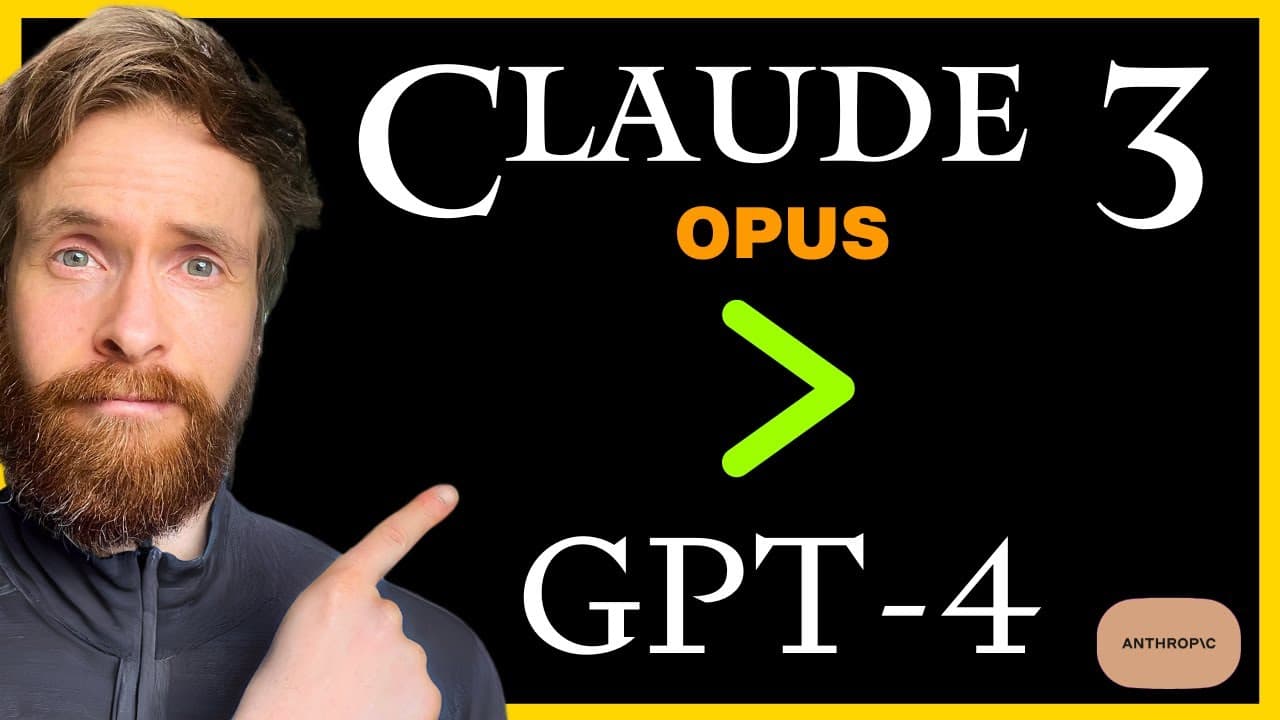
How Does Claude 3 API Perform in Various Tests?
TL;DR
The Claude 3 API excels in complex logical tests, accurately solving scenarios involving multiple conditions. It demonstrates strong text comprehension by locating specific information in large datasets and efficiently generates code for animations and websites. While its Bitcoin price predictions show promise, further optimization may enhance accuracy. Overall, it showcases powerful language processing capabilities suitable for various applications.
Transcript
here are the test we are going to be performing today with the claw Tre Opus API so the first one is going to be some custom logical tests uh I thought it turn out pretty cool and the second test is going to be the needle in the Hast stack test where we feeded around 100,000 words we put in like a fact in the middle and try to find that fact the th... Read More
Key Insights
- 🏆 The CLA Tre Opus API excels in solving logical tests involving complex scenarios, demonstrating its ability to understand and reason through multiple conditions.
- 🧑🏭 It effectively finds specific facts within large text datasets, showcasing its text comprehension capabilities.
- 👻 The API accurately extracts relevant information from code bases, allowing for the creation of dynamic animations and websites.
- 🤩 Bitcoin price predictions generated by the CLA Tre Opus API consider historical data and key factors, but optimization may be required for more precise estimations.
- 👍 Overall, the API proves valuable in various tasks, offering powerful language processing capabilities and potential for further development.
- 👀 It is recommended for those seeking reliable language processing solutions and looking to streamline their development process.
- 🔠 Further exploration and experimentation with the CLA Tre Opus API can unlock additional use cases and insights.
Install to Summarize YouTube Videos and Get Transcripts
Explore YouTube Video Summarizer or Get YouTube Transcript Extractor
Questions & Answers
Q: How does the CLA Tre Opus API perform in logical tests involving complex scenarios?
The CLA Tre Opus API successfully solves logical tests by comprehending multiple conditions and providing accurate answers. It can handle confusing scenarios and arrive at the correct solutions.
Q: Can the model find specific facts within large text datasets?
Yes, the CLA Tre Opus API is capable of identifying specific facts within large text datasets. In the needle in a haystack test, it correctly identifies the provided fact, showcasing its text comprehension abilities.
Q: How effective is the CLA Tre Opus API in extracting relevant information from coding examples?
The API performs well in extracting pertinent information from code bases. It can retrieve specific functions and generate code snippets that fulfill given requirements, such as creating a Bitcoin terminal price animation.
Q: Does the CLA Tre Opus API successfully generate accurate Bitcoin price predictions?
The API renders Bitcoin price predictions based on images and prompts. It leverages historical data and key factors to provide estimations, although some predictions may be overly optimistic. Further optimization can enhance its forecasting capabilities.
Summary & Key Takeaways
-
The content covers various tests conducted with the CLA Tre Opus API, ranging from logical tests to coding examples, Bitcoin price predictions, and HTML website building.
-
Logical tests involve confusing the model with complex scenarios, such as determining the number of apples and the location of a river based on several conditions.
-
The needle in a haystack test evaluates the model's ability to find a specific fact within a large text dataset.
-
The coding examples demonstrate using the CLA Tre Opus API to extract relevant information and create dynamic animations and websites.
-
Bitcoin price predictions are made using images and prompts, taking into account historical data and key factors.
Read in Other Languages (beta)
Share This Summary 📚
Summarize YouTube Videos and Get Video Transcripts with 1-Click
Try YouTube Summary with ChatGPT & Claude or YouTube Transcript Generator
Explore More Summaries from All About AI 📚



Summarize YouTube Videos and Get Video Transcripts with 1-Click
Try YouTube Summary with ChatGPT & Claude or YouTube Transcript Generator