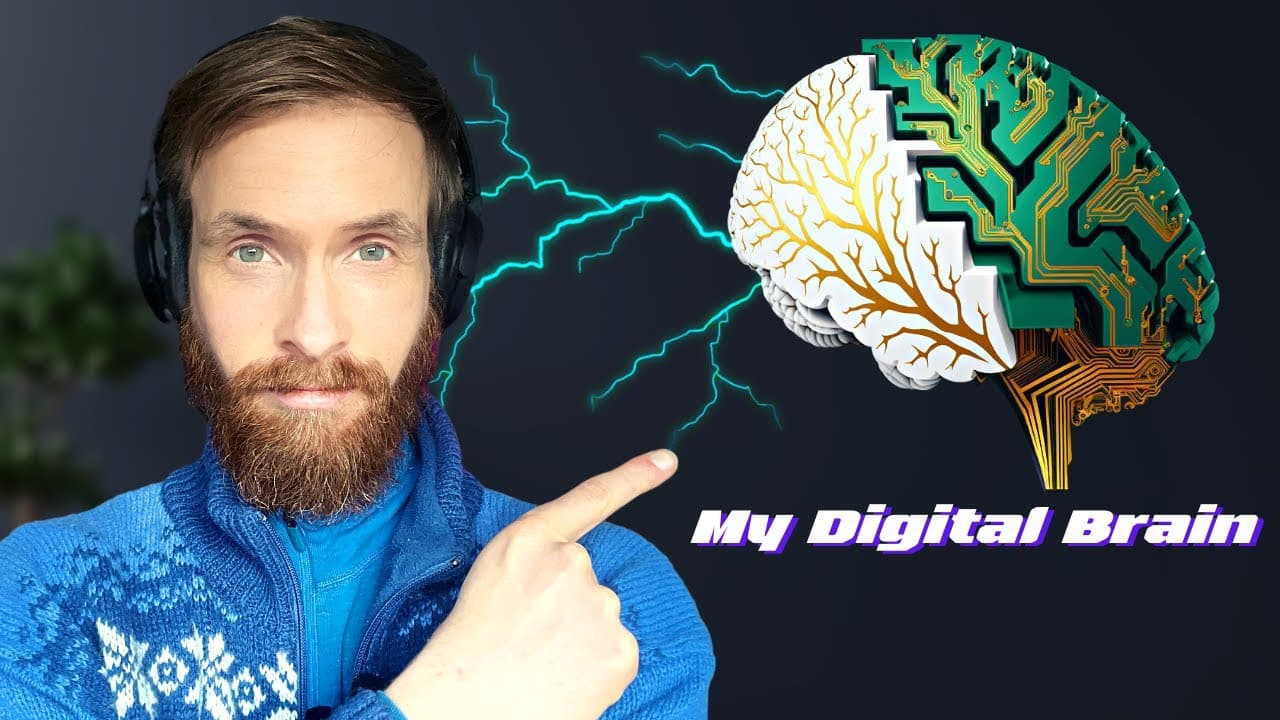
How I Built My Second Brain with AI (GPT-3) and Semantic Search
TL;DR
You can build a searchable second brain by collecting personal notes, converting their text into JSON with vector embeddings, and using semantic search to retrieve relevant memories. Chris demonstrates it with 12 days of journal entries, finding meetings, activities, and dates such as an airport trip on Friday the 13th. Read on to see how searches, summaries, and memory deletion work in practice.
Transcript
today I have something special for you we are gonna take a look at my second digital brain and how it works and we are gonna create a new brain that uses semantic search to look up information I think this is very exciting so let's just get started first let's just start by looking what exactly is semantics search with vectors so just imagine you h... Read More
Key Insights
- 💁 Semantic search with vectors enables efficient and accurate retrieval of information from large collections of data.
- 🧠 Building a digital brain involves collecting and organizing personal notes and converting them into searchable vector embeddings.
- 🧠 The digital brain can be effectively used to find specific information based on descriptive queries.
- 👻 The ability to alter or delete memories in a digital brain allows for customization and control over stored information.
- 😒 The digital brain can be applied to various use cases beyond personal note-taking, such as analyzing articles or researching specific topics.
- 🖐️ Responsible AI, including concepts like responsible deployment and development, plays a crucial role in the advancement of AI technology.
- 🌥️ Fine tuning models may not be necessary for certain tasks, such as answering questions from a large text corpus.
Install to Summarize YouTube Videos and Get Transcripts
Explore YouTube Video Summarizer or Get YouTube Transcript Extractor
Questions & Answers
Q: How can you build a second brain with AI and semantic search?
Start by collecting and organizing personal information, such as journal entries, work details, passions, goals, and daily activities. Convert the note strings into a JSON object with numerical vector embeddings, then use those embeddings to search the stored information with natural-language questions.
Q: How does semantic search with vectors work?
Semantic search compares the descriptive words in a query with the characteristics represented in a collection of information. The computer looks for the entries most similar to the description, like finding a library book from clues about its author, genre, and publication date.
Q: What information did Chris put in his second digital brain?
Chris stored details including his name, location, work, passions, life views, goals, and journal entries. His notes say he is from Norway, likes YouTube, video production, teaching, nature, generative AI, and the Premier League, and tries to be one percent better each day.
Q: How did the second brain identify when Chris drove his mother to the airport?
Chris asked, “When did I drive my mother to the airport?” The system searched the embeddings and returned that he got up at 4:40 on Friday the 13th to drive her there.
Q: Can the second brain find meetings from personal notes?
Yes. When Chris asked when he had a meeting with Timmy on Catering, the second brain found that it took place on Thursday the 19th of January at 11.
Q: Can the second brain answer questions about opinions recorded in a journal?
Yes, when the notes contain evidence for the answer. Asked whether Chris liked the movie Her, it answered yes because his Friday the 13th entry said he watched it and thought it was very good.
Q: Can the second brain summarize a week of journal entries?
Yes. When asked to summarize the last week, it reported that Chris spent the week in Norway doing activities related to his work and passions, including working on a blog post, going to the gym, releasing a ChatGPT video, visiting family, and watching Arsenal versus Manchester United with friends.
Q: Can memories be deleted from the second digital brain?
Yes. Chris deleted the note about driving his mother to the airport, saved the change, and updated the brain. When he repeated the airport question, the system said that none of the listed days showed that he had driven her there.
Summary & Key Takeaways
-
Semantic search with vectors allows for finding relevant information based on descriptive words or characteristics.
-
Building a digital brain involves collecting and organizing personal notes and converting them into a searchable format using embeddings.
-
Practical examples demonstrate the effectiveness of the digital brain in retrieving information accurately and efficiently.
Read in Other Languages (beta)
Share This Summary 📚
Summarize YouTube Videos and Get Video Transcripts with 1-Click
Try YouTube Summary with ChatGPT & Claude or YouTube Transcript Generator
Explore More Summaries from All About AI 📚




Summarize YouTube Videos and Get Video Transcripts with 1-Click
Try YouTube Summary with ChatGPT & Claude or YouTube Transcript Generator