Why TSMC Earnings Sparked the AI Semiconductor Rally
TL;DR
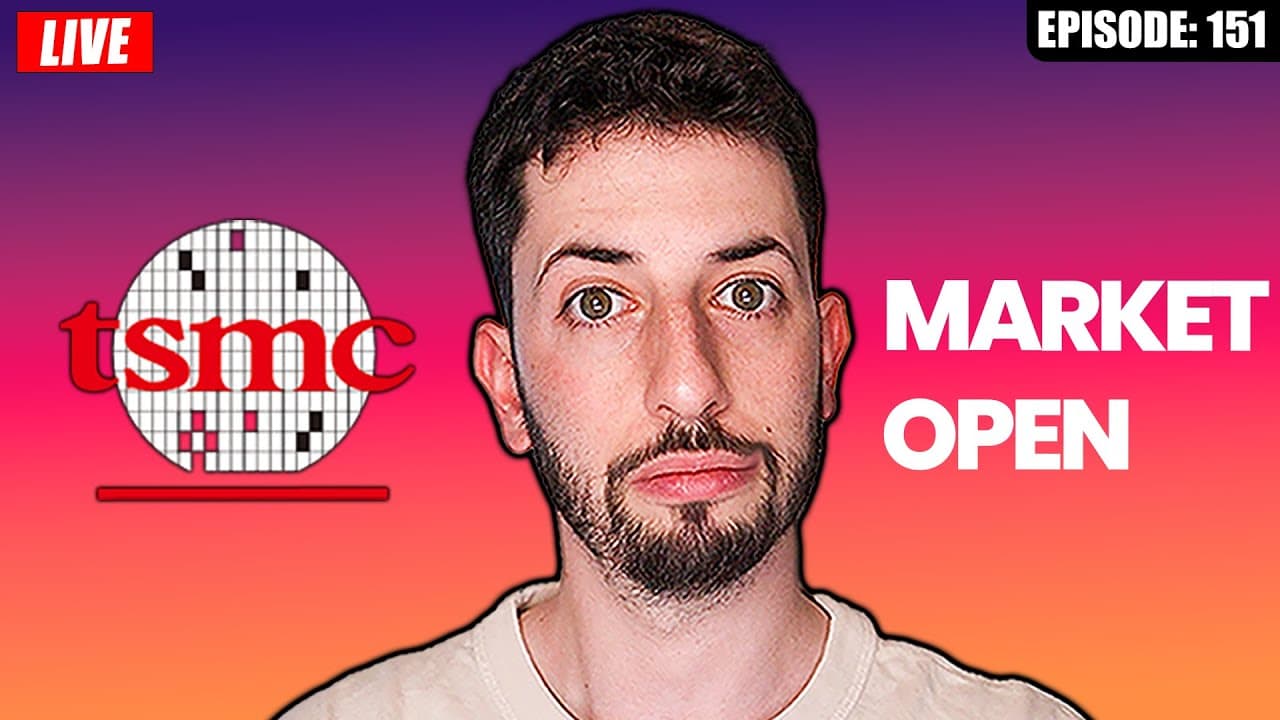
TSMC beat on revenue, gross margin, operating margin, and net profit, and raised fiscal 2026 capex to $52-56 billion versus $40.9 billion in 2025 and a $48 billion estimate. That capex jump signaled strong multi-year AI demand, lifting the whole chip-equipment basket, with Lam Research, Applied Materials, and ASML each up roughly 7-8% pre-market.
Transcript
How? Good morning, good afternoon, good evening everyone and welcome back to the Breakfast show we have the first big earnings report of this season. Unless you are interested in banks because they also reported but TSM reported before the market opens. Stock is up. The whole semiconductor segment basket is up as well. So we'll touch on that in thi... Read More
Key Insights
- TSMC beat across the board on revenue, gross margin, operating margin, and net profit, and also beat both Wall Street expectations and its own prior guidance, with Q1 guidance topping estimates on revenue and margins as well.
- Fiscal 2026 capex is guided to $52-56 billion versus $40.9 billion in fiscal 2025 and analyst estimates of $48 billion, and because TSMC is normally conservative, a raise this large signals demand strong enough to justify years of new fab capacity.
- Chip-equipment makers rallied hardest pre-market because expanding fabs need more tools, with Lam Research up 8%, Applied Materials up 7.7%, ASML up 7.2%, KLA up 6.7%, and TSM itself up 5.5%.
- Revenue by technology is led by 5-nanometer nodes at 35%, followed by 3-nanometer at 28% and 7-nanometer at 14%, and even older nodes keep generating money, which the host calls the magic of the foundry model.
- High-performance computing dominates TSMC's platform mix at 55% for the quarter and 58% for full-year 2025, while smartphone contributes 32% for the quarter and grew 11%, and automotive grew 34% over the year.
- TSMC expects long-term revenue growth approaching a 25% CAGR in US-dollar terms over a five-year period starting from 2024, and the business crossed one trillion New Taiwan dollars for what the host believes is the first time.
- Silicon supply from TSMC, not power or electricity, is the current bottleneck for AI infrastructure buildout according to customers, meaning as TSMC ramps capacity, downstream AI companies can generate more revenue.
- The market's prevailing thesis is that 'AI is going to eat software,' as big software names like Salesforce and Adobe have fallen substantially over the past 12 months despite still growing and remaining profitable.
Install to Summarize YouTube Videos and Get Transcripts
Explore YouTube Video Summarizer or Get YouTube Transcript Extractor
Questions & Answers
Q: Why did semiconductor stocks rise after TSMC earnings?
TSMC reported quarterly results before market open that beat across the board on revenue, gross margin, operating margin, and net profit, topping both Wall Street expectations and its own guidance. This lifted the entire semiconductor basket into the green pre-market. Equipment makers rose most because expanding fabs require more tools, with Lam Research up 8%, Applied Materials up 7.7%, ASML up 7.2%, and KLA up 6.7%, while TSM itself rose 5.5%.
Q: What is TSMC's fiscal 2026 capex guidance and why does it matter?
TSMC guided fiscal 2026 capex to $52-56 billion, up substantially from $40.9 billion in fiscal 2025 and above the roughly $48 billion analyst estimate. It matters because TSMC is normally a conservative company, and building fabs costs a lot of money. A raise this large means management sees demand durable enough for the coming years, not just the next 12 months, since they would not risk fabs running below full capacity later.
Q: How is TSMC's revenue split by technology node?
Revenue by technology is led by 5-nanometer nodes at 35%, the current majority, followed by 3-nanometer at 28% and 7-nanometer at 14%. Comparing 2025 to 2024, the 3-nanometer share rose from 18% to 24%, while 7-nanometer slipped from 17% to 14% and 5-nanometer stayed roughly flat. The host emphasizes that even older nodes keep generating money, which he describes as the magic of the foundry model.
Q: What platforms drive TSMC's revenue?
High-performance computing dominates TSMC's platform mix, at 55% for the quarter and 58% for full-year 2025. Smartphone is the next largest at 32% for the quarter and 29% for the year, and it grew 11%. Over the full year, IoT grew 15% and automotive grew 34%. For the quarter, HPC was up 4% quarter over quarter, while automotive was down 1% and DCE was down 22%, though DCE is only about 1% of the pie.
Q: What are TSMC's long-term financial targets?
TSMC expects long-term revenue growth approaching a 25% compound annual growth rate in US-dollar terms over a five-year period starting from 2024. It targets long-term gross margins of 56% and higher through the cycle and return on equity in the high 20s through the cycle, despite rising manufacturing costs and overseas expansion. The host also notes the business crossed one trillion New Taiwan dollars, which he believes is a first.
Q: Is power or chip supply the bottleneck for AI infrastructure?
According to TSMC, customers indicate that silicon supply from TSMC is currently the bottleneck for AI infrastructure buildout, not power or electricity supply that many had planned around years earlier. The host frames this positively, arguing that as TSMC ramps up capacity, the companies waiting on chips can get to work and start generating far more revenue. It suggests concerns about energy and electricity are not the constraint at the moment.
Q: Why are chip-equipment makers like ASML rallying?
Equipment makers rally because TSMC's expansion and strong demand mean every new fab needs more equipment, sourced from suppliers like ASML, Lam Research, and Applied Materials. Pre-market, Lam Research was up 8%, Applied Materials up 7.7%, ASML up 7.2%, and KLA up 6.7%. The host notes ASML, worth about $500 billion, roughly doubled from its August 2025 lows on the NASDAQ and is up 139% over the past five years.
Q: What is the current market thesis on software stocks?
The prevailing market thesis is that 'AI is going to eat software,' a reversal of the older idea that 'software is going to eat the world.' The host notes that nearly every big software name, including Salesforce and Adobe, is down substantially over the past 12 months, even though most continue to grow and remain quite profitable, making them cheap. The open question is when the market will distinguish the eventual winners from the losers.
Summary & Key Takeaways
-
TSMC reported before market open and beat on revenue, gross margin, operating margin, and net profit, topping both Wall Street expectations and its own guidance. Q1 guidance also beat on revenue and margins. The result lifted the entire semiconductor basket, which was green across the board in pre-market trading.
-
Fiscal 2026 capex guidance of $52-56 billion, up from $40.9 billion in 2025 and above the $48 billion estimate, signaled strong multi-year demand. Because building fabs is costly, TSMC only raises capex this much when demand is durable. Equipment makers Lam Research, Applied Materials, ASML, and KLA rallied 6.7-8% pre-market on that read-through.
-
TSMC targets long-term revenue growth near a 25% CAGR in US-dollar terms from 2024, gross margins of 56% and higher, and high-20s ROE through the cycle. Customers say TSMC silicon supply, not power, is the AI buildout bottleneck. Separately, the host notes software names have been crushed on the thesis that AI will eat software.
Read in Other Languages (beta)
Share This Summary 📚
Summarize YouTube Videos and Get Video Transcripts with 1-Click
Try YouTube Summary with ChatGPT & Claude or YouTube Transcript Generator
Explore More Summaries from Couch Investor 📚





Summarize YouTube Videos and Get Video Transcripts with 1-Click
Try YouTube Summary with ChatGPT & Claude or YouTube Transcript Generator