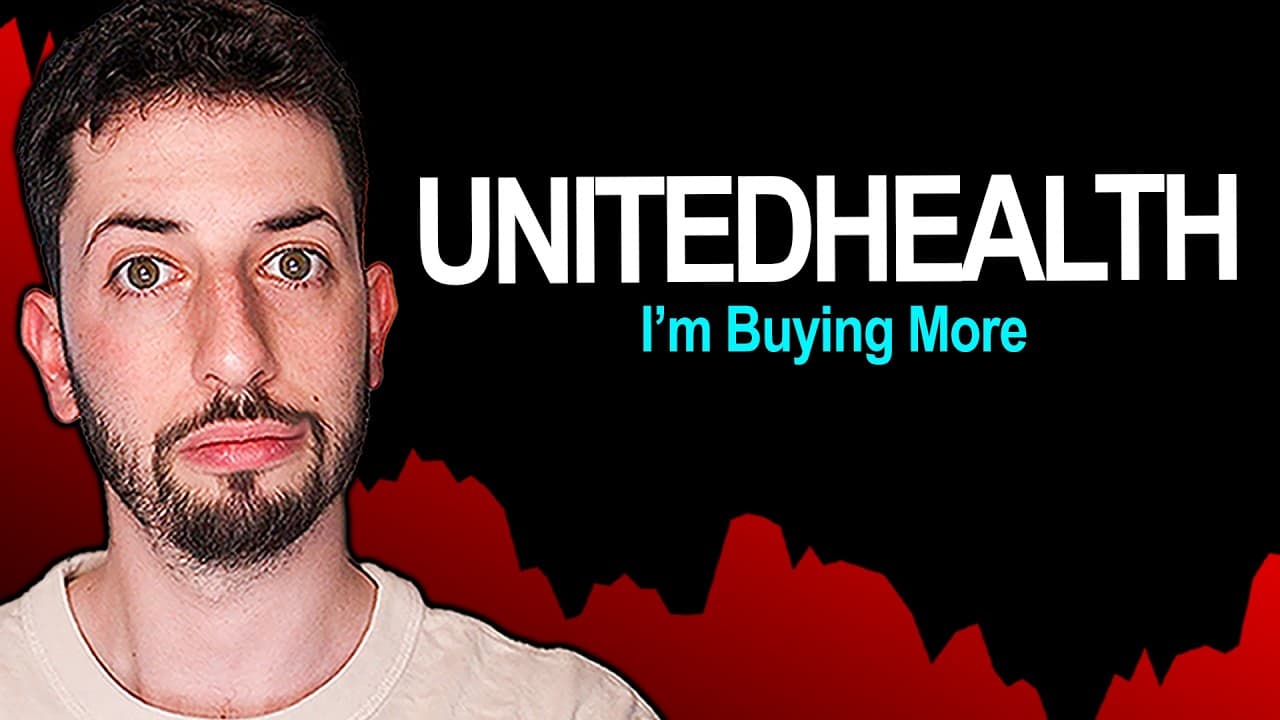
UnitedHealth Stock: Why I'm Buying After Earnings
TL;DR
UnitedHealth trades at roughly 11 times trailing earnings versus a 10-year median of 22, with management guiding to at least $16 EPS and a new outside CFO leading a turnaround. A 50% return over 12 months is plausible, though doubling your money quickly is not, and the comparison to Meta's 2022 recovery is deliberately overstated.
Transcript
Hey everyone and welcome back to another video for today. So as planned, I did buy a little bit more of United Health after the company reported its quarterly figures and provided us with a little bit more guidance for the upcoming quarters and upcoming years. So I'll explain the rationale behind it. It's still a very small position in the portfoli... Read More
Key Insights
- UnitedHealth's trailing PE sits around 11 times versus a 10-year median of 22.18, while the forward PE is 14.15 times against a median of 18.74, signaling the stock trades well below its historical valuation.
- Management guided to EPS of at least $16, setting what the investor calls a deliberately low bar so the company can focus on executing and recovering rather than overpromising.
- The Meta 2022 comparison in the title is an intentional joke, since no other company can match Meta's top and bottom line growth from that bottom, and UnitedHealth has many factors outside its control.
- Total EBIT dropped 34.6% last quarter and gross profit margin fell from 25% to 20.8% over roughly two years, while operating margin declined to 7.3% annually, marking the core of the problem.
- Free cash flow reached $25.2 billion over the last 12 months and is expected to remain above $20 billion, growing about 12% into fiscal 25, 3.1% in 26, and 15.7% in fiscal 27.
- UnitedHealth is exiting Medicare plans serving over 600,000 members, expects Medicare Advantage costs to rise 10% in 2026, and projects most major changes to become visible in 2026.
- Optum Health's long-term margins are now guided to 6 to 8%, down from the previous 8 to 10% range, with value-based care specifically expected around 5%.
- The company hired a new CFO from outside the firm and raised the dividend by 5%, prioritizing a strong balance sheet and credit rating over accelerating share buybacks in the near term.
Install to Summarize YouTube Videos and Get Transcripts
Explore YouTube Video Summarizer or Get YouTube Transcript Extractor
Questions & Answers
Q: Is UnitedHealth stock really like buying Meta in 2022?
No, the investor states the title is a joke and that nothing is truly like Meta 2022, which he calls a one-off. He argues nobody has a CEO like Mark Zuckerberg, Meta had everything under control, and no stock can grow its top and bottom lines as fast as Meta did from that bottom. UnitedHealth has a large part of its business fixable, but many factors are out of its control, making the direct comparison unrealistic.
Q: What return does the investor expect from UnitedHealth stock?
The investor believes a 50% return over the next 12 months is possible, plus a small dividend along the way. He explicitly rules out doubling your money in the next couple of quarters, calling that unrealistic. He adds that anyone who thinks 50% over 12 months is not good enough has likely only invested during the last bull market, emphasizing that such a return is quite strong by normal standards.
Q: What is UnitedHealth's current valuation compared to its history?
UnitedHealth's trailing PE sits at about 11 times, well below its 10-year median of 22.18. The forward PE is 14.15 times versus a median of 18.74. Because management guided EPS to at least $16, and potentially higher at 16.5, 16.7, or 17, the forward PE could drop further, especially as the stock price continues to fall. This makes the stock appear undervalued relative to its own historical multiples.
Q: What is UnitedHealth's EPS guidance for the coming years?
Management guided EPS to at least $16, which the investor notes is lower than expected but sets a deliberately low bar. For 2026 they expect solid but moderate earnings growth, meaning likely well above $16, and they expect earnings growth to strengthen quickly in 2027 and rise steadily in succeeding years. The investor believes the company threw out everything it needed to say in this earnings call so it can now focus on executing and recovering.
Q: Why did UnitedHealth's margins and EBIT decline?
Total EBIT dropped 34.6% last quarter, a huge decline. Gross profit margin fell from 25% to 20.8% over roughly two years, and operating margin declined to 7.3% annually, a level last seen around 2016 to 2017. The investor identifies margin compression, not revenue, as the core problem, since revenue still grew 12.9% last quarter. Free cash flow margin actually increased slightly to 6% since Q2 2024, showing cash generation remained resilient.
Q: What changes is UnitedHealth making in its Medicare business?
In Medicare, UnitedHealth is working to remediate true pricing, product design, and benefit changes, aiming to be within the lower half of targeted margin ranges in 2026 and advancing further in 2027. The company made a difficult decision to exit plans that currently serve over 600,000 members, and Medicare Advantage costs are projected to rise by 10% in 2026. Most major changes will become noticeable in 2026 or toward the end of 2025's guidance period.
Q: How is UnitedHealth handling buybacks and dividends?
The company raised its dividend by 5% and gave no indication in the earnings call that it would accelerate share buybacks soon, choosing instead to focus on restoring financial stability. Over the last 20 years, shares outstanding fell 33%, though buybacks moved faster around 2005 to 2008. The investor personally prefers accelerated buybacks over dividends while the stock is cheap, since buying more shares at lower prices removes more shares and boosts future EPS growth, but he expects buybacks to stay measured near term.
Q: What did UnitedHealth management say about fixing the business?
Management acknowledged past pricing and operational mistakes and is implementing reviews by independent experts. They emphasized a cultural shift toward greater transparency and responsiveness to stakeholders and a focus on restoring performance and strengthening institutional culture. They hired a new CFO from outside the company with strong business and financial experience. The investor compares this turnaround to PayPal's shift from growth at all cost to profitable and then durable growth, expecting UnitedHealth to follow the same path.
Summary & Key Takeaways
-
The investor bought more UnitedHealth after quarterly earnings, keeping it a small portfolio position. The video title comparing it to Meta 2022 is a deliberate joke, since the investor argues nothing truly resembles Meta's 2022 recovery and no stock can grow as fast from that bottom.
-
Valuation looks cheap with a trailing PE near 11 versus a 10-year median of 22.18 and a forward PE of 14.15. Management guided EPS to at least $16, and higher assumptions plus a falling stock price could push the forward PE even lower.
-
Margins have compressed sharply, with EBIT down 34.6% and gross margin falling to 20.8%, but a new outside CFO, acknowledged past mistakes, and a low guidance bar suggest a turnaround toward profitable, durable growth into 2026 and 2027.
Read in Other Languages (beta)
Share This Summary 📚
Summarize YouTube Videos and Get Video Transcripts with 1-Click
Try YouTube Summary with ChatGPT & Claude or YouTube Transcript Generator
Explore More Summaries from Couch Investor 📚

Summarize YouTube Videos and Get Video Transcripts with 1-Click
Try YouTube Summary with ChatGPT & Claude or YouTube Transcript Generator