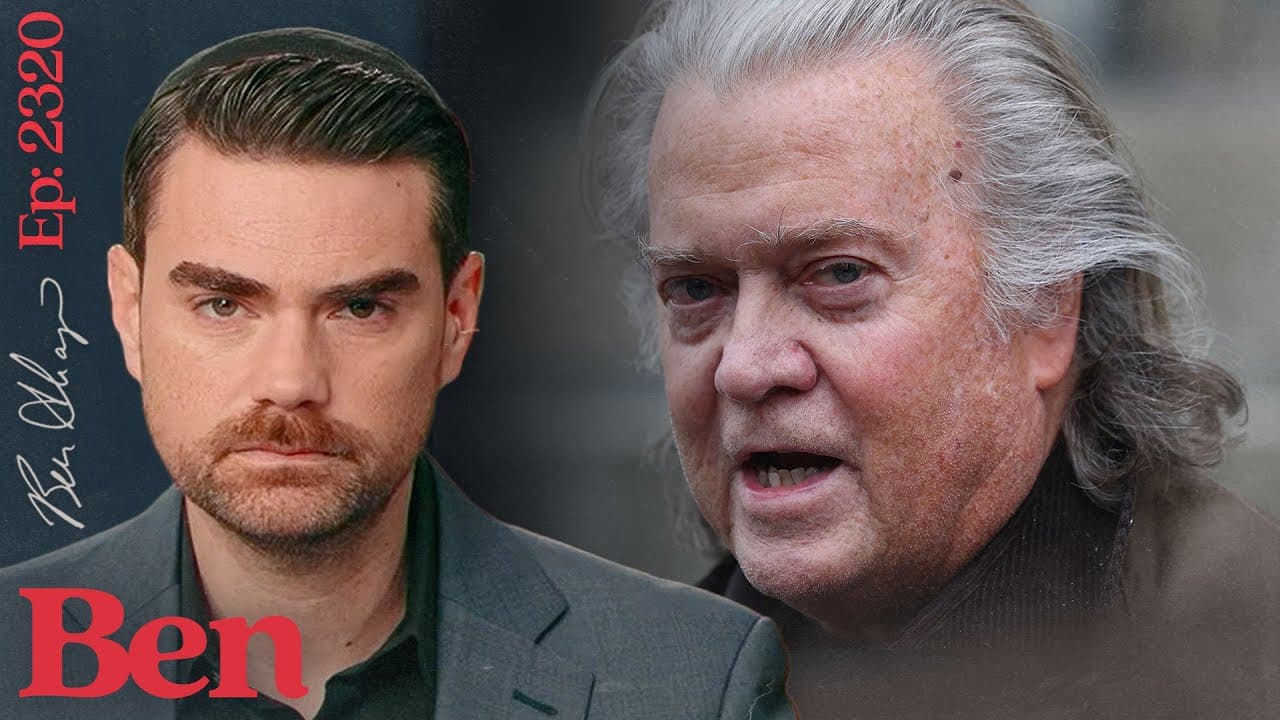
What Did Steve Bannon Do for Jeffrey Epstein?
TL;DR
Released messages reportedly show Steve Bannon helping Jeffrey Epstein develop legal and media responses during 2018, a decade after Epstein’s first conviction. Ben Shapiro argues that this relationship undermines Bannon’s credibility as an Epstein critic and challenges his attempt to shape a post-Trump version of MAGA, which Shapiro says cannot exist independently of Donald Trump.
Transcript
As more Epstein files drop, some of the biggest conspiracy theorists are ins snared in the scandal itself. Plus, we get to Marjgery Taylor Green rebelling against the president of the United States and the stock market taking a tumble. What comes next first? Tomorrow night, join me, Matt Walsh, Michael Moles, and Andrew Claven for a new live episod... Read More
Key Insights
- The released messages reportedly show Bannon and Epstein discussing legal and media strategy during 2018, when public scrutiny of Epstein was intensifying. Shapiro emphasizes that this occurred about 10 years after Epstein’s first conviction, not during an earlier period before his criminal history was publicly established.
- Bannon reportedly described the renewed scrutiny surrounding Epstein as a sophisticated operation and asked who was running it. According to the cited Guardian account, he advised Epstein on adversarial responses involving media organizations, the justice system, and Epstein’s victims while also discussing broader political and publicity objectives.
- Shapiro’s central criticism is that an Epstein critic loses credibility if that person previously served as Epstein’s confidant or publicity adviser. He characterizes the reported relationship as especially damaging because Bannon’s involvement allegedly occurred after Epstein was already widely known as a convicted sex offender.
- Bannon’s political career is portrayed as a succession of relationships that increased his influence. Shapiro connects documentaries about Michelle Bachmann, Sarah Palin, and Andrew Breitbart to Bannon’s eventual prominence at Breitbart and subsequent position in the first Trump administration before he was forced out.
- The fight over MAGA’s future is presented as an internal Republican struggle among figures with competing positions on economics and foreign policy. Shapiro contends that Bannon expects to influence this contest by presenting himself as an intellectual force behind the movement after Trump’s political power declines.
- MAGA is defined by Donald Trump rather than by a transferable political doctrine, according to Shapiro. He argues that attempts to convert Trump’s impulses and instincts into a consistent philosophical program fail because Trump holds conflicting views and adjusts his decisions according to practical political circumstances.
- Trump’s approach is characterized as pragmatic populism, meaning he tries policies and moves away from them when they do not work. Shapiro uses Trump’s potentially changing position on assistance for Ukraine as an example of why a fixed MAGA ideology cannot reliably predict Trump’s choices.
- The episode’s broader agenda includes Marjorie Taylor Greene and Thomas Massie challenging Trump’s control of MAGA, political arguments about releasing Epstein records, market turmoil, and a United Nations decision concerning Trump’s Gaza plan. However, the supplied transcript concentrates primarily on Bannon, Epstein, and MAGA’s identity.
Install to Summarize YouTube Videos and Get Transcripts
Explore YouTube Video Summarizer or Get YouTube Transcript Extractor
Questions & Answers
Q: What did Steve Bannon reportedly do for Jeffrey Epstein?
Steve Bannon reportedly helped Jeffrey Epstein develop legal and media responses as Epstein faced renewed public scrutiny during 2018. The cited Guardian reporting describes hundreds of messages exchanged over almost a year and says Bannon advised Epstein regarding media outlets, the justice system, and victims. Shapiro characterizes Bannon as more than an acquaintance, describing him as a confidant and publicity adviser.
Q: When did Steve Bannon reportedly advise Jeffrey Epstein?
The reported communications began as early as June 2018 and continued through much of the final year of Epstein’s life. Shapiro stresses that 2018 was approximately 10 years after Epstein’s first conviction and controversial plea agreement. He uses that timing to distinguish Bannon’s reported involvement from social contact that other people had with Epstein before his criminal conduct became broadly known.
Q: How were the Bannon and Epstein messages identified?
According to the Guardian reporting quoted in the commentary, contextual details connected the messages to Bannon, including his documented activities, business interests, and media projects at the time. One document also reportedly contained an unredacted telephone number that matched a number linked to Bannon in a legal case involving Trump adviser Roger Stone. These details were presented as evidence of his identity.
Q: Why does Shapiro consider Bannon’s reported Epstein relationship damaging?
Shapiro argues that advising a convicted sex offender on publicity and legal responses is incompatible with claiming authority as a leading critic of the Epstein scandal. He considers the timing particularly important because the reported advice came years after Epstein’s first conviction. In Shapiro’s view, Bannon’s alleged role raises questions about his credibility and suitability to guide the Republican Party’s future.
Q: Why does Shapiro say MAGA cannot exist without Trump?
Shapiro says MAGA is defined personally by Donald Trump rather than by a stable set of ideas that another politician or strategist can inherit. He argues that Trump holds conflicting positions, responds pragmatically to events, and can change direction when an approach fails. Therefore, efforts to package Trump’s instincts into a consistent ideology for Bannon, JD Vance, Ted Cruz, or another successor are destined to fail.
Q: What does pragmatic populism mean in Shapiro’s description of Trump?
Pragmatic populism means that Trump tests positions or policies and changes course when they appear unsuccessful or circumstances shift. Shapiro says Trump is not rigidly ideological and may articulate different versions of MAGA at different moments. He gives support for Ukraine as an example, arguing that Trump could oppose such support and later favor it if Russian intransigence changed his assessment.
Q: How does Shapiro describe Steve Bannon’s political rise?
Shapiro describes Bannon as someone who advanced by associating himself with increasingly influential people. He says Bannon made documentaries involving Michelle Bachmann, Sarah Palin, and Andrew Breitbart, then used his Breitbart prominence to secure a role in the first Trump administration. After being removed, Bannon spent time outside the administration, served a short jail term, and established his War Room program.
Q: What political motive does Shapiro attribute to Bannon’s Epstein commentary?
Shapiro suggests Bannon is using the Epstein controversy as part of an internal Republican effort to reduce Trump’s control and promote Bannon’s own interpretation of MAGA. He says Bannon assumes Trump is approaching lame-duck status and expects a struggle over the party’s future. Shapiro rejects Bannon’s implied claim to be MAGA’s intellectual architect and argues that Trump alone determines the movement’s direction.
Summary & Key Takeaways
-
Ben Shapiro focuses on reports that Steve Bannon communicated extensively with Jeffrey Epstein during 2018. According to the cited Guardian reporting, their messages concerned legal and publicity strategies as Epstein faced renewed scrutiny over his criminal history, favorable treatment by the justice system, and relationships with influential figures across politics, business, and academia.
-
The commentary portrays Bannon as a political operator who repeatedly used associations with prominent figures to advance his career. Shapiro traces a path involving documentaries about Michelle Bachmann, Sarah Palin, and Andrew Breitbart, followed by Bannon’s rise at Breitbart, his role in the first Trump administration, his departure, imprisonment, and later War Room program.
-
Shapiro argues that Bannon and other Republican figures are positioning themselves for a struggle over MAGA’s future as Trump’s political power eventually wanes. However, he rejects the idea that MAGA can be separated from Trump or transferred as a coherent ideology, describing Trump instead as a pragmatic populist whose positions can change with circumstances.
Read in Other Languages (beta)
Share This Summary 📚
Summarize YouTube Videos and Get Video Transcripts with 1-Click
Try YouTube Summary with ChatGPT & Claude or YouTube Transcript Generator
Explore More Summaries from Ben Shapiro 📚





Summarize YouTube Videos and Get Video Transcripts with 1-Click
Try YouTube Summary with ChatGPT & Claude or YouTube Transcript Generator