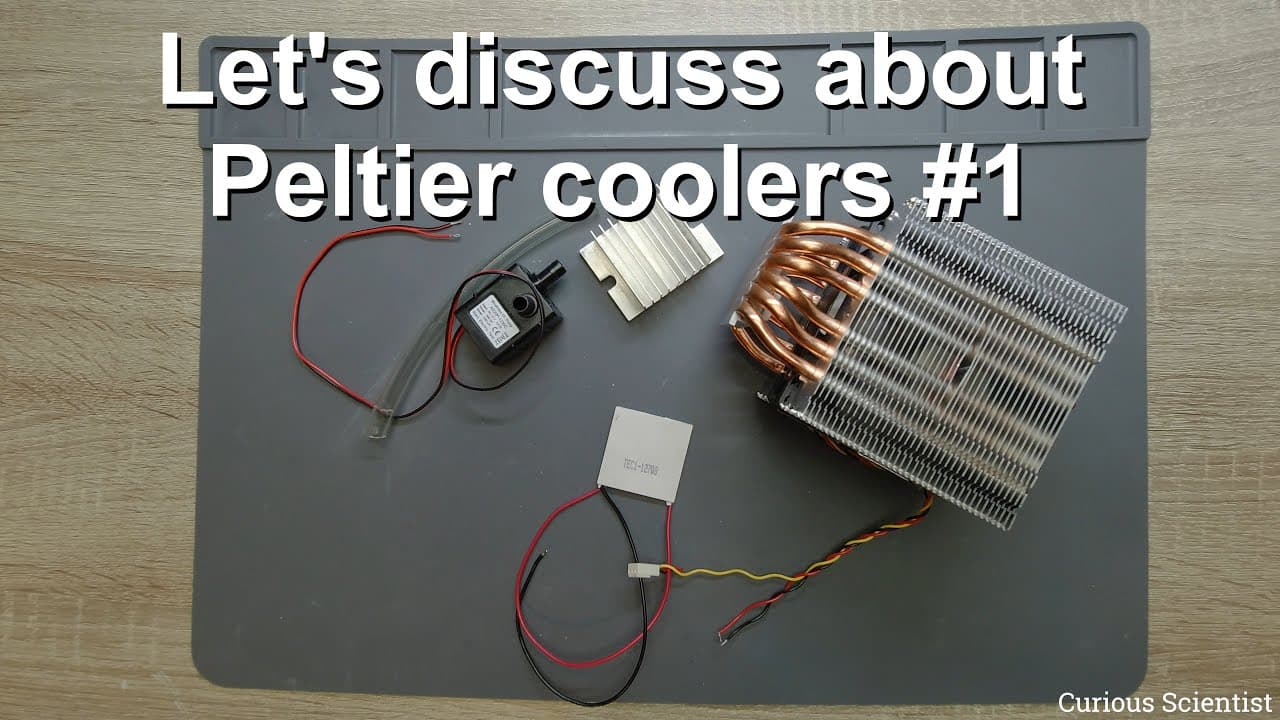
Let's discuss about Peltier coolers #1 - Water pump analogy
TL;DR
Clarification on spontaneous vs. non-spontaneous cooling and Peltier cooler function.
Transcript
welcome everyone in this video I'm going to talk about the Patea cooling again and cooling in general because I saw some misconceptions or bad ideas about cooling and patchy cooling in general so I would like to try to clarify those things and I would like to give you some better ideas about how these things works work and how these things can be u... Read More
Key Insights
- 😎 Cooling processes can be categorized into spontaneous and non-spontaneous types, with distinct energy requirements.
- 🥵 Surface area plays a crucial role in efficient heat transfer; heat sinks utilize larger surface areas to facilitate this.
- 😎 The second law of thermodynamics constrains cooling capabilities, limiting spontaneous cooling to ambient temperatures.
- 🥵 Peltier coolers are essential for applications needing temperatures below room temperature, functioning as heat pumps.
- 🥵 Fans complement heat sinks by improving air circulation, drastically increasing the cooling efficiency of electronic components.
- 🥵 The analogy between heat flow and water movement simplifies complex cooling concepts for better understanding.
- ✋ Proper cooling methods can significantly impact device performance, especially in high-demand scenarios like overclocking.
Install to Summarize YouTube Videos and Get Transcripts
Explore YouTube Video Summarizer or Get YouTube Transcript Extractor
Questions & Answers
Q: What are the two types of cooling discussed in the video?
The video distinguishes between spontaneous and non-spontaneous cooling. Spontaneous cooling happens naturally, such as a hot object reaching room temperature, while non-spontaneous cooling requires energy input, like a refrigerator or Peltier cooler, to create a thermal difference and achieve lower temperatures.
Q: How does a heat sink enhance the cooling process?
A heat sink increases the surface area available for heat exchange with the environment. More surface area means more air molecules can interact with the heat sink, leading to increased heat dissipation. This is essential for maintaining lower temperatures in devices like CPUs, where efficient cooling is critical.
Q: Why can’t spontaneous cooling lower temperatures below room temperature?
Spontaneous cooling relies on thermal equilibrium, which states that heat naturally flows from hotter to cooler objects until both reach the same temperature. Thus, a hot object can only cool down to the ambient temperature, as dictated by the second law of thermodynamics, without the introduction of work or additional cooling mechanisms.
Q: What role does a Peltier cooler serve and how does it differ from a heat sink?
A Peltier cooler operates as a heat pump, actively transferring heat from a cooler area to a warmer one using electrical energy. Unlike heat sinks, which passively dissipate heat, Peltier coolers can reduce temperatures below ambient by moving heat against its natural flow, requiring power to function.
Q: Can you explain the water analogy used to describe heat flow?
The video employs a water analogy, illustrating heat flow with two buckets. When water is poured from one bucket (hot object) to another (room temperature), it stops flowing once both are equal, demonstrating spontaneous processes. To move water to a higher bucket (cool below ambient), a pump (like a Peltier cooler) must be used, emphasizing the need for work.
Q: How does introducing a fan help in cooling?
A fan increases airflow, enhancing the heat exchange process by allowing more air molecules to interact with the surface of the heat sink. This augmented contact accelerates the cooling process, making it more efficient, although it still cannot lower temperatures beyond room temperature.
Summary & Key Takeaways
-
The video explains cooling processes, differentiating between spontaneous cooling, which occurs naturally, and non-spontaneous cooling, which requires energy input to work.
-
It emphasizes that heat sinks increase surface area for more efficient heat transfer, but spontaneous cooling cannot lower temperatures below room temperature without additional energy input.
-
The Peltier cooler is identified as a non-spontaneous cooling device, needing energy to pump heat from a cooler object to a warmer environment, thus enabling temperatures below ambient.
Read in Other Languages (beta)
Share This Summary 📚
Summarize YouTube Videos and Get Video Transcripts with 1-Click
Try YouTube Summary with ChatGPT & Claude or YouTube Transcript Generator
Explore More Summaries from Curious Scientist 📚

![Building a Peltier cooler-based cooling box - First iteration, improvements [Part 2/6] thumbnail](/_next/image?url=https%3A%2F%2Fi.ytimg.com%2Fvi%2F0YlNw0EGnzI%2Fhqdefault.jpg&w=750&q=75)
![Building a coil winder [Part 6] - A few improvements thumbnail](/_next/image?url=https%3A%2F%2Fi.ytimg.com%2Fvi%2F3eyxG_g2iUA%2Fhqdefault.jpg&w=750&q=75)

Summarize YouTube Videos and Get Video Transcripts with 1-Click
Try YouTube Summary with ChatGPT & Claude or YouTube Transcript Generator