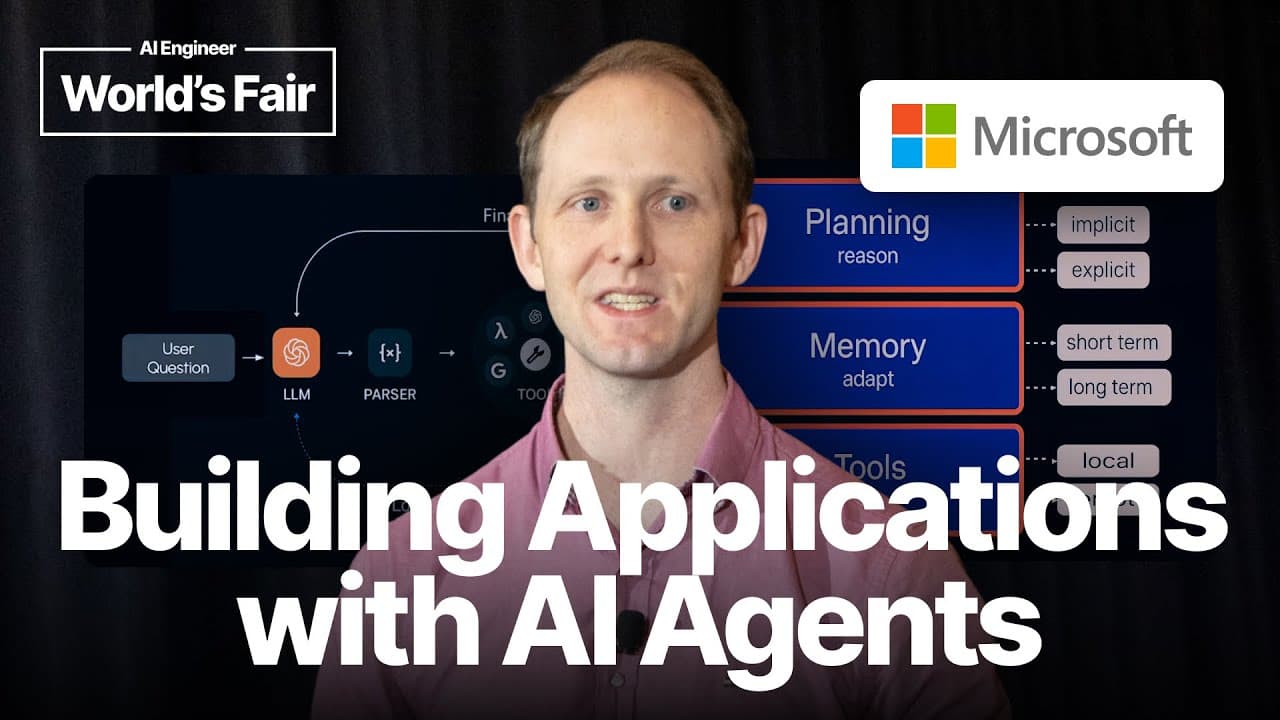
How to Build Effective Applications with AI Agents, Michael Albada, Microsoft
TL;DR
Build effective AI applications by treating agency as a tool, carefully managing function-calling tools and workflows, and continuously evaluating effectiveness, observability, and security. Michael Albada of Microsoft warns that prototypes may reach 70% accuracy while the long tail of complex scenarios remains increasingly difficult. The talk explains how orchestration, specialized agents, and rigorous testing can help preserve performance as agency increases. Read on for the core design principles and common pitfalls.
Transcript
It's a pleasure to be with you today. My name is Michael Alba and I'm a principal applied scientist at Microsoft and today I'm going to be presenting on building applications with AI agents. So just as a brief bio, I've been at Microsoft for about two years. So why I've been one of the key contributors to security copilot and the recently announced... Read More
Key Insights
- AI agents are entities that can reason, act, communicate, and adapt to solve tasks.
- Agentic systems are not binary; they exist on a spectrum of agency and effectiveness.
- Tool use is crucial; exposing too many tools can confuse the agent and reduce accuracy.
- Orchestration patterns like chains and trees help manage tool invocation and workflow.
- Multi-agent systems can handle tool complexity by dividing tasks among specialized agents.
- Evaluation is critical for optimizing agent performance and requires rigorous test sets.
- Observability tools help track system performance and identify failure modes.
- Security and safety are paramount, requiring robust design and evaluation practices.
Install to Summarize YouTube Videos and Get Transcripts
Explore YouTube Video Summarizer or Get YouTube Transcript Extractor
Questions & Answers
Q: How do you build effective applications with AI agents?
Start with a foundation model, then add the components needed for the system to reason, act, communicate, and adapt. Manage tool complexity with clear orchestration, evaluate performance rigorously, add observability, and prioritize security so increased agency does not reduce effectiveness.
Q: What is an AI agent?
Michael Albada defines an AI agent as an entity that can reason, act, communicate, and adapt to solve tasks. The foundation model provides the base, while additional components can improve performance and effectiveness in different scenarios.
Q: Are systems either agentic or non-agentic?
No. Agentic systems exist on a continuum, and their degree of agency should be considered separately from their effectiveness. Agency is a tool for solving problems, not an end in itself.
Q: Why is tool use important for AI agents?
Foundation models normally predict tokens, but they can also output function calls. By exposing tools through APIs, developers let agents invoke a broad range of functionality, although that capability also introduces risks and implementation challenges.
Q: Why can exposing too many tools reduce agent accuracy?
A large, poorly organized tool set can confuse an agent and reduce accuracy. Grouping tools logically or assigning subsets to specialized agents helps manage that complexity.
Q: How do orchestration patterns help AI agents?
Orchestration patterns such as chains and trees structure how tools are invoked and how work moves through a workflow. They help developers manage multi-step tasks and maintain system effectiveness.
Q: Why are evaluation and observability essential for AI agents?
Rigorous evaluation sets help developers measure performance, optimize the system, and identify failure modes. Observability complements evaluation by tracking behavior and making problems visible during development and operation.
Q: What common pitfalls should AI-agent developers avoid?
Developers should avoid insufficient evaluation, excessive tool complexity, poor observability, and weak security practices. They should also avoid adding agency when it compromises effectiveness, because an agentic prototype may reach 70% accuracy while the long tail of complex scenarios remains difficult.
Summary & Key Takeaways
-
AI agents offer a promising way to build intelligent systems capable of complex task management. They leverage foundation models to reason, act, and adapt, but require careful orchestration and tool management to maintain effectiveness. Key challenges include tool complexity, evaluation, and security, making rigorous testing and observability critical to successful implementation.
-
Tool use and orchestration are central to effective agentic systems. Exposing too many tools can reduce accuracy, so grouping them logically is essential. Orchestration patterns like chains and trees help manage workflows, while multi-agent systems can handle tool complexity by dividing tasks among specialized agents.
-
Evaluation and security are critical components of successful AI agent deployment. Rigorous evaluation sets help optimize performance, while observability tools track system effectiveness and identify failure modes. Security requires robust design and evaluation practices to ensure the safety of agentic systems.
Read in Other Languages (beta)
Share This Summary 📚
Summarize YouTube Videos and Get Video Transcripts with 1-Click
Try YouTube Summary with ChatGPT & Claude or YouTube Transcript Generator
Explore More Summaries from AI Engineer 📚




Summarize YouTube Videos and Get Video Transcripts with 1-Click
Try YouTube Summary with ChatGPT & Claude or YouTube Transcript Generator