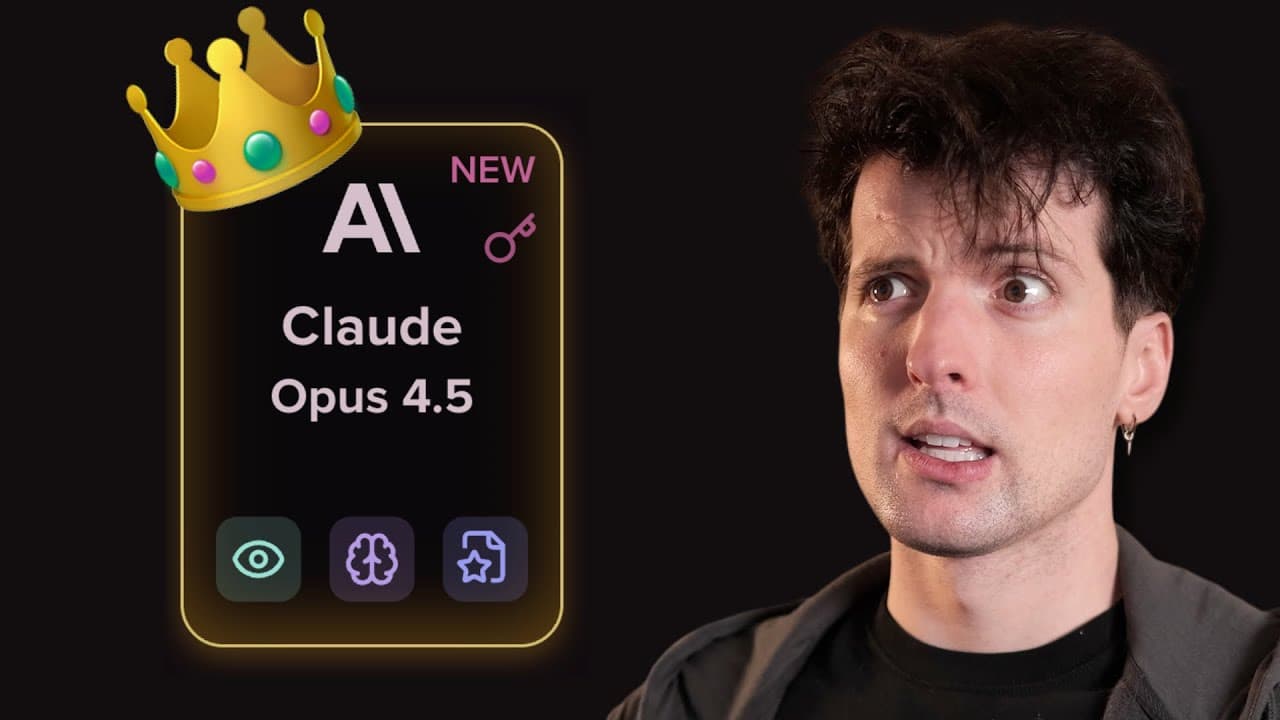
Claude Opus 4.5 Review: Best Model for Coding
TL;DR
Claude Opus 4.5 is the reviewer’s preferred coding model because it combines strong code generation, reliable tool use, visual understanding, and unusually efficient token usage. It costs $5 per million input tokens and $25 per million output tokens, so it remains expensive, but its lower token consumption may make some tasks cheaper than using Sonnet 4.5.
Transcript
I have a new favorite model. I really didn't think I'd be sitting here today saying this, especially after we had two groundbreaking models for coding and developers just last week. Yes, it's been three groundbreaking models in just 7 days. But here we are. Opus 4.5 is here, and it's the best model I've ever used for code. Y'all know me, I am far f... Read More
Key Insights
- Claude Opus 4.5 is the reviewer’s strongest coding model to date, based on extensive hands-on use across numerous projects and hundreds of dollars in token spending. He found its developer performance compelling despite previously expressing considerable skepticism toward Anthropic.
- Opus 4.5 is primarily valuable for developer work, according to the reviewer. He does not consider it especially useful outside coding, and he remains unconvinced by its writing quality, even though trusted contacts described the model as surprisingly funny.
- The API price is $5 per million input tokens and $25 per million output tokens. That is one-third of the previous Opus pricing of $15 and $75 respectively, although the model remains substantially more expensive than GPT 5.1 and Gemini 3 Pro.
- Token efficiency is a central improvement in Opus 4.5. Anthropic reported that it surpassed internal coding benchmarks while using half as many tokens, and one SWE-bench comparison showed the medium setting outperforming Sonnet 4.5 with about one-third of the token usage.
- Opus 4.5 achieved leading results on SWE-bench Verified, Terminal-Bench 2, agentic tool use, and computer use in the presented evaluations. The reviewer views practical testing as more informative because model behavior can differ substantially from benchmark rankings.
- Visual understanding is meaningfully better in Opus 4.5, according to the reviewer. Earlier Claude models sometimes appeared to receive or interpret downscaled images, while the new model seemed able to understand supplied visual information much more directly and accurately.
- ARC-style problem solving is a notable strength of Opus 4.5. The reported results reached 80% on ARC AGI version one for public models and 37.6% on ARC AGI 2, which the reviewer considered particularly impressive and difficult to dismiss as benchmark gaming.
- Benchmark interpretation requires skepticism because presentation and scoring choices can influence perceived performance. The reviewer criticized a SWE chart with a truncated vertical axis and questioned Anthropic’s inconsistent response when its model, rather than a competitor, discovered an unexpected but legitimate workaround.
Install to Summarize YouTube Videos and Get Transcripts
Explore YouTube Video Summarizer or Get YouTube Transcript Extractor
Questions & Answers
Q: Is Claude Opus 4.5 the best model for coding?
Claude Opus 4.5 is the best coding model the reviewer has personally used. That conclusion came from coding with it throughout the day, spending hundreds of dollars on tokens, and rerunning or rebuilding numerous projects. He emphasizes practical developer experience over benchmark placement, while limiting his recommendation mainly to coding rather than writing or general-purpose use.
Q: How much does Claude Opus 4.5 cost?
Claude Opus 4.5 costs $5 per million input tokens and $25 per million output tokens. Previous Opus pricing was $15 per million input tokens and $75 per million output tokens, so both rates fell by a factor of three. Even after that reduction, the reviewer says Opus remains more expensive than GPT 5.1 and Gemini 3 Pro.
Q: Can Claude Opus 4.5 be cheaper than Sonnet 4.5?
Claude Opus 4.5 could be cheaper than Sonnet 4.5 for some workloads if its improved token efficiency offsets its higher listed rates. The cited SWE-bench comparison showed an Opus medium setting scoring above Sonnet 4.5 while using about one-third as many tokens. Actual cost therefore depends on how many input and output tokens a particular task consumes.
Q: What coding benchmarks did Claude Opus 4.5 perform well on?
Claude Opus 4.5 produced leading reported results on SWE-bench Verified, Terminal-Bench 2, and agentic tool-use evaluations. It also performed strongly in computer use and internal coding tests. The reviewer cautions that benchmark scores do not always match his practical experience, particularly as leading models approach the upper ranges of established evaluations.
Q: How good is Claude Opus 4.5 at tool use?
Claude Opus 4.5 performed very well on agentic tool-use benchmarks and was presented as a leading model for scaled tool usage. The reviewer sees this as part of a broader improvement across recent models, which can now call tools relatively reliably. He still treats reliability as relative rather than absolute and does not claim that failures have disappeared.
Q: How well does Claude Opus 4.5 understand images?
Claude Opus 4.5 shows a meaningful improvement in visual understanding according to the reviewer’s experience. Earlier Claude models sometimes seemed to receive or process a downscaled version of an supplied image, limiting their comprehension. Opus 4.5 appeared to understand visual inputs more directly, although the transcript does not provide a detailed visual test or numerical comparison.
Q: Why is Claude Opus 4.5 notable on ARC AGI tests?
Claude Opus 4.5 reportedly scored 80% on ARC AGI version one for public models and 37.6% on ARC AGI 2. The reviewer considers these results striking because the tasks were designed to resist ordinary language-model strategies, especially in the second version. He also regards this family of evaluations as relatively difficult to manipulate through conventional benchmark optimization.
Q: Why does the reviewer remain skeptical of Claude Opus 4.5 benchmarks?
The reviewer believes benchmarks can diverge from real usage and can be framed in misleading ways. He points to a SWE chart whose vertical axis began at 70 and ended at 82, visually enlarging modest differences. He also criticizes inconsistent evaluation standards when Anthropic praised its model for finding a workaround after previously discounting competing models for similar unexpected behavior.
Summary & Key Takeaways
-
Claude Opus 4.5 impressed the reviewer most as a developer tool, not as a general writing model. After spending hundreds of dollars testing it across rebuilt projects, he considered it the best coding model he had used. Its practical performance mattered more to him than its benchmark rankings or broader conversational abilities.
-
Anthropic reduced Opus pricing from $15 to $5 per million input tokens and from $75 to $25 per million output tokens. Although the new model remains more expensive than GPT 5.1 and Gemini 3 Pro, improved token efficiency could narrow or reverse the effective cost difference for certain coding workloads.
-
Opus 4.5 achieved strong results in coding, terminal operation, tool use, computer use, visual understanding, and ARC-style problem solving. The reviewer nevertheless questioned benchmark interpretation, noting both compressed chart scales and inconsistent treatment of models that discover valid workarounds beyond the expected path in agent evaluations.
Read in Other Languages (beta)
Share This Summary 📚
Summarize YouTube Videos and Get Video Transcripts with 1-Click
Try YouTube Summary with ChatGPT & Claude or YouTube Transcript Generator
Explore More Summaries from Theo - t3․gg 📚






Summarize YouTube Videos and Get Video Transcripts with 1-Click
Try YouTube Summary with ChatGPT & Claude or YouTube Transcript Generator