How AI Agents Accelerate Medical Discoveries
TL;DR
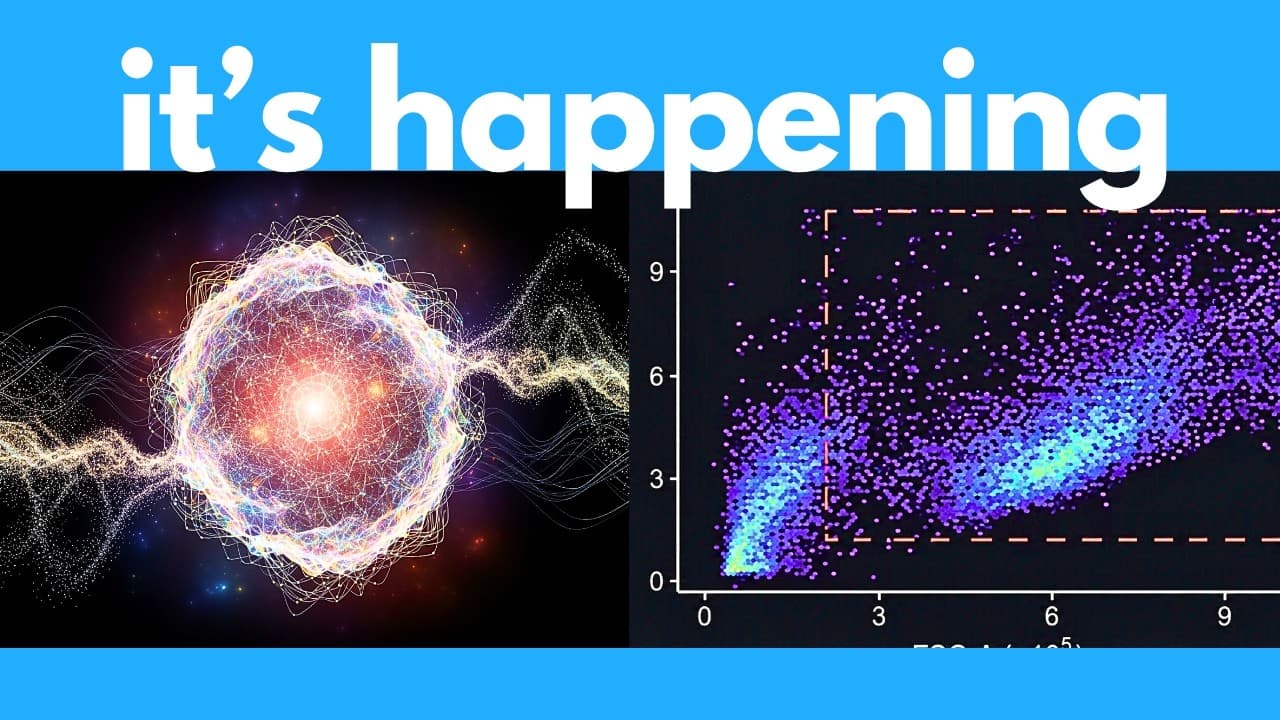
Specialized AI agents can generate, criticize, refine, and rank scientific hypotheses, then direct researchers toward ideas worth testing. Google’s co-scientist surpassed human experts and other AI models in blind evaluations of biomedical proposals, while laboratory testing showed that some suggested drug-repurposing candidates were highly effective against acute myeloid leukemia cells.
Transcript
The acceleration is happening right now. This isn't just sci-fi anymore. AI is already coming up with huge and completely new scientific discoveries, and it's getting faster and faster. In the same week, we had not one but two papers published in Nature, which is like the most prestigious scientific journal in the world. Both of them involve using ... Read More
Key Insights
- Co-scientist is an ecosystem of specialized AI agents that divides scientific reasoning into supervision, literature synthesis, criticism, clustering, refinement, and ranking. This virtual-lab structure allows different components to focus on distinct parts of hypothesis development rather than relying on one model’s first response.
- The supervisor agent is an administrative coordinator that interprets a human scientist’s research goal and distributes work to other agents. It keeps the process aligned with the requested objective, while the underlying generation, reflection, evolution, proximity, and ranking agents perform the substantive scientific reasoning.
- The reflection agent is a rigorous internal reviewer that attempts to disprove generated hypotheses. It checks factual accuracy, searches for logical flaws, and evaluates whether an idea is genuinely novel rather than a minor restatement of existing scientific findings.
- The proximity agent is a duplication-control mechanism that maps proposals into a high-dimensional space and groups similar ideas. By detecting multiple variations of essentially the same hypothesis, it helps the system stop spending computational resources on redundant concepts and explore different directions.
- The evolution agent is an iterative hypothesis improver that uses criticism to repair surviving proposals. It can bridge logical gaps and combine promising elements from separate ideas, allowing the system to develop stronger candidates through repeated revision rather than simple one-pass brainstorming.
- The ranking agent is an automated tournament system that compares scientific hypotheses through simulated debates. An Elo rating method updates proposal scores after judged head-to-head contests, causing ideas that remain persuasive across repeated challenges to rise toward the top of the leaderboard.
- Blind expert evaluation is evidence that co-scientist’s outputs were not merely confident fabrications. On 15 difficult biomedical goals supplied by PhD-level scientists, sufficiently refined proposals were judged significantly higher in novelty, plausibility, and impact than solutions from human experts and other tested AI models.
- Laboratory testing is the practical validation step for AI-generated biomedical hypotheses. After screening 2,300 FDA-approved drugs for possible use against acute myeloid leukemia, co-scientist identified candidates including binimetinib, which showed an IC50 of two nanomolar against leukemia cells in laboratory testing.
Install to Summarize YouTube Videos and Get Transcripts
Explore YouTube Video Summarizer or Get YouTube Transcript Extractor
Questions & Answers
Q: How does Google’s AI co-scientist generate scientific hypotheses?
Google’s co-scientist begins with a research goal supplied by a human scientist. A supervisor agent interprets that goal and allocates tasks, while a generation agent searches scientific literature and synthesizes relevant findings into initial hypotheses. Reflection, proximity, evolution, and ranking agents then criticize, organize, refine, compare, and prioritize those proposals through repeated cycles.
Q: Why does co-scientist use multiple specialized AI agents?
Multiple specialized agents allow co-scientist to separate tasks that require different forms of reasoning. One agent coordinates the work, another generates ideas, and another aggressively searches for factual or logical weaknesses. Additional agents detect duplication, improve surviving hypotheses, and rank alternatives. Together, these roles create an iterative virtual laboratory instead of depending on one unchallenged model response.
Q: How does the reflection agent improve scientific ideas?
The reflection agent tries to destroy weak hypotheses before researchers invest effort in them. It examines every proposed idea for factual mistakes, logical gaps, and other flaws. It also checks novelty, asking whether a proposal is genuinely new or merely a rewording of an existing discovery. Its criticism supplies the pressure and feedback needed for later refinement.
Q: How does the Elo ranking system evaluate AI-generated hypotheses?
The ranking agent stages simulated head-to-head debates between pairs of hypotheses. Each proposal argues that it is more novel, plausible, or testable and identifies weaknesses in its competitor. A separate AI model judges the exchange, after which winners gain Elo points and losers lose them. Repeated comparisons produce a leaderboard where more robust ideas rise over time.
Q: How was co-scientist compared with human biomedical experts?
Researchers supplied co-scientist with 15 difficult, unsolved biomedical goals written by PhD-level scientists. Human experts and other state-of-the-art AI models also proposed their strongest solutions. Independent experts then conducted a blind evaluation without knowing each idea’s source. After sufficient iteration, co-scientist’s proposals received significantly higher ratings for novelty, plausibility, and impact.
Q: How did co-scientist search for acute myeloid leukemia treatments?
Researchers gave co-scientist a dataset containing 2,300 drugs already approved by the FDA for human use but used for other purposes. The system was asked which drugs could be repurposed against acute myeloid leukemia. This approach sought faster candidates than designing a new drug from scratch, which the transcript says can take almost a decade and millions of dollars.
Q: What laboratory evidence supported co-scientist’s leukemia proposal?
Co-scientist identified several drug-repurposing candidates, including binimetinib, which was already used for skin cancer rather than leukemia. Researchers tested binimetinib on acute myeloid leukemia cells and reported an IC50 of two nanomolar. The transcript describes this as an extremely low concentration, meaning relatively little drug was required to inhibit cancer-cell survival by half.
Q: Why did co-scientist propose the drug CUR-6 for leukemia?
Co-scientist was specifically asked to identify candidates with no prior published connection to leukemia or cancer. It proposed CUR-6, a molecule that inhibits the enzyme IRE1 alpha, which manages cellular stress and the clearance of misfolded or broken proteins. The system reasoned that rapidly dividing cancer cells face substantial internal stress, making this stress pathway a potential selective vulnerability.
Summary & Key Takeaways
-
Google’s co-scientist functions as a virtual laboratory of specialized agents rather than a single chatbot. A supervisor assigns tasks, a generation agent proposes hypotheses from scientific literature, a reflection agent searches for errors and weak reasoning, and additional agents organize, refine, compare, and rank the surviving ideas through repeated evaluation cycles.
-
The system evaluates competing hypotheses through simulated head-to-head debates and an Elo-based ranking process. Separate judging models assess qualities such as novelty, plausibility, and testability. Across many comparisons, stronger proposals rise on the leaderboard, while critiques and evolutionary refinement help the system improve ideas instead of accepting its first generated answers.
-
Researchers tested the approach on difficult biomedical problems and compared its proposals with solutions from PhD-level scientists and other leading AI models. Independent experts conducted blind evaluations and preferred co-scientist’s sufficiently refined ideas. Laboratory experiments also supported selected leukemia drug-repurposing proposals, connecting automated hypothesis generation with measurable biological results in practice.
Read in Other Languages (beta)
Share This Summary 📚
Summarize YouTube Videos and Get Video Transcripts with 1-Click
Try YouTube Summary with ChatGPT & Claude or YouTube Transcript Generator
Explore More Summaries from AI Search 📚




Summarize YouTube Videos and Get Video Transcripts with 1-Click
Try YouTube Summary with ChatGPT & Claude or YouTube Transcript Generator