Products
Features
YouTube Video Summarizer
Summarize YouTube videos
Web & PDF Highlighter
Highlight web pages & PDFs
Chat with PDF
Ask any PDF questions with AI
Ask AI Clone
Chat with your highlights & memories
Audio Transcriber
Transcribe audio files to text
Glasp Reader
Read and highlight articles
Kindle Highlight Export
Export your Kindle highlights
Idea Hatch
Hatch ideas from your highlights
Integrations
Obsidian Plugin
Notion Integration
Pocket Integration
Instapaper Integration
Medium Integration
Readwise Integration
Snipd Integration
Hypothesis Integration
Apps & Extensions
Chrome Extension
Safari Extension
Edge Add-ons
Firefox Add-ons
iOS App
Android App
Discover
Discover
Ideas
Discover new ideas and insights
Articles
Curated articles and insights
Books
Book recommendations by great minds
Posts
Essays and notes from readers
Quotes
Inspiring quotes collection
Videos
Curated videos and summaries
Explore Glasp
Glasp Newsletter
Weekly insights and updates
Glasp Talk
Interview series with great minds
Glasp Blog
Latest news and articles
Glasp Use Cases
Learn how others use Glasp
Build & Support
Glasp API
Access Glasp's API for developers
MCP Connector
Connect Glasp to Claude & ChatGPT
Community
Glasp Reddit Community
Students
Student discount and benefits
FAQs
Frequently Asked Questions
AboutPricing
DashboardLog inSign up

Editing M-Mode ultrasound images for creating a figure in Powerpoint
339 views
•
August 4, 2016
by
Dory Video
YouTube video player
Editing M-Mode ultrasound images for creating a figure in Powerpoint

TL;DR

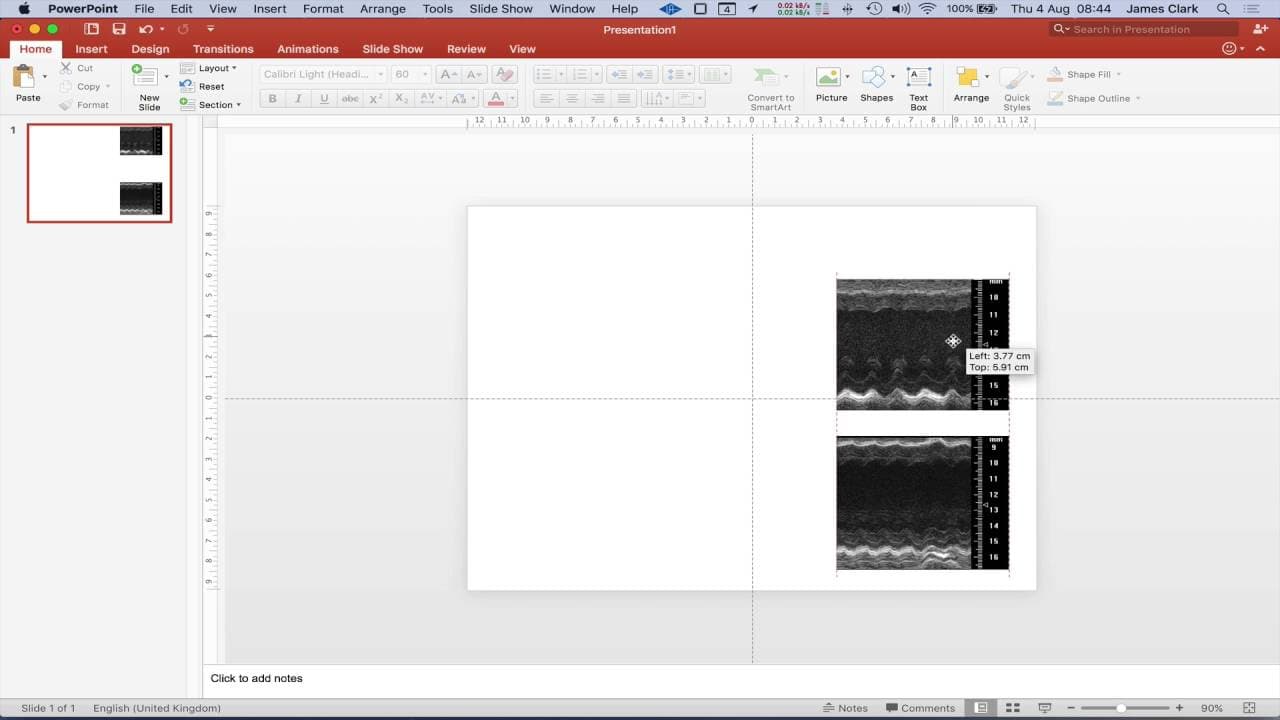
Learn how to create a side-by-side comparison figure using cardiac ultrasound M-mode images with different scales.

Transcript

hello so we've got the situation where we want to create a figure using images from a cardiac ultrasound machine we've got cardiac ultrasound M mode images here taken on a visual Sonic Vivo 770 and you can see we've got an image at the top an image at the bottom the image at the top is looking fairly decent you can see the uh sepal wall and the the... Read More

Key Insights

  • 🤶 Two cardiac ultrasound M-mode images can be easily compared by creating a side-by-side figure with similar scales.
  • 🥰 The scale differences in the images are due to changes in heart size and remodeling over time.
  • ⚖️ Cropping, aligning, and adjusting the transparency and scale of one image can help create a visually comparable figure.
  • 🤩 The use of the control key (or command key on Mac) and the shift key can aid in precise cropping and alignment.

Install to Summarize YouTube Videos and Get Transcripts

Explore YouTube Video Summarizer or Get YouTube Transcript Extractor

Questions & Answers

Q: Why is it important to have the same scale when comparing two ultrasound images?

Having the same scale allows for direct visual comparison between the two images, making it easier to identify functional differences and changes over time.

Q: How can you ensure that the two ultrasound images have the same scale?

By cropping an area of interest from both images, aligning them, and adjusting the transparency, one image can be stretched or scaled to match the other and achieve uniformity.

Q: What should be done if a mistake is made during the cropping process?

Pressing the control key (or command key on Mac) while cropping allows for unrestricted cropping. If a mistake is made, the cropping can be undone and readjusted.

Q: How can the alignment and scale of the images be further refined?

Using the shift key while moving the images can constrain the movement to the horizontal axis, allowing for precise alignment. The scale can be adjusted until the images are perfectly aligned.

Summary & Key Takeaways

  • The content discusses the process of creating a figure using two cardiac ultrasound M-mode images with different scales.

  • The purpose is to visually compare the differences between the two images and highlight any functional changes.

  • By cropping and aligning the images, adjusting transparency, and stretching one image to match the other, a scaled and aligned figure can be created.


Read in Other Languages (beta)

English

Share This Summary 📚

Summarize YouTube Videos and Get Video Transcripts with 1-Click

Download browser extensions on:

Try YouTube Summary with ChatGPT & Claude or YouTube Transcript Generator

Explore More Summaries from Dory Video 📚

Setting up multi instrument layers in Kontact thumbnail
Setting up multi instrument layers in Kontact
Dory Video
Roland Cloud Anthology 1987 - Sampled D50 LA synth thumbnail
Roland Cloud Anthology 1987 - Sampled D50 LA synth
Dory Video
How to Perform Linear Regression in GraphPad Prism thumbnail
How to Perform Linear Regression in GraphPad Prism
Dory Video
WavesFactory MERCURY Piano for Kontakt thumbnail
WavesFactory MERCURY Piano for Kontakt
Dory Video
Graphpad Prism - using the layout tool to publish your data thumbnail
Graphpad Prism - using the layout tool to publish your data
Dory Video
Playing Vienna Instruments (VSL) with a ROLI Seaboard RISE thumbnail
Playing Vienna Instruments (VSL) with a ROLI Seaboard RISE
Dory Video

Summarize YouTube Videos and Get Video Transcripts with 1-Click

Download browser extensions on:

Try YouTube Summary with ChatGPT & Claude or YouTube Transcript Generator

Apps & Extensions

  • Chrome Extension
  • Safari Extension
  • Edge Add-ons
  • Firefox Add-ons
  • iOS App
  • Android App

Key Features

  • YouTube Video Summarizer
  • Web & PDF Summarizer
  • Web & PDF Highlighter
  • Chat with PDF
  • Ask AI Clone
  • Audio Transcriber
  • Glasp Reader
  • Kindle Highlight Export
  • Idea Hatch

Integrations

  • Obsidian Plugin
  • Notion Integration
  • Pocket Integration
  • Instapaper Integration
  • Medium Integration
  • Readwise Integration
  • Snipd Integration
  • Hypothesis Integration

More Features

  • APIs
  • MCP Connector
  • Blog & Post
  • Embed Links
  • Image Highlight
  • Personality Test
  • Quote Shots

Company

  • About us
  • Blog
  • Community
  • FAQs
  • Job Board
  • Newsletter
  • Pricing
Terms

•

Privacy

•

Guidelines

© 2026 Glasp Inc. All rights reserved.