How to Build a High-Power T-Shirt Cannon

TL;DR
A high-power T-shirt cannon can shoot farther by using a larger accumulator tank, a longer barrel, and a wider connecting tube that does not restrict airflow. The final eight-inch cannon launched a 13-pound payload at 500 PSI for two and a half football fields, while a timed parachute and Kevlar bag protected the payload during landing.
Transcript
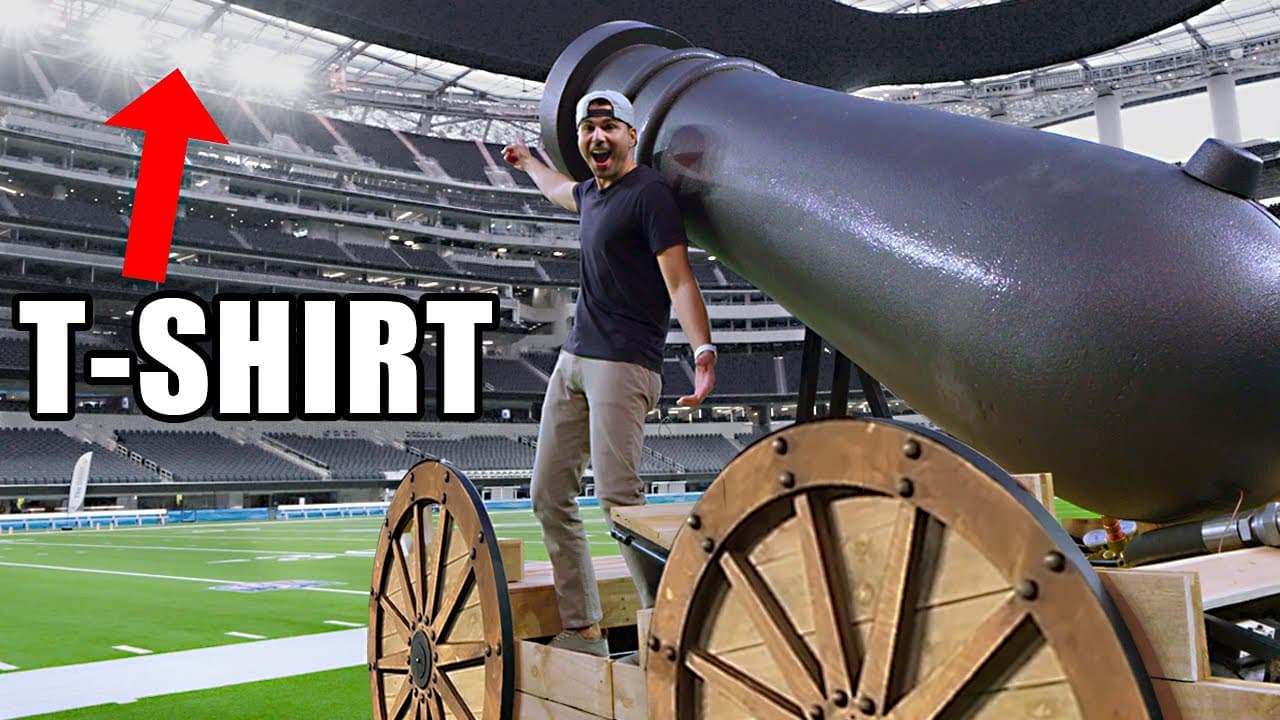
- This is a T-shirt cannon. (T-shirt boinging) And this is the cannon that just happens to shoot a T-shirt. (cannon firing) (Mark laughing) (person cheering) That went farther than anticipated. But to understand the convoluted path for how I ended up here and eventually right here, and who the heck this kid is, we've gotta first go back a few month... Read More
Key Insights
- A cannon propels its payload when rapidly expanding gas seeks an exit through the barrel and pushes the obstructing object forward. A pneumatic T-shirt cannon applies the same principle by releasing stored high-pressure air instead of burning gunpowder.
- An actual Civil War cannon was unsuitable for the planned stadium demonstration because six ounces of black powder launched the T-shirt with excessive force. The test established that a safer pneumatic system was necessary before anything could be fired toward a football crowd.
- A larger accumulator tank sustains force on the payload for longer during launch. Anthony contrasted this sustained airflow with the brief burst produced by a smaller tank, making tank capacity one of his three recommendations for achieving greater range.
- A longer barrel gives the payload more distance in which to accelerate. Anthony recommended extending the barrel after early shots fell short of the drone positioned at the scaled location of the stadium's top-row target.
- A wider connecting tube improves airflow by removing the narrowed section between the pressure tank and barrel. The design aimed to prevent a traffic jam of escaping air, allowing it to move faster toward the payload.
- A Kevlar bag and timed parachute solved the payload recovery problem. Anthony designed, built, and tested a system that released the parachute after a prescribed delay, allowing the bag to survive its landing in pristine condition.
- The modified eight-inch cannon launched a 13-pound payload at 500 PSI over two and a half football fields. Its flight cleared the drone target that represented the stadium seat and passed over the height of a 30-story building.
- Stadium safety requirements changed the final configuration before the public demonstration. Lawyers required a smaller barrel and payload, yet a one-third-power test still cleared the intended last-seat area, and a repeated shot banked off the stadium roof.
Install to Summarize YouTube Videos and Get Transcripts
Explore YouTube Video Summarizer or Get YouTube Transcript Extractor
Questions & Answers
Q: How does a pneumatic T-shirt cannon work?
A pneumatic T-shirt cannon stores high-pressure air in an accumulator tank. Opening a valve gives that crowded air a path through the connecting tube and barrel. As the air rushes toward the exit, it pushes the T-shirt payload ahead of it. The transcript compares this principle with shooting a spitball through a straw and with the operation of other air-powered launch systems.
Q: Why was an actual cannon rejected for launching T-shirts?
The actual Civil War cannon was rejected because it produced far more force than the stadium application could safely use. A test placed six ounces of black powder behind a T-shirt, and the resulting shot traveled farther than anticipated. Mark concluded that the Jimmy Kimmel Bowl would probably not permit such shots into the crowd, so the project pivoted to a controllable pneumatic design.
Q: How can a pneumatic T-shirt cannon shoot farther?
The three recommended changes were a larger accumulator tank, a longer barrel, and a wider connecting tube. The larger tank sustains pressure on the payload instead of delivering only a brief burst. The longer barrel provides more distance for acceleration. Removing the narrowed connection reduces airflow congestion, helping the stored air escape faster and transfer more motion to the payload.
Q: Why did the early T-shirt cannon payloads fail?
The early shots exposed both range and durability problems. A two-thirds-power attempt fell well short of the drone marking the scaled stadium target. A later 500 PSI shot with an eight-pound payload still lacked enough range, while the canvas bag ripped despite being taped. Additional tests throughout the day could not reach Guillermo's planned top-row position, forcing a redesign.
Q: How did the design stop the payload bag from ripping?
Anthony proposed replacing the canvas payload bag with a stronger Kevlar bag. He also created a timed parachute system to reduce the stress of landing. The system was designed to release its parachute after a prescribed delay rather than immediately after launch. During the successful 13-pound test, the parachute opened at the right moment, and the Kevlar bag landed in pristine condition.
Q: How was the stadium target simulated during testing?
The team used the known horizontal and vertical measurements of Guillermo's intended top-row seat at SoFi to create a correctly scaled field test. They positioned a drone in the sky at that exact relative location, then treated hitting or clearing the drone as the objective. This setup showed whether each launch had enough height and horizontal range before the cannon entered the stadium.
Q: What were the results of the successful full-scale test?
The successful configuration used an eight-inch cannon, a 13-pound payload with a parachute, and 500 PSI. It launched the payload for two and a half football fields and carried it over the height of a 30-story building. The shot traveled well beyond the simulated Guillermo target, while Anthony's timed parachute deployed correctly and returned the Kevlar bag without damage.
Q: What happened when the cannon was tested at SoFi Stadium?
Stadium lawyers required the team to use the smaller barrel and payload for safety. The first stadium test began at one-third power, with the intention of increasing power gradually, but the shot already traveled through the last-seat area and went out of the intended range. A repeat at the same setting reached the target area with a bank shot off the roof.
Summary & Key Takeaways
-
An actual Civil War cannon demonstrated that rapidly expanding gas can propel a payload with tremendous force, but it was far too powerful for firing T-shirts toward football fans. The project therefore shifted to a pneumatic design that stored high-pressure air in an accumulator tank and released it through a barrel.
-
Early pneumatic tests revealed two central problems: the heavy payload could not reach the simulated top-row target, and its canvas bag ripped during launch. Anthony proposed a stronger Kevlar bag, a timed parachute, a larger pressure tank, a longer barrel, and a wider connecting tube to improve distance and recovery.
-
After the modifications, the eight-inch cannon launched a 13-pound payload at 500 PSI for two and a half football fields, clearing the simulated target. Stadium lawyers required a smaller barrel and payload for safety, but even a one-third-power test traveled through the last-seat area and struck the roof during another shot.
Read in Other Languages (beta)
Share This Summary 📚
Summarize YouTube Videos and Get Video Transcripts with 1-Click
Try YouTube Summary with ChatGPT & Claude or YouTube Transcript Generator
Explore More Summaries from Mark Rober 📚


Summarize YouTube Videos and Get Video Transcripts with 1-Click
Try YouTube Summary with ChatGPT & Claude or YouTube Transcript Generator