How to Build AI Agents Without Coding Experience
TL;DR
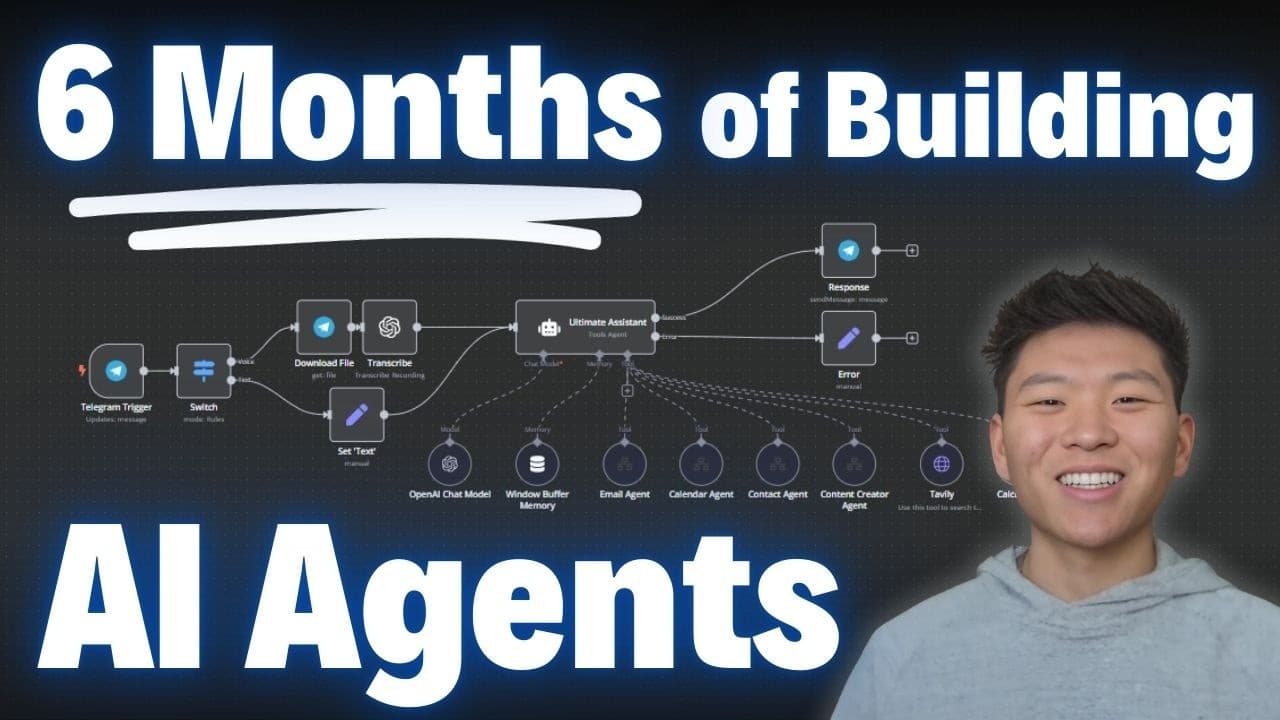
AI agents can be built without coding skills using no-code tools like n8n. Key lessons include understanding the difference between AI agents and workflows, the importance of context and wireframing, and recognizing the limitations of no-code platforms. While AI agents offer dynamic decision-making, most problems can be solved with simpler AI-enhanced workflows.
Transcript
everyone is talking about AI agents right now and we are living in such a cool time because with zero coding background you can get in there and leverage these tools and build some really cool AI systems if you guys don't know me my name is Nate I have zero programming background and around 6 months ago I started experimenting with implementing AI ... Read More
Key Insights
- AI agents and AI workflows are often confused; workflows are sequential, while agents are non-deterministic.
- Building workflows before agents can simplify processes and avoid unnecessary complexity.
- Wireframing before building helps prevent overcomplicated workflows and identifies necessary integrations.
- Context is crucial for AI performance; garbage in equals garbage out.
- Vector databases are not always necessary; structured data often fits better in relational databases.
- Prompting is critical for AI agents; reactive prompting is more effective than proactive prompting.
- Scaling AI agents can introduce issues like hallucinations and retrieval problems, requiring robust testing.
- No-code tools like n8n are powerful but have limitations, especially at scale in enterprise environments.
Install to Summarize YouTube Videos and Get Transcripts
Explore YouTube Video Summarizer or Get YouTube Transcript Extractor
Questions & Answers
Q: How to differentiate between AI agents and AI workflows?
AI agents are non-deterministic, meaning they can choose different paths based on input, whereas AI workflows are sequential and follow a predefined path. Understanding this distinction helps in choosing the right approach for automation tasks, as many problems can be effectively solved with AI-enhanced workflows rather than full-fledged AI agents.
Q: Why is wireframing important before building AI systems?
Wireframing helps in visualizing the entire process before building, preventing overcomplicated workflows and identifying necessary integrations. It serves as a blueprint, breaking down projects into manageable tasks and ensuring all steps and integrations are considered, reducing errors and making the development process more efficient.
Q: What role does context play in AI agent performance?
Context is crucial for AI agents to perform effectively. Without proper context, AI can produce hallucinations, misuse tools, and provide vague responses. Providing detailed context ensures that AI can make informed decisions, leading to more accurate and useful outputs, especially in specific domains with unique business processes.
Q: When should you not use a vector database?
Vector databases are not always necessary, especially for structured data that requires exact retrieval. For structured data, relational databases are more efficient as they allow for precise querying using SQL. Vector databases are better suited for unstructured data, where semantic search capabilities are needed to retrieve information based on meaning rather than exact matches.
Q: What is reactive prompting in AI agents?
Reactive prompting involves starting with minimal prompts and adding instructions based on observed AI behavior. This approach allows for precise adjustments, ensuring that each change made to the prompt is effective and does not introduce new issues. It contrasts with proactive prompting, which uses extensive pre-generated prompts and can lead to complex debugging processes.
Q: What challenges arise when scaling AI agents?
Scaling AI agents can lead to increased hallucinations, retrieval issues, and inconsistent outputs. As the user base grows, the system may face performance bottlenecks and longer response times. Rigorous testing, setting guardrails, and continuous monitoring are essential to ensure the system remains robust and reliable at scale.
Q: What are the limitations of no-code tools like n8n?
No-code tools like n8n are excellent for building workflows quickly without coding, but they have limitations in handling large-scale enterprise solutions. They may struggle with processing massive datasets, secure authentication at scale, and complex tool calling. Combining no-code tools with custom code can provide more robust solutions for large-scale applications.
Q: How can non-programmers build AI automations effectively?
Non-programmers can use no-code tools like n8n to build AI automations by leveraging visual interfaces and pre-built integrations. Learning the fundamentals of workflow automation, understanding the importance of context, and practicing reactive prompting can enhance the effectiveness of AI systems. Joining communities and accessing resources can further support learning and development in AI automation.
Summary & Key Takeaways
-
Building AI agents without coding skills is possible using no-code tools like n8n. It's crucial to differentiate between AI agents and workflows, as many problems can be solved with simpler AI-enhanced workflows. Wireframing before building can prevent overcomplicated designs and identify necessary integrations.
-
Context is vital for effective AI performance. Providing AI with detailed context prevents issues like hallucinations and vague responses. While vector databases are popular, structured data often fits better in relational databases for exact retrieval.
-
Prompting AI agents is an art; reactive prompting is more effective than using pre-generated prompts. Scaling AI agents can introduce challenges such as hallucinations and retrieval problems, necessitating robust testing. No-code tools have limitations, especially in large-scale enterprise environments.
Read in Other Languages (beta)
Share This Summary 📚
Summarize YouTube Videos and Get Video Transcripts with 1-Click
Try YouTube Summary with ChatGPT & Claude or YouTube Transcript Generator
Explore More Summaries from Nate Herk | AI Automation 📚




Summarize YouTube Videos and Get Video Transcripts with 1-Click
Try YouTube Summary with ChatGPT & Claude or YouTube Transcript Generator