Testing and comparing different Peltier coolers - Part 1- Introduction
TL;DR
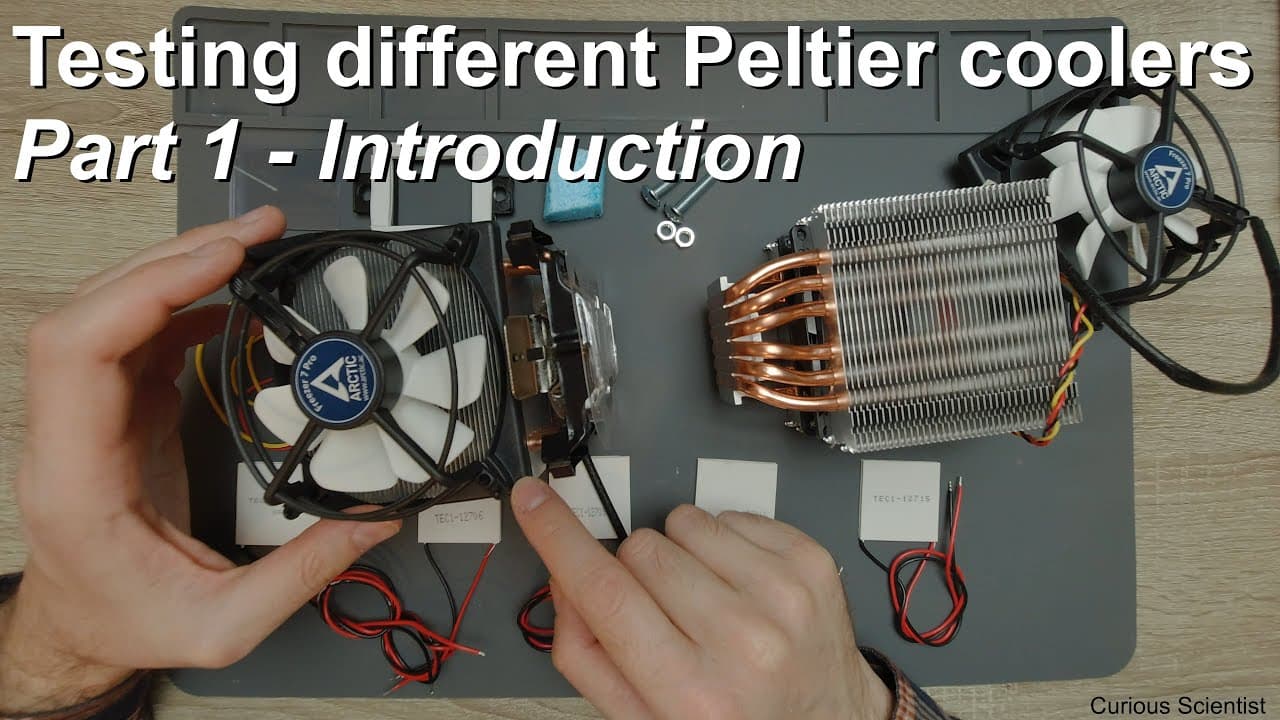
The video introduces a series comparing five thermoelectric coolers' performance and setup.
Transcript
welcome everyone in this video I'm going to start the series where I'm going to compare five different thermoelectric coolers and these five different colors have different performance so people see how they behave and what are the differences so as you can see there are several parts online table so I'm going to explain you what is what so first o... Read More
Key Insights
- 🥵 The choice of using a CPU cooler over water cooling aims at simplifying the experimental setup while still maintaining effective heat dissipation.
- 🥵 Custom engineering of the clamping mechanism represents an innovative approach to maximizing thermoelectric cooler efficiency by reducing heat transfer from the hot to cold side.
- 👻 Varying the current input allows the examination of each cooler's unique performance characteristics, crucial for determining optimal operating conditions.
- 🥶 Analyzing a parabolic relationship between current and cold side temperature could lead to identifying the maximum cooling efficiency for each cooler.
- 😥 Usage of thermocouples at strategic points ensures comprehensive temperature profiling, critical for achieving accurate experimental results.
- 🎮 The series will conclude with a summary video to compare all coolers' performances and highlight the findings from the experiments.
- 😎 It’s important to understand the principle of thermoelectrics, particularly how increasing current improves cooling up to a certain point before reversing effects occur.
Install to Summarize YouTube Videos and Get Transcripts
Explore YouTube Video Summarizer or Get YouTube Transcript Extractor
Questions & Answers
Q: What are thermoelectric coolers and why are they being compared?
Thermoelectric coolers, also known as Peltier devices, are solid-state devices that create a heat flux between the junction of two different types of materials when electric current flows through them. The video compares different models to analyze their cooling capabilities, efficiency, and performance under similar conditions to determine which is most effective for various applications.
Q: Why did the presenter choose to use a CPU cooler for this experiment?
The presenter opted for a CPU cooler instead of traditional water cooling to create a more straightforward and adaptable experimental setup. The CPU cooler can effectively manage heat dissipation by utilizing a fan and heat pipes, providing a controlled environment in which the thermoelectric coolers' performances can be reliably evaluated.
Q: How will the performance of each thermoelectric cooler be measured?
The performance will be assessed by measuring the cold side temperature while applying varying currents. Additionally, a thermocouple will gauge the hot side temperature, while monitoring the cooling efficiency across different operational parameters to generate a parabolic curve, highlighting the maximum cooling points and effective current levels.
Q: What challenges might arise when trying to use thermoelectric coolers for air conditioning?
Using thermoelectric coolers for air conditioning presents challenges, mainly the need for effective heat dissipation from the hot side. If both the cold and hot sides are placed in the same environment, the cooling effect can be negated. Ensuring that heat is adequately vented away from the cooling mechanism is vital for achieving a net cooling effect in a room.
Q: What specific measurements will be taken during the experiment?
The experiment will specifically measure the minimum cold side temperature, current levels (3, 6, 8, 10, and 15 amperes), and the corresponding temperatures using thermocouples at various locations. This data will help plot the efficiency and behavior of each thermoelectric cooler as they operate under different electrical conditions.
Q: What modifications were made to the cooler setup?
Modifications include a custom-clamping mechanism designed to secure the thermoelectric cooler while only gripping the cold side to minimize heat transfer losses. Enhanced insulation and a small air chamber will also be introduced to optimize cooling performance and ensure accurate temperature readings.
Summary & Key Takeaways
-
The video outlines the setup and objectives for testing five different thermoelectric coolers, focusing on performance variations under controlled conditions.
-
A CPU cooler will be employed instead of water cooling, with custom modifications for optimal thermal contact and insulation to improve heat transfer efficiency.
-
Temperature measurements will be extensively recorded to analyze how each cooler behaves at various currents, aiming to determine their effectiveness in a cooling context.
Read in Other Languages (beta)
Share This Summary 📚
Summarize YouTube Videos and Get Video Transcripts with 1-Click
Try YouTube Summary with ChatGPT & Claude or YouTube Transcript Generator
Explore More Summaries from Curious Scientist 📚





Summarize YouTube Videos and Get Video Transcripts with 1-Click
Try YouTube Summary with ChatGPT & Claude or YouTube Transcript Generator