How Does Mindset Affect Health and Longevity?
TL;DR
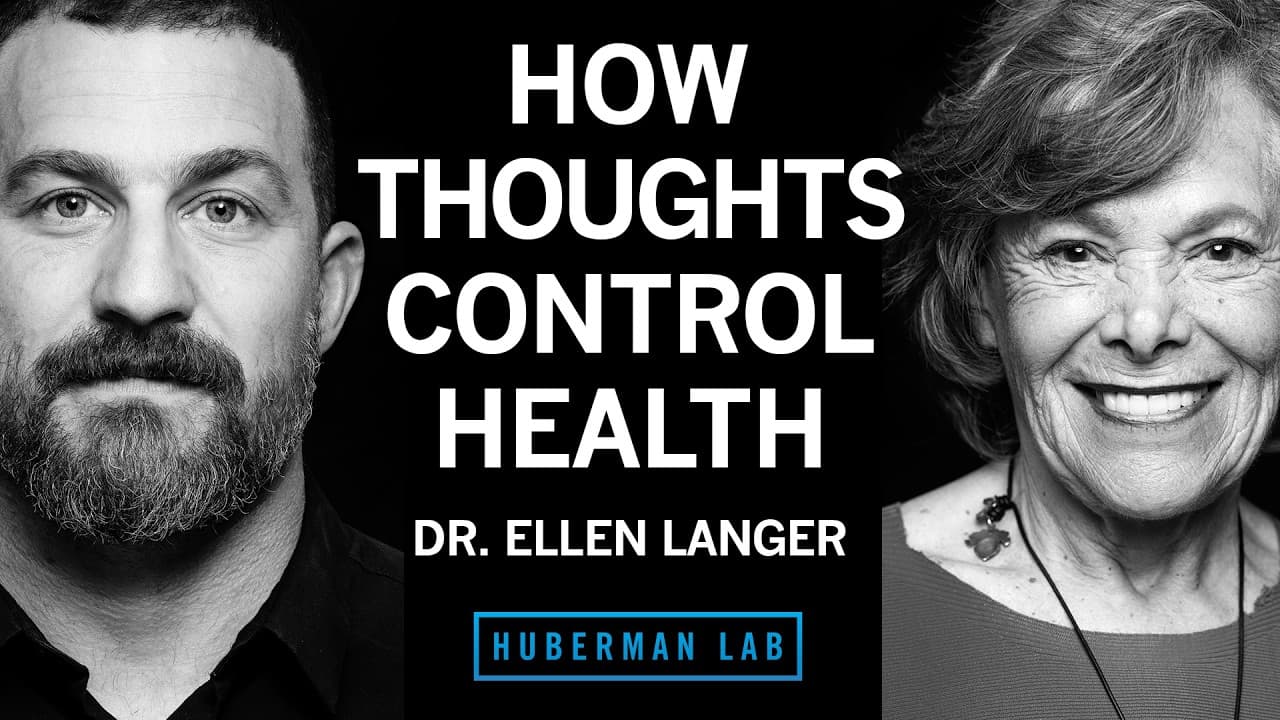
Mindset profoundly influences health and aging, with studies showing that perception and environment changes can enhance physical and cognitive abilities. Dr. Ellen Langer's research highlights mindfulness as active engagement with the world, demonstrating the mind-body connection and the power of belief in determining health outcomes.
Transcript
welcome to the huberman Lab podcast where we discuss science and science-based tools for everyday life I'm Andrew huberman and I'm a professor of neurobiology and Opthalmology at Stanford School of Medicine my guest today is Dr Ellen Langer Dr Ellen Langer is a professor of psychology at Harvard University and one of the world&#... Read More
Key Insights
- Dr. Ellen Langer has pioneered research on the mind-body connection, demonstrating that mindset can significantly impact physical health and aging.
- Her studies show that changing one's environment to reflect a past era can lead to improved mobility, cognitive function, and biological markers in elderly individuals.
- Mindfulness, as defined by Dr. Langer, is not just meditation but a way of actively noticing and engaging with the world around us.
- The perception of control and the act of making choices can enhance longevity and overall health.
- Dr. Langer's research suggests that the placebo and nocebo effects highlight the power of belief and perception in health outcomes.
- She challenges the traditional mind-body dualism, advocating for a unified view where mental states directly influence physical states.
- Dr. Langer's work emphasizes the importance of questioning established norms and embracing uncertainty to foster creativity and personal growth.
- Her studies reveal that perceived sleep quality can influence cognitive and biological functioning more than actual sleep duration.
Install to Summarize YouTube Videos and Get Transcripts
Explore YouTube Video Summarizer or Get YouTube Transcript Extractor
Questions & Answers
Q: What is Dr. Ellen Langer's definition of mindfulness?
Dr. Ellen Langer defines mindfulness as a way of being that involves actively noticing new things, which keeps us engaged and aware. Unlike meditation, which is a practice, mindfulness is about being present and noticing changes, leading to greater awareness and understanding of the world around us.
Q: How does Dr. Langer's research challenge traditional views on aging?
Dr. Langer's research challenges traditional views on aging by showing that mindset and environmental changes can reverse markers of biological aging. Her studies, such as the counterclockwise study, demonstrate that when elderly individuals are placed in environments resembling their past, they show improved physical and cognitive functions.
Q: What role does perception play in health according to Dr. Langer?
According to Dr. Langer, perception plays a crucial role in health. She highlights the placebo and nocebo effects as examples where belief and perception can lead to significant health outcomes. Her research suggests that how we perceive our actions, such as exercise, can influence our physical health and well-being.
Q: How does Dr. Langer view the mind-body relationship?
Dr. Langer views the mind-body relationship as a unified entity rather than separate components. She argues that mental states directly influence physical states, and by changing our mindset, we can alter our physical health. This perspective challenges the traditional dualistic view and emphasizes the interconnectedness of mind and body.
Q: What is the significance of choice in Dr. Langer's research?
Choice is significant in Dr. Langer's research as it is linked to improved health and longevity. Her studies indicate that when individuals have the autonomy to make choices, it leads to greater engagement and control over their lives, which positively impacts their physical and mental health.
Q: How does Dr. Langer's work relate to the placebo effect?
Dr. Langer's work relates to the placebo effect by highlighting the power of belief and perception in health outcomes. She suggests that the effects of placebos demonstrate how our mindset can lead to real physiological changes, underscoring the importance of perception in health and healing.
Q: What is Dr. Langer's perspective on traditional education?
Dr. Langer criticizes traditional education for promoting mindlessness by teaching absolute answers and discouraging questioning and exploration. She advocates for a more mindful approach to education that encourages curiosity, critical thinking, and an understanding of the uncertainty and variability in knowledge.
Q: How does Dr. Langer suggest we approach life's uncertainties?
Dr. Langer suggests approaching life's uncertainties with an open and curious mindset. By embracing uncertainty and questioning established norms, individuals can foster creativity, personal growth, and a deeper understanding of the world. This approach can lead to greater fulfillment and adaptability in life.
Summary & Key Takeaways
-
Dr. Ellen Langer discusses the profound impact that mindset and perception have on health and aging, drawing on her extensive research in the field of psychology. She emphasizes the importance of mindfulness as a means of actively engaging with the world.
-
Through various studies, Dr. Langer demonstrates how altering one's environment and perception can lead to significant improvements in physical and cognitive health, challenging traditional notions of aging and health management.
-
The conversation explores the placebo and nocebo effects, the integration of mind and body, and the potential for personal growth through embracing uncertainty and questioning societal norms.
Read in Other Languages (beta)
Share This Summary 📚
Summarize YouTube Videos and Get Video Transcripts with 1-Click
Try YouTube Summary with ChatGPT & Claude or YouTube Transcript Generator
Explore More Summaries from Andrew Huberman 📚
Summarize YouTube Videos and Get Video Transcripts with 1-Click
Try YouTube Summary with ChatGPT & Claude or YouTube Transcript Generator