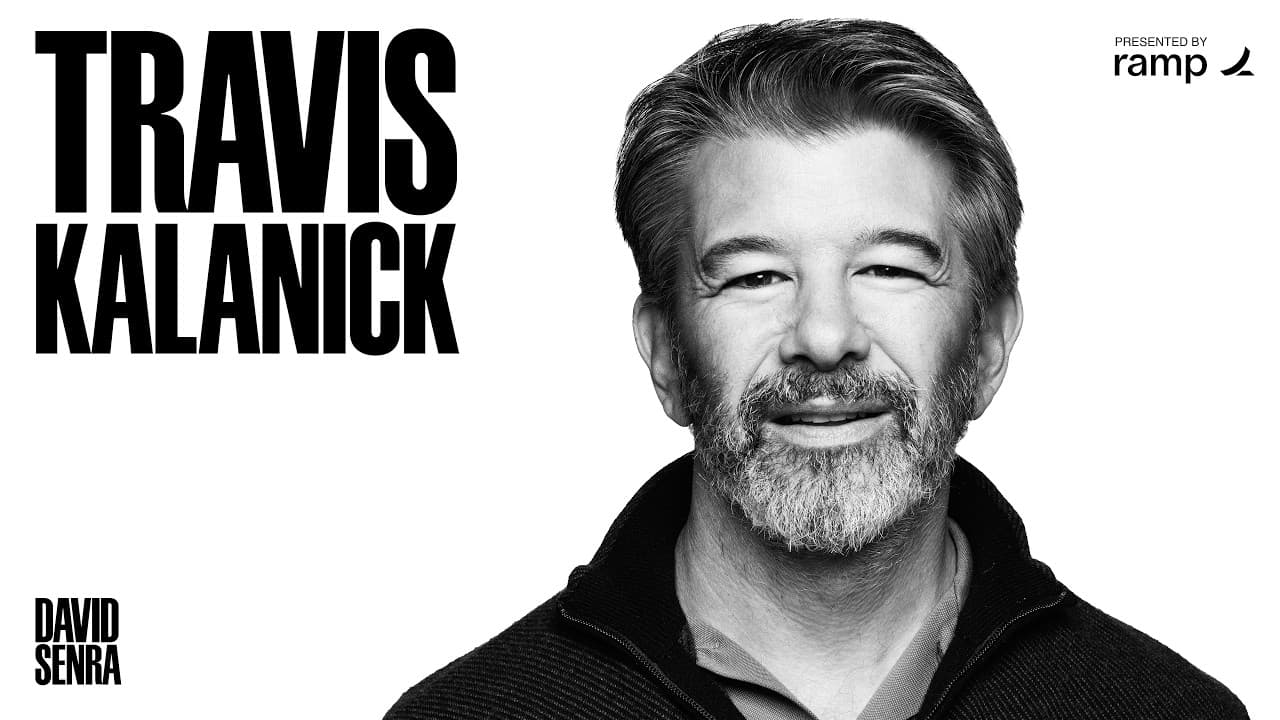
How Does Travis Kalanick Manage Hard Problems?
TL;DR
Organizational ambition depends on keeping problem-solving capacity equal to or greater than the rate at which new problems are created. Travis Kalanick argues that leaders should pursue difficult but possible challenges, predict their delayed consequences, expand management capacity, and temporarily slow expansion whenever unresolved problems threaten to overwhelm the organization.
Transcript
I want to start with Adams. >> Yeah. >> You have this great line on the website that I actually love. It's this awesome sentence. It says, "Physical world autonomy requires AI for the physical world. This kind of intelligence requires computation we haven't invented at an efficiency we can't yet fathom with deep learning models to understand and ac... Read More
Key Insights
- Management capacity is the practical limit on how much of a founder's imagination can become real. When leaders must personally solve numerous small problems, they cannot pursue as many ambitious possibilities, while a deeper organization expands the amount of complexity the company can handle.
- The meta problem is keeping the rate of problem solving equal to or above the rate of problem creation. If an organization creates challenges faster than it resolves them, unresolved complexity accumulates until the company is overwhelmed and must reduce its pace.
- Expansion is a deliberate act of problem creation rather than a purely positive milestone. Entering a country such as China creates interesting challenges, but leaders must estimate both the nature of those challenges and the organization's future capacity to address them.
- The consequences of strategic decisions can take six months or longer to arrive heavily. Leaders therefore need to predict future operational demands before those demands become obvious, rather than judging a decision only by the manageable workload visible at launch.
- A sustainable response to overloaded management capacity is to pause the creation of new problems. The organization can resume expansion after its problem-solving rate recovers, preventing existing obligations from becoming an unmanageable flood of unresolved work.
- Uber's China expansion required starting the business again in important respects. Even foundational infrastructure such as GPS worked differently, and that difference was only one among roughly a hundred factors that prevented the company from simply transferring its established operating model.
- Specialized robotics is Adams's chosen approach to physical automation. The company intends to combine robotics and AI to transform one industry at a time, instead of offering general robots to any customer or focusing on humanoid machines.
- Infectious enthusiasm for hard problems is the meaning Kalanick assigns to being super pumped. He is especially attracted to challenges perceived as impossible, while distinguishing between problems that merely look impossible and those that are genuinely difficult but still possible.
- More videos with Travis Kalanick:
Install to Summarize YouTube Videos and Get Transcripts
Explore YouTube Video Summarizer or Get YouTube Transcript Extractor
Questions & Answers
Q: How does Travis Kalanick define the meta problem?
The meta problem is the requirement that an organization's rate of problem solving remain equal to or greater than its rate of problem creation. A company creates problems whenever it launches ambitious initiatives, such as entering a new country. If those challenges accumulate faster than management can resolve them, the organization becomes overwhelmed and must stop adding new work until its solving capacity catches up.
Q: Why is management capacity important for ambitious founders?
Management capacity determines how much of a founder's imagination can be translated into reality. A leader who must personally handle many small issues has limited attention for larger possibilities. Building a team with substantial problem-solving ability removes some of that constraint, allowing the organization to operate across more initiatives and manage the complexity produced by broader ambitions.
Q: When should a company slow or stop expanding?
A company should slow the creation of new challenges when its problem-solving rate falls below its problem-creation rate. Kalanick says leaders must recognize when the equation is out of balance and pause expansion while the organization catches up. This prevents unresolved obligations from continuing to accumulate and gives management time to restore enough capacity for sustainable growth.
Q: Why can the problems from expansion appear months later?
The full nature of a strategic decision is not always visible when the decision is made. Kalanick says created problems may begin coming ashore heavily around six months later, or even beyond that point. Leaders therefore must predict what kinds of operational demands an initiative will generate and whether their future management capacity will be sufficient when those demands arrive.
Q: Why did Uber have to start over when entering China?
Uber discovered that taking its business to China meant rebuilding many essential elements instead of simply transferring its existing system. Kalanick cites the country's different GPS system as one example because tracking cars through physical space required technical changes. He says that difference was one among roughly a hundred factors that made China effectively a new business requiring openness to unfamiliar methods.
Q: What is Adams building with robotics and AI?
Adams is pursuing physical automation intended to transform industries through specialized robotics and AI. Kalanick says the company is not focused on humanoid robots and is not building generic robotics for anyone who wants them. Its approach is to target one industry at a time, make a substantial impact there, gain experience, and then move into additional industries.
Q: What does being super pumped mean to Travis Kalanick?
Being super pumped means showing infectious enthusiasm for hard challenges. Kalanick says increasingly difficult, unusual, or complicated problems become more exciting because solving them would be more meaningful. He is particularly drawn to tasks other people call impossible, although he distinguishes easy problems that only appear impossible from problems that are truly difficult but remain achievable.
Q: How did Uber balance local independence with central control?
Uber empowered young operators to build individual markets from scratch while retaining close control over decisions that mattered most. Kalanick personally joined the pricing process for the company's first 20 to 30 cities. Each launch helped refine a repeatable playbook that could eventually function without him, reflecting his goal of finding a workable boundary between order and chaos.
Summary & Key Takeaways
-
Kalanick describes Adams as a company pursuing physical automation through specialized robotics and AI. Instead of producing general humanoid robots, it plans to transform industries one at a time. Its potential scope depends on management capacity, because every ambitious move creates operational problems that capable teams must eventually solve.
-
His central management framework compares the rate of problem solving with the rate of problem creation. Expansion remains sustainable only while solving capacity keeps pace. Because the true consequences of a decision may arrive months later, leaders must predict future demands and stop creating additional problems when their organizations begin falling behind.
-
Uber's entry into China demonstrated why expansion can require rebuilding a business rather than copying an existing model. Differences included the country's GPS system and many other operating conditions. Kalanick says entrepreneurs must approach such environments ready to learn, adapt, and become interested in doing things differently from the beginning.
Read in Other Languages (beta)
Share This Summary 📚
Summarize YouTube Videos and Get Video Transcripts with 1-Click
Try YouTube Summary with ChatGPT & Claude or YouTube Transcript Generator
Explore More Summaries from David Senra 📚





Summarize YouTube Videos and Get Video Transcripts with 1-Click
Try YouTube Summary with ChatGPT & Claude or YouTube Transcript Generator