How to Use the Passive Voice in English Grammar
TL;DR
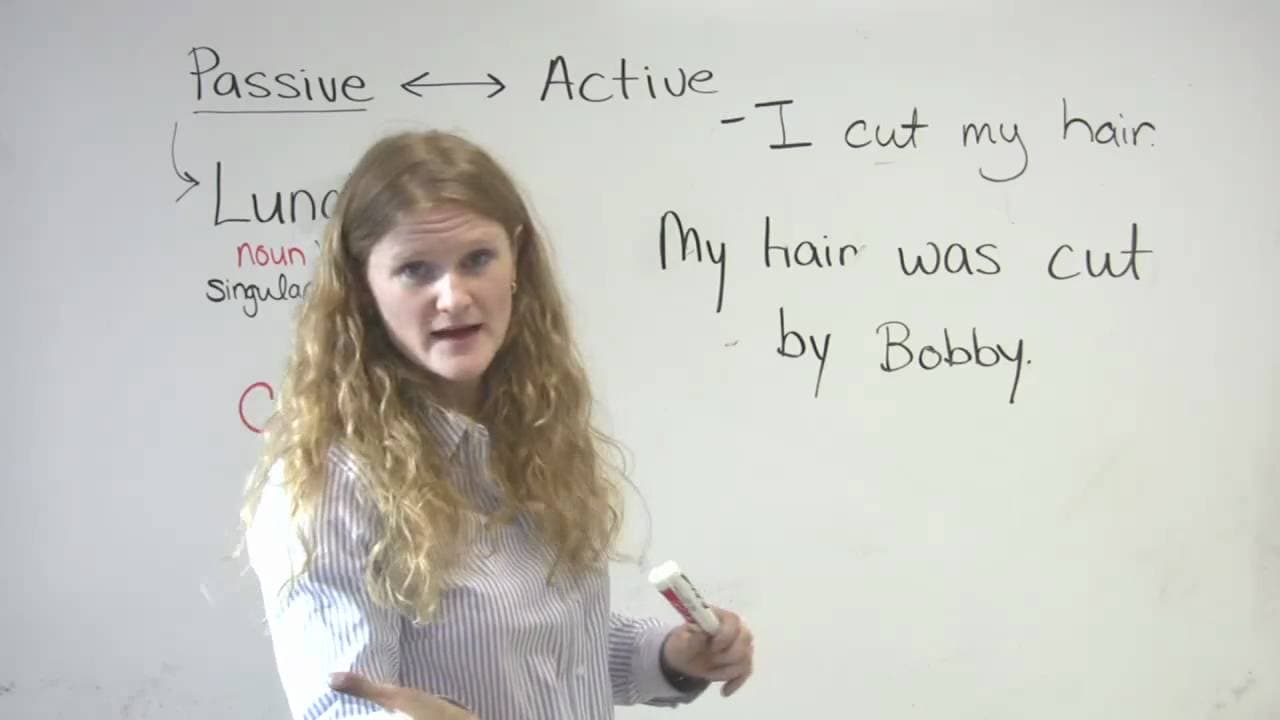
To use the passive voice in English, restructure the sentence to focus on the action rather than the subject by changing the verb and noun positions, often eliminating the subject. Form a passive sentence by using the verb 'to be' plus the past participle of the main verb, like 'was eaten' or 'were cut'. This structure emphasizes the action, making it useful when the doer is unknown or irrelevant.
Transcript
Hi there, my name is Ronnie and today English is going to be taught by me. I'm going to teach you English. This is going to be a grammar lesson. Everyone shudder. Not grammar. It is. I think this is a very difficult, hard to understand lesson. I don't want to teach. I give up. I'll try. Okay. Today we're going to learn about passive. The opposite o... Read More
Key Insights
- ❓ Passive sentences focus on the action rather than the subject.
- 🧘 Verb and noun positions are changed in passive sentences.
- 💁 The past participle form of the verb is used in passive sentences.
- ❓ The passive voice is used when we want to hide the doer or when it's not important.
- 😒 Plural nouns in passive sentences require the use of "were."
- 😒 "Cut" is a verb that remains the same in all forms, making it easy to use in passive sentences.
- 💇 The passive voice is commonly used when talking about getting a haircut or any action done by someone else.
Install to Summarize YouTube Videos and Get Transcripts
Explore YouTube Video Summarizer or Get YouTube Transcript Extractor
Questions & Answers
Q: What is the difference between active and passive sentences?
Active sentences focus on the subject performing the action, while passive sentences focus on the action itself without mentioning the doer.
Q: How do you form a passive sentence?
To form a passive sentence, start with the noun, use the appropriate form of the verb "to be" (e.g., "was"), and follow it with the past participle of the main verb.
Q: When should we use the passive voice?
The passive voice is used when we don't want to mention the person performing the action, don't know who it is, or when the doer is not important to the message.
Q: How can we indicate who performed the action in a passive sentence?
To indicate who performed the action in a passive sentence, you can add "by" followed by the doer or person responsible.
Summary & Key Takeaways
-
Passive sentences are used when we want to focus on the action rather than the subject.
-
To form a passive sentence, the verb and noun positions are changed, and the subject is often eliminated.
-
The past participle form of the verb is used, along with the verb "to be" (e.g., "was" + past participle).
Read in Other Languages (beta)
Share This Summary 📚
Summarize YouTube Videos and Get Video Transcripts with 1-Click
Try YouTube Summary with ChatGPT & Claude or YouTube Transcript Generator
Explore More Summaries from English with Ronnie · EnglishLessons4U with engVid 📚






Summarize YouTube Videos and Get Video Transcripts with 1-Click
Try YouTube Summary with ChatGPT & Claude or YouTube Transcript Generator