Mixed-Member Proportional Representation Explained
TL;DR
Mixed-Member Proportional representation combines local elections with a party vote, then adds party members until the council reflects voters’ overall preferences as closely as possible. In Queen Lion’s example, MMP doubles the council’s seats and gives each citizen two votes, correcting a result where Tuatara won 100% of seats with 49% support. Read on to see how local seats, party lists, and strategic voting work.
Transcript
Queen Lion of the animal kingdom is looking to improve her democracy. She recently allowed citizens to elect representatives to the Jungle Council which governs the kingdom. However, she recognizes that her citizens are not happy with the voting system. Let’s watch an election on one of the small islands of her Kingdom to see why: On this island th... Read More
Key Insights
- 🪡 Queen Lion recognizes the need to improve the voting system in her kingdom for better democracy.
- ❓ The First Past the Post system can result in the majority of citizens not being represented, causing discontent.
- 🤢 MMP allows for representation of various parties and improves the proportional distribution of seats in the council.
- 🥳 Citizens can strategically vote for local representatives while freely voting for their preferred political parties.
- 🥳 The list system in MMP gives political parties more control over the election process.
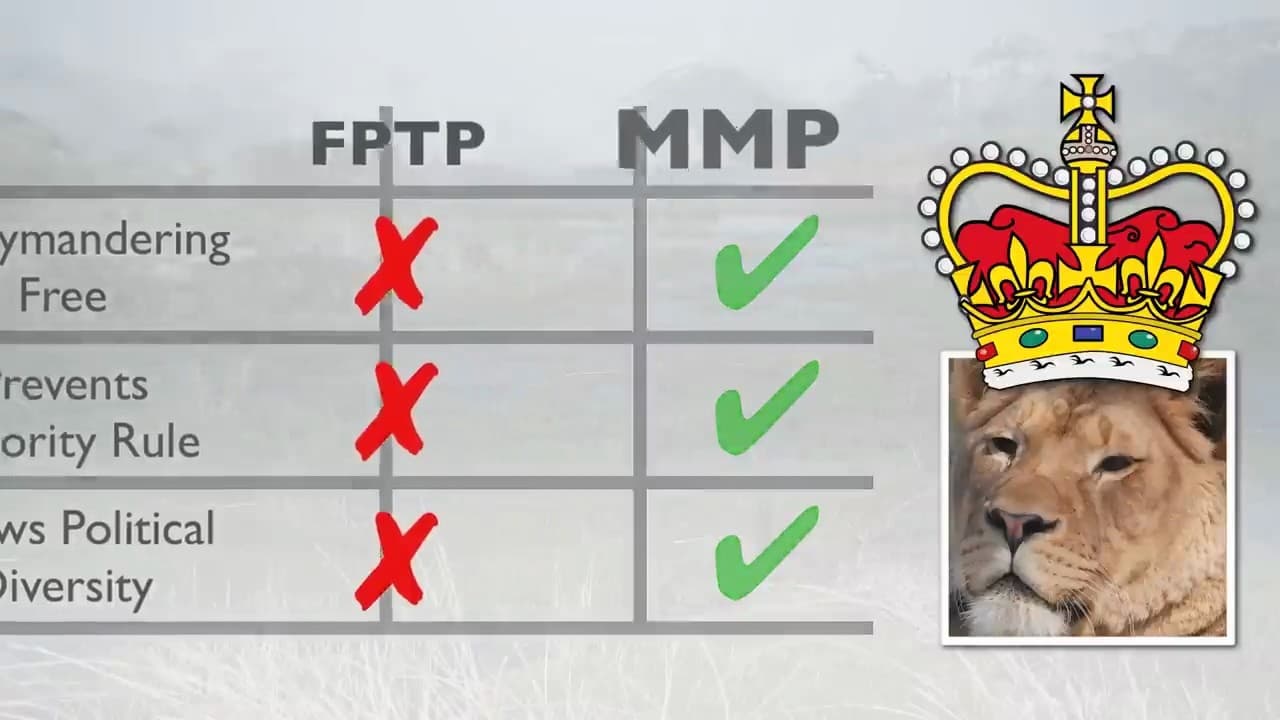
- 🥳 MMP eliminates gerrymandering and prevents minority parties from gaining excessive power.
- ❓ Queen Lion decides to adopt MMP as it better reflects the preferences of her citizens.
Install to Summarize YouTube Videos and Get Transcripts
Explore YouTube Video Summarizer or Get YouTube Transcript Extractor
Questions & Answers
Q: How does Mixed-Member Proportional representation work?
MMP gives each citizen two votes: one for a local candidate and one for a political party. Local candidates with the most votes win their ranges, while additional party members are added one at a time until the council is as proportional as possible to the overall party vote.
Q: Why was First Past the Post considered unfair in Queen Lion’s election?
Tuatara received 49% of the island-wide vote but won every local range, giving it 100% of the council seats. The 51% who voted for Kea or Kakapo received no council representation.
Q: What two changes does MMP make to the election system?
The number of council seats is doubled, and every citizen receives two votes instead of one. One vote selects a local representative, while the other measures support for a political party.
Q: How are the additional council seats allocated under MMP?
The party votes reveal how closely the existing council matches citizens’ overall preferences. Members are then added one at a time for underrepresented parties; in the example, Kea receives seats until Kakapo becomes the underrepresented party and receives the final seat.
Q: Who chooses the party members who fill the extra seats?
Before the election, each political party ranks its preferred candidates on a list. If the party receives one extra seat, its top-listed candidate is chosen; if it receives two, the first two candidates are chosen.
Q: What disadvantage of MMP does the explanation identify?
MMP makes political parties an official part of the election process through their candidate lists. This may give party leaders greater control because they can reward or punish members by changing their positions on the list.
Q: What benefits does MMP provide according to Queen Lion’s example?
Because fewer votes are wasted, MMP mostly eliminates gerrymandering and prevents minority rule. It also encourages political diversity and gives citizens more choice by allowing support for smaller parties to count toward council representation.
Q: Why might citizens vote differently for a local candidate and a political party?
Citizens may vote strategically in a local race when their preferred candidate has little chance of winning. Kakapo supporters, for example, may choose Kea locally to oppose Tuatara but still use their party vote for Kakapo because more party votes produce more council representatives.
Summary & Key Takeaways
-
Queen Lion allows citizens to elect representatives to the Jungle Council but realizes they are unhappy with the voting system.
-
On an island in her kingdom, an election using the First Past the Post system results in the majority of citizens not being represented.
-
Kiwi suggests using MMP, where citizens have two votes and additional seats are added to the council to make it more proportional.
Read in Other Languages (beta)
Share This Summary 📚
Summarize YouTube Videos and Get Video Transcripts with 1-Click
Try YouTube Summary with ChatGPT & Claude or YouTube Transcript Generator
Explore More Summaries from CGP Grey 📚



Summarize YouTube Videos and Get Video Transcripts with 1-Click
Try YouTube Summary with ChatGPT & Claude or YouTube Transcript Generator