How Does the Interstate Highway Numbering System Work? The Interstate's Forgotten Code
TL;DR
The Interstate numbering system reveals a highway’s general direction, location, and relationship to other routes. Major east-west routes end in zero, major north-south routes end in five, and three-digit Minors inherit their parent route’s last two digits. Their first digit also distinguishes returning routes from Spurs. Read on for examples, exceptions, and duplicate route numbers.
Transcript
The interstate highway shields hide within them long forgotten knowledge. As our great ancestors could navigate by the signs in the sky before the creation of the compass, so too before GPS could they navigate by these signs. Come with me and learn how to navigate the constellations created across a continent by the First, are the Interstate Major... Read More
Key Insights
- #️⃣ Interstate Majors are represented by double-digit numbers, with even numbers indicating east-west routes and odd numbers indicating north-south routes.
- 👪 Interstate Minors have three-digit numbers and can either connect back to their parent Major or continue as a spur without connecting back.
- ❓ Some exceptions and inconsistencies exist within the interstate numbering system.
- ❓ Interstates can be categorized as interstate interstates, intrastate interstates, bypasses, beltways, or spurs.
- #️⃣ The interstate system includes duplicate numbers for some Minors and Mediums to accommodate multiple routes in densely populated areas.
- 🦕 Long Island's Interstate 495 is technically an exception and should start with an odd digit, not an even one.
- 🎅 San Francisco's Interstate 238 does not follow the traditional bypass numbering pattern.
- #️⃣ There are one-off numbers and exceptions within the interstate system, such as Interstate 35 splitting into multiple branches.
- ❓ The numbering system of Interstate 69 is unique, featuring split routes and a separate designation.
- 🤘 Some smaller interstates, such as Interstate 878, may not have signs and can be challenging to locate.
Install to Summarize YouTube Videos and Get Transcripts
Explore YouTube Video Summarizer or Get YouTube Transcript Extractor
Questions & Answers
Q: How does the Interstate highway numbering system work?
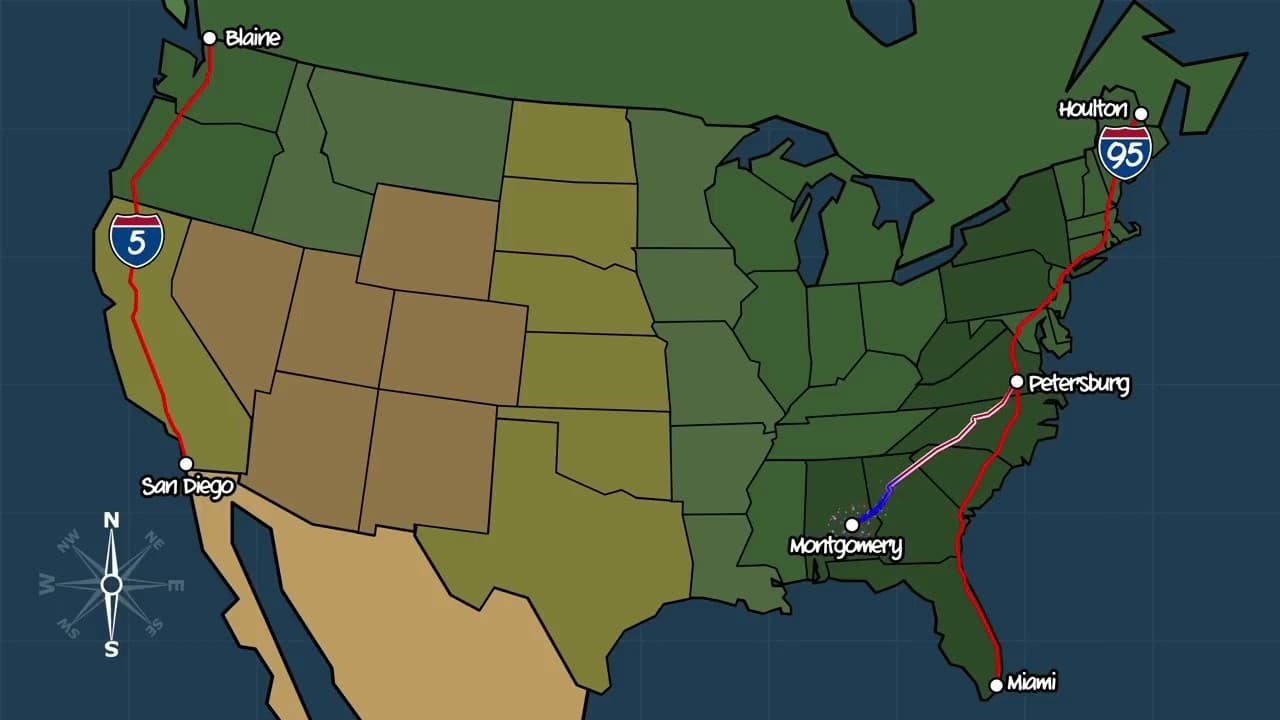
Interstate Majors generally use two-digit numbers, with east-west routes ending in zero and north-south routes ending in five. Lower numbers indicate farther south or west, while higher numbers indicate farther north or east.
Q: What do the numbers on east-west Interstate Majors mean?
East-west Interstate Majors end in zero, and their numbers increase toward the north. I-10 is the southernmost example given, while I-90 is the northernmost and longest.
Q: Why are there no Interstates I-50 and I-60?
The Department of Transportation skipped I-50 and I-60 because US Routes 50 and 60 already occupied the middle of the country. The omission was intended to prevent travelers from confusing Interstate numbers with US Route numbers.
Q: How are north-south Interstate Majors numbered?
North-south Interstate Majors generally end in five, and their numbers increase toward the east. I-5 runs along the opposite coast from I-95, although I-5 is an exception to the claim that every Major has two digits.
Q: What is the only intrastate Interstate Major?
I-45, running from Houston to Dallas, is identified as the only Interstate Major contained within one state. The transcript emphasizes that an Interstate does not have to cross a state boundary.
Q: How do three-digit Interstate Minors relate to their parent highway?
An Interstate Minor diverges from a Major and uses the parent Major’s number as its last two digits. For example, I-670 branches from I-70 around Kansas City and later reconnects with it.
Q: What does the first digit of a three-digit Interstate mean?
An even first digit indicates that the Minor eventually reconnects with its parent Major, often as a Bypass or Beltway. An odd first digit identifies a Spur that does not reconnect with its parent, such as I-190 diverging from I-90 near Buffalo.
Q: Can two Interstate highways have the same number?
Interstate Majors are uniquely numbered, but Mediums can have duplicate numbers. The transcript gives two I-76 routes and identifies duplicate I-84, I-86, I-87, and I-88 routes between I-80 and I-90.
Summary & Key Takeaways
-
Definition: Interstate Majors generally use two-digit numbers and provide the main national numbering framework.
-
Definition: East-west Interstate Majors end in zero, while north-south Majors end in five.
-
Compare: Lower route numbers indicate farther south and west, while higher numbers indicate farther north and east.
-
Who: The Department of Transportation skipped I-50 and I-60 to avoid confusion with US Routes 50 and 60.
-
Definition: Interstate Mediums use the same even east-west and odd north-south pattern as Majors.
-
Definition: Interstate Minors use three digits, with the final two matching the parent Major.
-
Compare: An even first digit signals a returning Bypass or Beltway, while an odd first digit signals a non-returning Spur.
-
Definition: I-670 leaves I-70 around Kansas City and later reconnects with its parent route.
-
Definition: I-190 diverges from I-90 near Buffalo and continues without returning to its parent.
-
Compare: Interstate Majors have unique numbers, while Mediums can have duplicate numbers.
-
Definition: I-45 runs from Houston to Dallas and is the only Interstate Major described as intrastate.
-
Definition: I-99 breaks the normal geographic ordering because Congress specifically selected its number.
Read in Other Languages (beta)
Share This Summary 📚
Summarize YouTube Videos and Get Video Transcripts with 1-Click
Try YouTube Summary with ChatGPT & Claude or YouTube Transcript Generator
Explore More Summaries from CGP Grey 📚






Summarize YouTube Videos and Get Video Transcripts with 1-Click
Try YouTube Summary with ChatGPT & Claude or YouTube Transcript Generator