How to Lead with Purpose and an Infinite Mindset
TL;DR
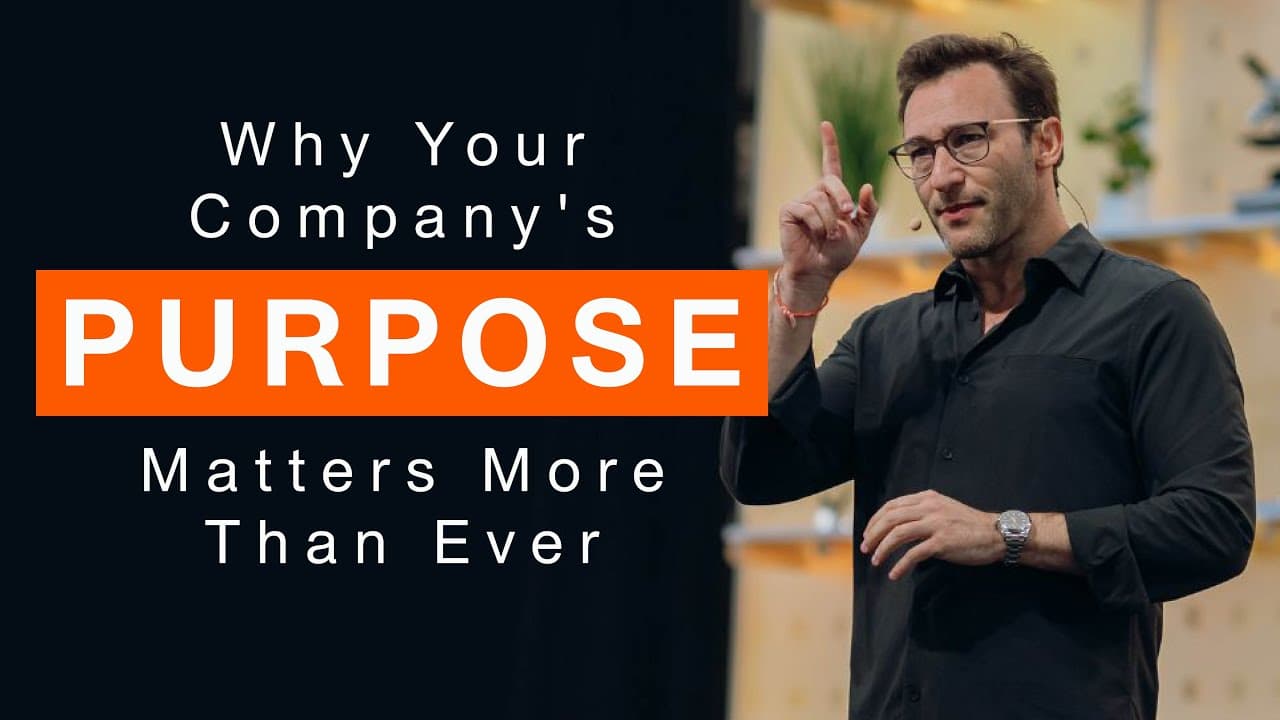
Purpose-driven leadership requires making decisions that advance the stated purpose, even when doing so creates short-term financial risk. Leaders can build stronger organizations by adopting an infinite mindset, empowering others through repeated practice, judging progress by long-term momentum, and treating optimism as confidence in a future people can build together.
Transcript
it is now time uh for me to introduce the final session um of day one and uh um the person who we have joining us is Simon cynic uh Simon is an unshakable optimist he believes in a bright future and our ability to build it together described as a Visionary thinker with a rare intellect Simon has devoted his professional life to help Advance a visio... Read More
Key Insights
- A purpose statement is meaningful only when an organization makes decisions that actively advance it. If leaders promote a purpose publicly but refuse to accept any cost, risk, or operational consequence associated with it, the statement functions as marketing rather than a genuine guide for the business.
- CVS aligned its actions with its health-focused purpose by removing every pack of cigarettes from its stores. Wall Street criticized the decision and the company surrendered billions of dollars in cigarette sales, but employee pride rose, average sales increased, and the stock price eventually recovered.
- Business is an infinite game with known and unknown participants, changeable rules, and no permanent winner. New competitors can enter, organizations can operate differently, and the practical objective is to remain capable of participating rather than reaching an imaginary final victory.
- A finite mindset in business focuses on being number one, beating competitors, and meeting agreed metrics within fixed time frames. Applying that mindset to a game without a finish line produces predictable declines in trust, cooperation, and innovation across the organization.
- An infinite mindset measures progress through direction and momentum rather than isolated targets. Goals remain useful, but missing a particular target does not define the organization when its broader trajectory is improving and its leaders remain committed to long-term health.
- Organizational dependence on one highly capable leader or specialist is a structural weakness. When leaders keep doing every important task because they believe they can do it better, they prevent others from developing and leave the business vulnerable whenever that individual is unavailable.
- Team empowerment requires allowing people to struggle, practice, and improve. In the submarine example, the captain resisted returning an essential parking task to the original expert after another crew member performed poorly, enabling additional people to become capable through repetition.
- Optimism is presented as belief in a brighter future and in people's ability to build that future together. Within leadership, this perspective supports patience, learning, growth, empowerment, and continued action when organizations face cultural, technological, or operational change.
Install to Summarize YouTube Videos and Get Transcripts
Explore YouTube Video Summarizer or Get YouTube Transcript Extractor
Questions & Answers
Q: How can leaders make corporate purpose meaningful?
Leaders make corporate purpose meaningful by using it as a practical standard for consequential decisions. A purpose becomes credible when the organization accepts real financial, operational, or reputational risk to uphold it. If executives repeatedly choose short-term numbers over the principles displayed in their purpose statement, employees and customers can see that the statement is marketing rather than an operating commitment.
Q: What is the difference between finite and infinite games?
A finite game has known players, fixed rules, an agreed objective, and a defined beginning, middle, and end. A winner necessarily implies a loser. An infinite game can include known and unknown players, allows new participants to join, and has changeable rules. Its objective is not final victory, but continuing to participate for as long as possible.
Q: Why should businesses adopt an infinite mindset?
Businesses should adopt an infinite mindset because business has no permanent winner or final finish line. Companies enter and leave the market, competitors change, and every organization can choose how it operates. Treating business like a finite contest encourages leaders to sacrifice organizational health for temporary victories, which can reduce trust, cooperation, and innovation.
Q: Can a company pursue targets while using an infinite mindset?
A company can still set goals and targets while operating with an infinite mindset. The important distinction is that a target is a measure of progress, not the final definition of victory. Organizations will sometimes hit their targets and sometimes miss them. Leaders should also examine momentum, long-term direction, cultural health, and the ability to remain in the game.
Q: How did removing cigarettes support CVS's purpose?
CVS said its purpose involved caring for customers and protecting their health, yet it continued selling cigarettes. The company resolved that contradiction by removing every pack of cigarettes from every store. Although Wall Street criticized the decision and cigarette sales represented billions of dollars, smoking declined in communities with many CVS stores, employee morale rose, and average sales increased.
Q: How can leaders become comfortable empowering their teams?
Leaders can become more comfortable with empowerment by recognizing that personal control creates organizational dependence. A leader may perform a task better today, but continually taking it back prevents other people from developing. Leaders need to let team members attempt important work, tolerate imperfect early results, and provide enough repeated opportunities for those individuals to become genuinely capable.
Q: Why is relying on one expert risky for an organization?
Relying on one expert makes an essential capability vulnerable to that person's absence. David Marquet's submarine had one crew member who was exceptionally skilled at parking it, but the captain recognized the problem if that person became unavailable. Training a second and then a third person created a stronger bench and made the operation less dependent on one individual.
Q: What does optimism mean in purpose-driven leadership?
Optimism means believing that a brighter future is possible and that people have the ability to build it together. In the leadership themes presented, optimism supports patient investment in people, continued learning, and action through change. It is connected to creating workplaces where people can feel inspired, safe, and fulfilled by the work they perform.
Summary & Key Takeaways
-
A corporate purpose has value only when leaders use it to make consequential decisions. CVS demonstrated this by removing cigarettes from its stores despite Wall Street criticism and the loss of billions of dollars in cigarette sales. The decision supported its health-focused purpose, strengthened employee pride, and ultimately benefited the business.
-
Business is an infinite game because participants can enter at any time, rules can change, and there is no final winner. Leaders who impose finite objectives on business can weaken trust, cooperation, and innovation. An infinite mindset instead emphasizes organizational health, cultural strength, patience, momentum, and the ability to continue playing.
-
Empowerment requires leaders to stop making the organization dependent on their personal ability. David Marquet's submarine example shows why teams need more than one expert for an essential task. Allowing another person to practice repeatedly, even after poor early attempts, builds competence, creates a deeper bench, and makes the organization more resilient.
Read in Other Languages (beta)
Share This Summary 📚
Summarize YouTube Videos and Get Video Transcripts with 1-Click
Try YouTube Summary with ChatGPT & Claude or YouTube Transcript Generator
Explore More Summaries from Simon Sinek 📚





Summarize YouTube Videos and Get Video Transcripts with 1-Click
Try YouTube Summary with ChatGPT & Claude or YouTube Transcript Generator