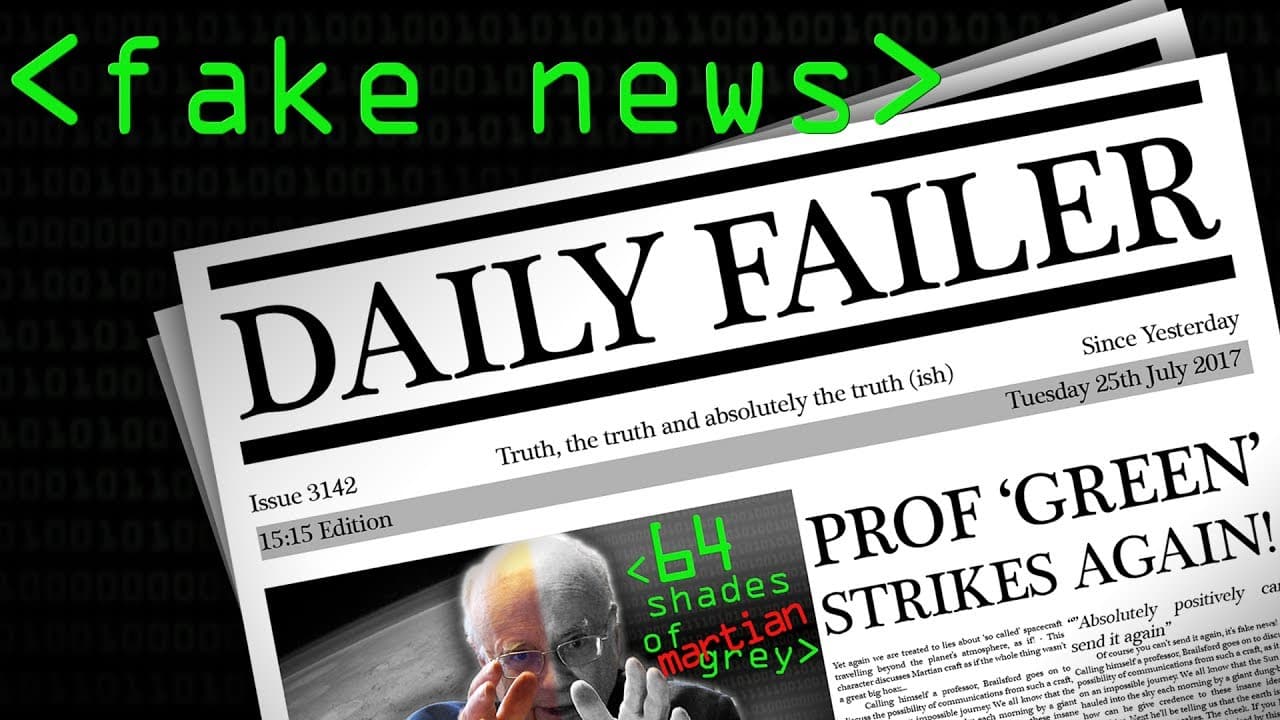
How Do People Distinguish Fake News Online?
TL;DR
People primarily judge news articles based on their titles and sources, making quick decisions about credibility. Eye-tracking research highlights the importance of technology in supporting news verification while also pointing to the need for community-driven solutions and user education to combat the spread of fake news.
Transcript
we're interested in sort of the intersection between humans and computers no human connection with interact and the part of my junior are meeting various researchers I met with Christian and immediately sort of identified some natural research interests that we shared it's been a an interesting encounter of computer scientists that's certainly not ... Read More
Key Insights
- 👾 The study aims to understand how people verify news in the context of social media and the digital space, highlighting the importance of interdisciplinary research.
- 🤨 Eye-tracking experiments reveal that individuals tend to judge news articles based on the title and source, raising the need for tools and algorithms to determine credibility.
- 😒 The research suggests the use of algorithms to assess news articles for fake indicators, but challenges regarding bias and trustworthiness remain.
- 📰 Incorporating social indicators in news verification could foster community-driven efforts to evaluate the credibility of news articles.
- 📰 The study emphasizes the role of technology in supporting individuals' ability to verify news, but also recognizes that user education and critical thinking are vital in combating fake news.
- 📰 Fake news is not a new phenomenon, but the speed and ease of sharing information via technology have amplified its impact.
- 🤨 The research raises questions about the responsibility of social media platforms in combating fake news and the potential biases of those reviewing articles.
Install to Summarize YouTube Videos and Get Transcripts
Explore YouTube Video Summarizer or Get YouTube Transcript Extractor
Questions & Answers
Q: How did the researchers approach studying people's understanding of news?
The researchers first conducted a survey to gain a broader understanding of how individuals perceive news. They then conducted interviews and utilized eye-tracking technology to analyze how participants interacted with a fake news feed on a simulated Facebook page.
Q: What criteria do people use to make judgments about news articles?
Participants primarily made initial judgments based on the article's title and the source. They would then consider additional factors such as the content, date, and author to verify the article's credibility.
Q: Can technology play a role in identifying fake news?
Yes, the researchers propose using algorithms to assess news articles based on various criteria, such as the source and content, and labeling them with indicators of credibility or fakeness. However, determining trustworthy algorithms and presenting the information effectively to readers pose challenges.
Q: How can social indicators be incorporated into news verification?
The researchers suggest enabling a community-driven approach where individuals can engage in conversations and contribute different sources to verify news articles. This could involve social indicators showing the percentage of people who believe an article to be true.
Summary & Key Takeaways
-
Researchers explore the intersection of computer science and sociology in a study on how people interact with fake news.
-
They conduct a descriptive survey to understand people's understanding of news and engage in qualitative work, including interviews and eye-tracking experiments, to delve deeper into their decision-making processes.
-
Key findings include the tendency for people to quickly judge news articles based on the title and source, emphasizing the need for tools and algorithms to help verify the veracity of news content.
Read in Other Languages (beta)
Share This Summary 📚
Summarize YouTube Videos and Get Video Transcripts with 1-Click
Try YouTube Summary with ChatGPT & Claude or YouTube Transcript Generator
Explore More Summaries from Computerphile 📚





Summarize YouTube Videos and Get Video Transcripts with 1-Click
Try YouTube Summary with ChatGPT & Claude or YouTube Transcript Generator