How to Build a Simple Emailer Using Go and SQLite
TL;DR
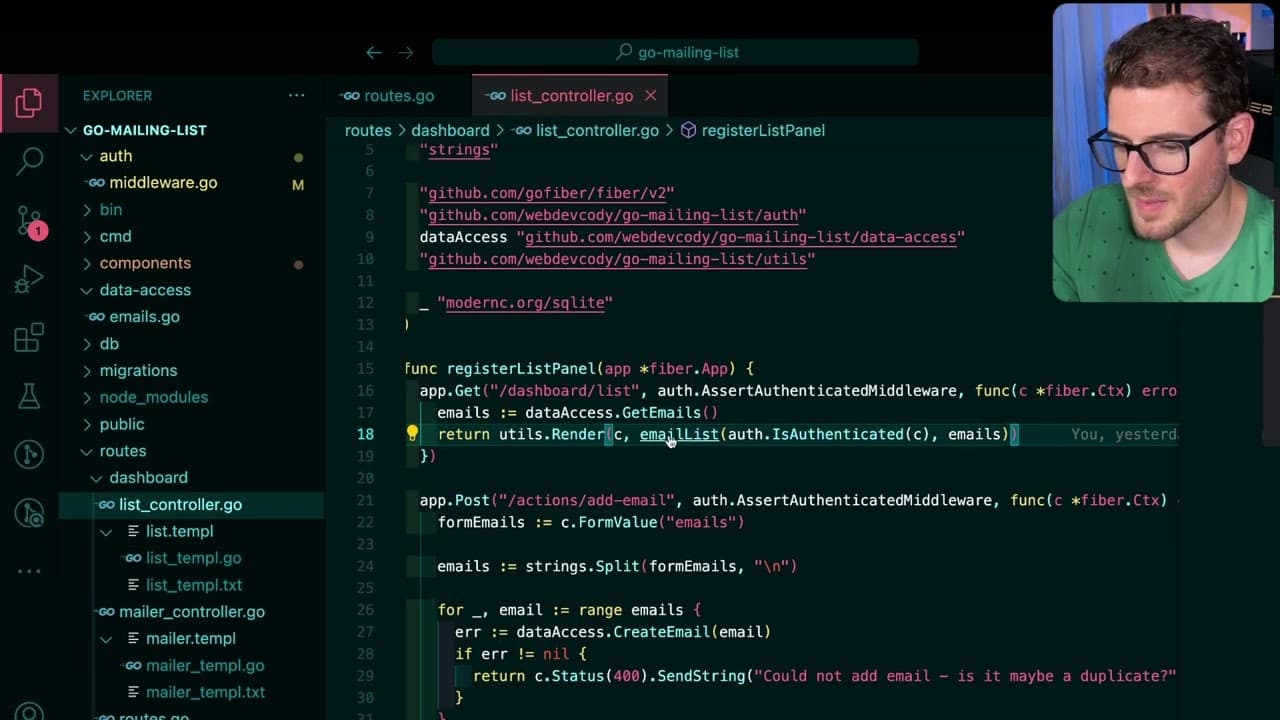
To build a simple emailer using Go and SQLite, set up a project that uses minimal dependencies and full server-side rendering. Implement routing and middleware for authentication, utilize Tailwind CSS for styling, and focus on maintaining a clear structure for managing email lists. Consider integrating HTMX to enhance user experience by minimizing full-page reloads.
Transcript
so I want to walk you through one of the projects that I'm building out in go just so I can kind of get a better understanding of how go works and just try to see what can I build doing as little as possible right so I don't really have that many external dependencies I have hwind for the styling and then other than that I have go and fiber I'm not... Read More
Key Insights
- 👶 Using minimal dependencies can simplify development and provide a clearer focus on learning a new programming language.
- 👻 Middleware in Fiber allows for customizable authentication that can enhance application security when correctly implemented.
- 🛟 Server-side rendering can result in a less responsive application experience compared to client-side rendering techniques.
- 👨💻 Colocating related functionality in the project can help with maintainability and improve code organization.
- 🔒 Directly writing SQL queries offers flexibility but also requires careful handling to avoid errors and security vulnerabilities.
- 👤 HTMX has significant potential to enhance user experience by enabling partial updates and reducing page reloads.
- 💨 Docker deployment is a useful way to manage application environments, but can require further refinement and testing for effective deployment.
Install to Summarize YouTube Videos and Get Transcripts
Explore YouTube Video Summarizer or Get YouTube Transcript Extractor
Questions & Answers
Q: What was the motivation behind choosing Go for this project?
The motivation for choosing Go stems from the speaker's desire to learn the language better and explore its features in a practical context. By building a project, they can familiarize themselves with Go's syntax, frameworks, and workflows while minimizing dependencies. This hands-on experience helps solidify their understanding of Go’s unique characteristics compared to JavaScript and TypeScript.
Q: How does the speaker implement authentication in their project?
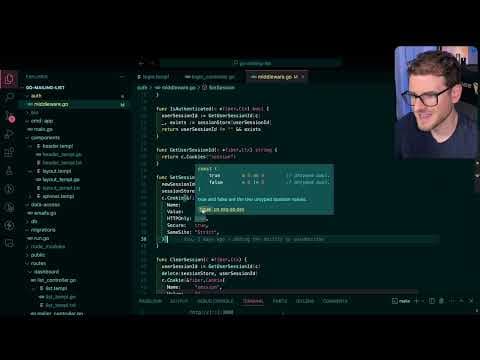
Authentication is managed through middleware that checks the user session stored in cookies. If the session is valid, users can access the dashboard; otherwise, they are redirected to the login page. The speaker encountered bugs with this implementation, where the user session ID was not properly validated, leading to difficulties in maintaining authenticated states within the application.
Q: What are the shortcomings of the current project regarding user experience?
The project currently suffers from a subpar user experience due to full-page refreshes when performing actions like adding or deleting emails. This approach disrupts the user flow by reloading the entire application each time, which can be frustrating. The speaker acknowledged the potential of HTMX to enhance interactivity, enabling inline updates without full page reloads.
Q: Can you explain the project’s structure and organization within Go?
The project structure involves using a combination of Fiber for routing and templates for rendering pages. The speaker employs a method of colocation, grouping related functionalities, and actions into designated folders. This custom organization allows the speaker to deviate from typical conventions to suit their development style and simplify maintainability according to their understanding and preferences.
Q: What is the speaker’s approach to database management within the project?
The project utilizes SQLite for data storage, with the speaker writing raw SQL queries for operations like fetching all emails or inserting new entries. While they are considering using an Object-Relational Mapping (ORM) tool in the future, they currently rely on simple prepared SQL statements to execute commands safely and mitigate the risk of SQL injection, which helps maintain data integrity.
Q: What are the future plans for enhancing the project?
Future enhancements include incorporating HTMX to improve user experience by allowing asynchronous updates for actions such as adding or deleting emails without entire page reloads. Additionally, the speaker intends to refine their authentication logic, optimize the Docker deployment process, and explore incorporating additional features or optimizations as they continue learning and developing in Go.
Summary & Key Takeaways
-
The speaker shares their experience building a Go project focused on server-side rendering, utilizing minimal external dependencies like Tailwind CSS for styling and Fiber for routing.
-
Challenges faced in the project include issues with authentication middleware and the need for improved user experience with full-page reloads, which may be enhanced by integrating HTMX.
-
The speaker demonstrates the structure of the application, including routing, templating, and basic CRUD functionalities for managing email lists, and discusses future plans for feature improvement.
Read in Other Languages (beta)
Share This Summary 📚
Summarize YouTube Videos and Get Video Transcripts with 1-Click
Try YouTube Summary with ChatGPT & Claude or YouTube Transcript Generator
Explore More Summaries from Web Dev Cody 📚
Summarize YouTube Videos and Get Video Transcripts with 1-Click
Try YouTube Summary with ChatGPT & Claude or YouTube Transcript Generator