What Are Markov Decision Processes in Reinforcement Learning?
TL;DR
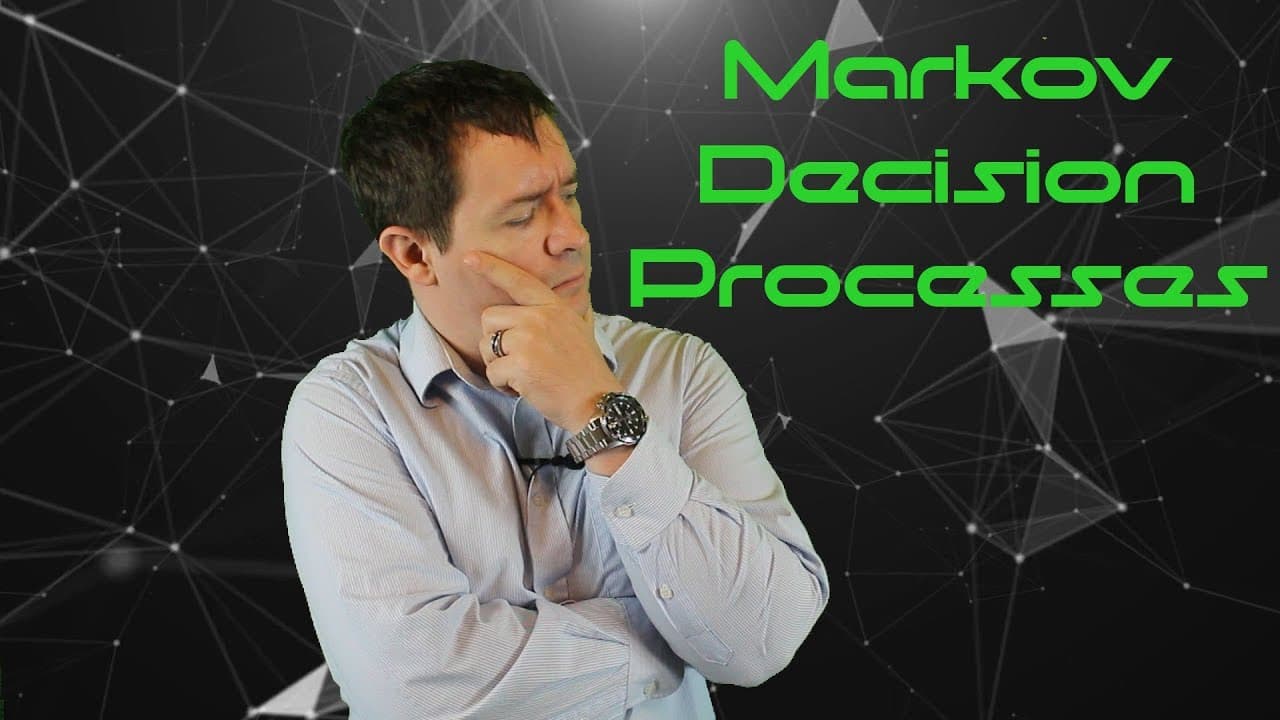
Markov Decision Processes (MDPs) are mathematical frameworks used in reinforcement learning to model decision-making where each state is determined by the previous state and the action taken. They help agents maximize rewards over time through a sequence of states, actions, and rewards, facilitating various algorithms to solve complex decision-making problems.
Transcript
welcome back did the free reinforcement learning course from neural net dot AI I'm your host Phil Taber if you're not subscribed be sure to do that now and hit the bell icon so you get notified for each new module in the course in module one we covered some essential concepts in reinforcement learning so if you haven't seen it go ahead and check it... Read More
Key Insights
- ⌛ Reinforcement learning involves an agent interacting with an environment and seeking to maximize rewards over time.
- ⏮️ Markov Decision Processes (MDPs) provide the mathematical framework for reinforcement learning, assuming states depend only on previous states and actions.
- 🍳 Episodic tasks are tasks in reinforcement learning that can be broken down into discrete episodes, while continuous tasks pose challenges due to potentially infinite rewards.
- ☠️ Discounting, using a discount rate, is used to prioritize immediate rewards over future rewards in both episodic and continuing tasks.
- ↩️ The value function in reinforcement learning represents the expected return when starting in a particular state and following a policy.
- 👻 The Bellman equation defines the value function recursively, allowing for the development of algorithms to maximize it.
- ↩️ Exploiting the recursive relationship between subsequent returns is a common strategy in solving the Bellman equation.
Install to Summarize YouTube Videos and Get Transcripts
Explore YouTube Video Summarizer or Get YouTube Transcript Extractor
Questions & Answers
Q: What is the main goal of a reinforcement learning agent?
The main goal of a reinforcement learning agent is to maximize rewards over time by making decisions that lead to favorable outcomes. The agent learns from the environment based on the feedback received in the form of rewards.
Q: What is a Markov Decision Process (MDP)?
A Markov Decision Process (MDP) is a mathematical model used in reinforcement learning. It consists of states, actions, and rewards, where each state depends only on the previous state and the agent's action. MDPs provide the framework for decision-making and value estimation in reinforcement learning.
Q: What is the expected return in a Markov Decision Process?
The expected return in a Markov Decision Process is a measure of the cumulative reward obtained by the agent over a sequence of steps. It is calculated as the sum of rewards from the current time step to a final time step.
Q: What are episodic tasks in reinforcement learning?
Episodic tasks are tasks in reinforcement learning that can be divided into discrete periods called episodes. Each episode consists of state transitions, actions, and rewards, and it has a terminal state. The agent's expected reward for the terminal state is zero since no future rewards follow.
Summary & Key Takeaways
-
Reinforcement learning involves an agent interacting with an environment and receiving rewards based on its decisions.
-
Markov Decision Processes (MDPs) are a mathematical model for reinforcement learning, where states, actions, and rewards form a decision process.
-
MDPs assume that each state is purely determined by the previous state and the agent's action, allowing for the application of mathematical concepts in reinforcement learning.
Read in Other Languages (beta)
Share This Summary 📚
Summarize YouTube Videos and Get Video Transcripts with 1-Click
Try YouTube Summary with ChatGPT & Claude or YouTube Transcript Generator
Explore More Summaries from Machine Learning with Phil 📚


Summarize YouTube Videos and Get Video Transcripts with 1-Click
Try YouTube Summary with ChatGPT & Claude or YouTube Transcript Generator