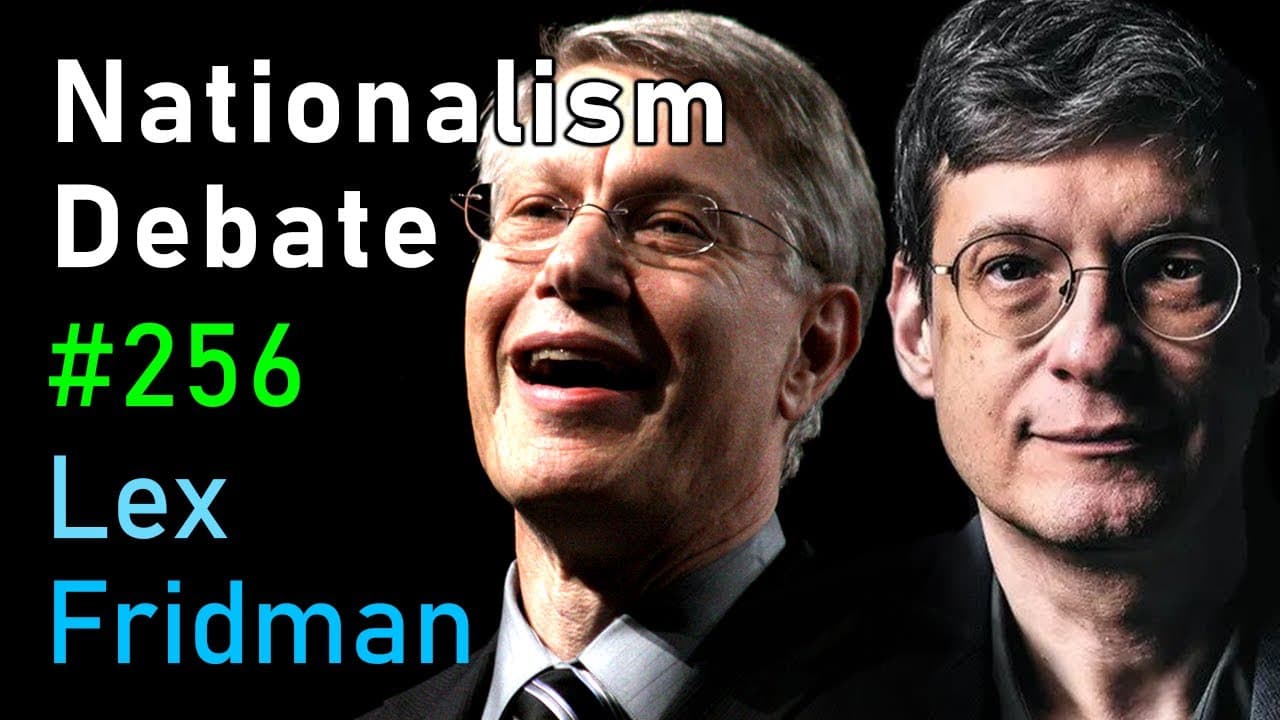
Nationalism Debate: Yaron Brook and Yoram Hazony | Lex Fridman Podcast #256
TL;DR
Yaron Brook and Yoram Hazony debate the essence of nationalism and individualism, outlining their contrasting views on conservatism and tradition's role in society. Hazony emphasizes the importance of tradition for national strength, while Brook advocates for continual improvement based on historical understanding. Their discussion reveals how individual freedom and historical context shape political ideologies.
Transcript
the following is a conversation with yaran brook and yoram hazoni this is iran's third time on this podcast in yoram's first time euron brook is an objectivist philosopher chairman of the iran institute host of the euron brook show and the co-author of free market revolution and equal is unfair yo ramazoni is a national conservatism thinker chairma... Read More
Key Insights
- 🌍 Conservatism emphasizes the importance of tradition and history in maintaining a nation and advancing human well-being.
- ❓ Rationalism and empiricism offer different approaches to political theory, with rationalism relying on abstract reasoning and empiricism emphasizing evidence and historical context.
- 🗯️ Communism failed due to its denial of individual rights, collectivist principles, and disregard for the lessons of history.
- 🌎 The founding fathers of America held diverse perspectives, combining elements of individualism and conservatism in shaping the nation's principles.
Install to Summarize YouTube Videos and Get Transcripts
Explore YouTube Video Summarizer or Get YouTube Transcript Extractor
Questions & Answers
Q: How do Yaron Brook and Yoram Hazony define conservatism?
Yoram defines conservatism as a political standpoint that values the recovery, elaboration, and restoration of tradition to maintain and strengthen a nation. Yaron sees conservatism as the constant improvement and adaptation of principles based on historical knowledge and consequences.
Q: What is the difference between rationalism and empiricism in political theory?
Rationalism, as proposed by Descartes, emphasizes deriving truths through a priori reasoning and disregards the importance of historical context. Empiricism, represented by thinkers like David Hume, focuses on studying human nature and societies through inductive reasoning and empirical evidence.
Q: Why did communism fail according to Yaron Brook and Yoram Hazony?
Yaron believes communism failed because it denied individual rights, overlooked the importance of human nature and history, and ultimately led to mass suffering and death. Yoram sees communism as a consequence of collectivism, disregard for the sanctity of the individual, and an elevation of the state, which he deems equally destructive as other forms of collectivism.
Q: Were the founding fathers of America individualists or conservatives?
The founding fathers were a diverse group with differing perspectives, but they encompassed aspects of both individualism and conservatism. Some, like Thomas Jefferson and Thomas Paine, embraced a more individualistic view, while others, like Alexander Hamilton, embraced a conservative approach by drawing upon the English legal tradition and blending it with new ideas.
Key Insights:
- Conservatism emphasizes the importance of tradition and history in maintaining a nation and advancing human well-being.
- Rationalism and empiricism offer different approaches to political theory, with rationalism relying on abstract reasoning and empiricism emphasizing evidence and historical context.
- Communism failed due to its denial of individual rights, collectivist principles, and disregard for the lessons of history.
- The founding fathers of America held diverse perspectives, combining elements of individualism and conservatism in shaping the nation's principles.
- The debate highlights the ongoing tension between nationalism and individualism, and the importance of balancing power between the state, the individual, and the preservation of tradition.
Summary
This conversation is a debate between Yaron Brook and Yoram Hazony on the topic of nationalism versus individualism. They discuss their views on conservatism, the implementation of conservatism, the differences between studying history and tradition, and the failures of communism. They delve into the concepts of rationalism and empiricism and how they relate to political theories. They also touch on the role of education and the state in society, and the importance of individualism in achieving human flourishing.
Questions & Answers
Q: How does Yoram Hazony define conservatism?
Yoram defines conservatism as a political standpoint that values maintaining and strengthening a nation through the recovery, elaboration, and restoration of tradition. He sees conservatism as deeply rooted in the history of a particular area or society.
Q: How does the implementation of conservatism differ from the ideal of conservatism?
Yoram points out that the implementation of conservatism can vary depending on the country and the specific values of its people. He mentions that there is a classical English conservative tradition that includes figures like Edmund Burke, and the American Federalist Party reflects this tradition to some extent. However, he also acknowledges that there is a mix of liberalism in contemporary conservatism, which can create confusion about what conservatism actually means.
Q: What is the essential idea of conservatism according to Yaron Brook?
Yaron argues that the essential idea of conservatism is the understanding that history is important and that the full history of a nation or society matters. He disagrees with the notion that the individual should be separated from their history and traditions. Yaron emphasizes that reason should be grounded in reality and the facts of history.
Q: What is the difference between studying history and tradition?
Yaron explains that studying history involves looking at past events, understanding what worked and what didn't, and deriving principles based on the consequences of different ideas and actions. Tradition, on the other hand, he sees as a set of inherited practices and beliefs that may or may not be rational or beneficial. The distinction lies in evaluating and judging the actions of the past based on a standard, which should be human well-being in his view.
Q: How does rationalism differ from empiricism?
Hazony describes rationalism as a philosophical approach that emphasizes the use of reason divorced from reality and experience. Rationalists believe that universal truths can be derived from a priori axioms or self-evident premises. Empiricism, on the other hand, is an approach that collects evidence from observation and experience to develop knowledge. It recognizes the importance of integrating empirical evidence and rational understanding to derive truths.
Q: Why did communism fail and what were the criticisms from conservatives?
According to Yoram, communism failed because it was based on collectivism, mysticism, and the sacrifice of individuals for the greater good. He sees communism as part of a tradition that looks at groups rather than individuals and expects some people to be sacrificed. He also points out that communism places the proletariat or the state above the value of the individual. The criticisms from conservatives are rooted in the understanding that collectivism and the sacrifice of individuals ultimately lead to human suffering and the destruction of freedom.
Q: Can conservatism support revolutions?
Yoram explains that conservatism is not opposed to change or revolutions per se. The objection lies in revolutions that seek to annihilate a certain part of the population and replace established systems with a completely new theory or ideology. He highlights the difference between repairing or improving a system based on experience and completely upending it without regard for the consequences.
Q: What is the problem with placing the state above the individual in education?
Yaron criticizes the idea of placing the state above the individual in education because it leads to a lack of individual freedom and stifles competition and innovation. He argues that state-controlled education often promotes political agendas and ignores what actually works in teaching and learning. He advocates for market-based approaches to education, which allow for competition and individual choice.
Q: What is the fundamental difference between Yaron and Yoram's views on change and improvement?
Yaron believes that change and improvement can be achieved through reason and understanding of history, and that there can be progress towards achieving human well-being and individual freedom. He sees the pursuit of truth as a process of abstraction and learning from the experiences of the past. Yoram, on the other hand, emphasizes the role of tradition and the preservation of the nation as important for maintaining stability and cohesion. While both agree that trial and error are necessary, they have different perspectives on how best to achieve progress.
Q: How do Yaron and Yoram view the role of the individual in society?
Yaron sees the individual as the primary unit of value and believes that individual freedom is crucial for human flourishing and success. He criticizes any ideology or system that places something above the value of the individual, whether it's the state, ethnicity, race, or social class. Yoram acknowledges the importance of individuals and their ability to judge and evaluate, but he also emphasizes the significance of the nation and the collective identity in maintaining stability and promoting values that lead to human flourishing.
Q: What are the main differences between Yaron and Yoram's overall philosophies?
Yaron advocates for individualism and reason grounded in reality as the principles for achieving human flourishing and success. He believes in the importance of individual freedom and the pursuit of self-interest. Yoram, on the other hand, places greater emphasis on the role of tradition and the nation in maintaining stability and promoting values that lead to human flourishing. While they both appreciate the significance of history, their views on the role of the individual and the nation differ in the overall scope of their philosophies.
Takeaways
Both Yaron Brook and Yoram Hazony offer different perspectives on the debate between nationalism and individualism. They raise important points about the role of history, tradition, reason, and the state in society. While Yaron emphasizes the value of individual freedom and the pursuit of self-interest for human flourishing, Yoram emphasizes the importance of the nation and collective identity for maintaining stability. The conversation offers insights into the complexities of these philosophical concepts and encourages reflection on the balance between individualism and the collective good.
Summary & Key Takeaways
-
The conversation is a debate between Yaron Brook, an objectivist philosopher, and Yoram Hazony, a national conservatism thinker, on the topics of nationalism and individualism.
-
They discuss the definition and principles of conservatism, the implementation of conservative ideas, and the differences between nationalism, individualism, and conservatism.
-
The conversation also touches on the role of history, reason, and tradition in shaping political ideologies and highlights the importance of individual freedom and human well-being.
Read in Other Languages (beta)
Share This Summary 📚
Summarize YouTube Videos and Get Video Transcripts with 1-Click
Try YouTube Summary with ChatGPT & Claude or YouTube Transcript Generator
Explore More Summaries from Lex Fridman Podcast 📚





Summarize YouTube Videos and Get Video Transcripts with 1-Click
Try YouTube Summary with ChatGPT & Claude or YouTube Transcript Generator