How to Choose Books That Improve Your Thinking
TL;DR
Choose books that change how you think, challenge your beliefs, or prevent confident mistakes. The recommended toolkit addresses four recurring failures: confusing luck with skill, defending established expertise, judging decisions by outcomes, and using intelligence to rationalize errors. Practical exercises include auditing luck, studying failed peers, testing beliefs as hypotheses, assigning probabilities, and keeping a decision journal.
Transcript
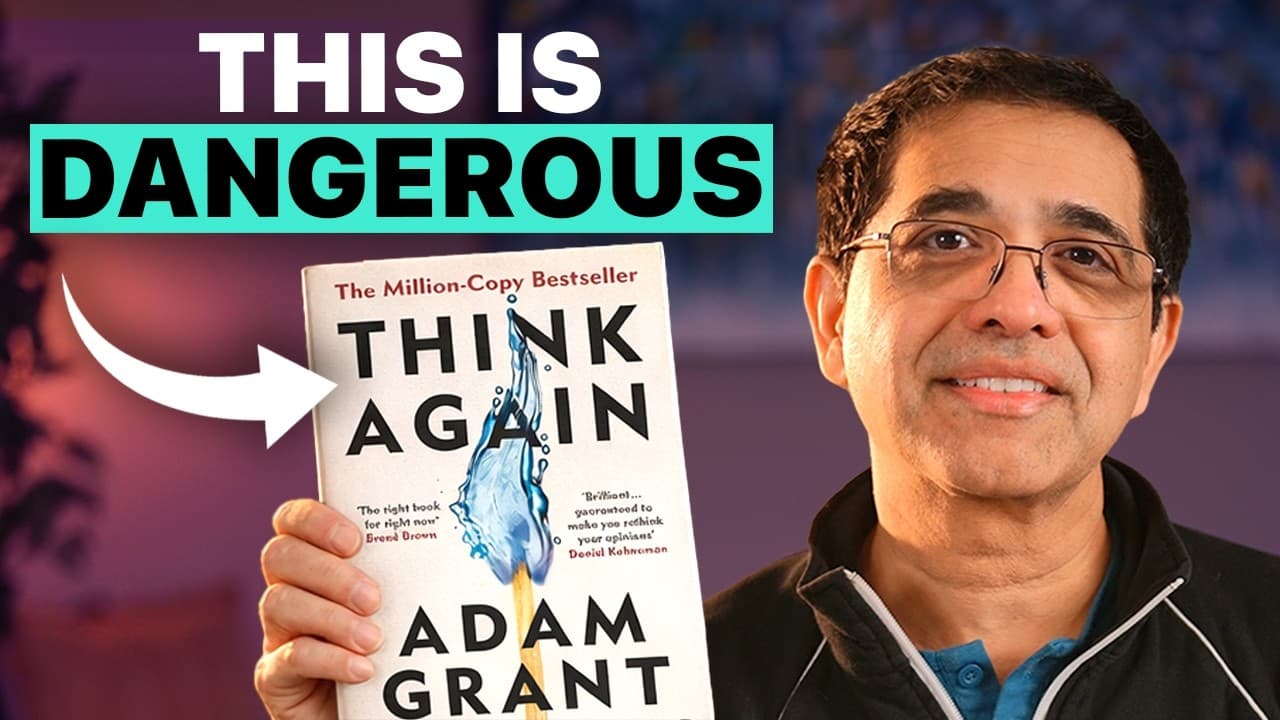
Most people read books to get smarter. They get more informed, but their life stays exactly the same. But a few books make you dangerously smart. They rewire your brain and change how you think, how you decide, and how you see what others don't. I've been a CEO and board adviser to billion-dollar companies. And I've distilled hundreds of titles dow... Read More
Key Insights
- The three-gate framework identifies valuable books by asking whether they change how a reader thinks, challenge existing beliefs, or prevent confident but costly mistakes. Passing even one gate suggests that a book offers a reusable reasoning tool instead of merely adding information or validating current opinions.
- Survivorship bias makes successful people appear more skilled than evidence warrants because failed participants disappear from view. In the coin-flip example, 312 of 10,000 traders remain after five consecutive wins, even though their impressive records were produced entirely by randomness rather than superior judgment.
- A luck-labor audit separates controlled effort from timing and tailwinds by reviewing wins in two columns every Friday. If the luck column is always empty, the analysis is probably distorted by ego and may encourage someone to repeat risks without recognizing the favorable conditions behind earlier success.
- The wreckage tour improves planning by studying people who made the same bet but failed. Examining only visible winners hides critical evidence, while failed cases reveal whether a strategy is resilient across conditions or depends on unusually favorable circumstances that may not recur.
- The proficiency prison occurs when knowledge and past success make people defend established answers instead of searching for better ones. The cited tax study found that seasoned professionals failed three times more often than students after rules changed slightly, illustrating how expertise can become rigid.
- Scientist mode treats beliefs as provisional hypotheses that should change when evidence changes. Rewriting a claim as a current belief and specifying what would disprove it reduces attachment to certainty, while stranger mode exposes unclear assumptions by testing whether an industry outsider can understand the strategy.
- Thinking in bets separates decision quality from eventual outcomes by stating confidence as a probability, identifying known and unknown factors, and specifying evidence that would change the estimate. This approach replaces binary predictions with repeated revisions as new information becomes available.
- The intelligence trap arises when smart people use their reasoning ability to rationalize errors and defend themselves. Intelligence alone does not guarantee sound judgment because a capable thinker may construct stronger excuses, question contrary evidence, or protect an identity instead of reconsidering a flawed position.
Install to Summarize YouTube Videos and Get Transcripts
Explore YouTube Video Summarizer or Get YouTube Transcript Extractor
Questions & Answers
Q: How can I choose books that genuinely improve my thinking?
Use three gates before committing your time and attention. Ask whether the book will change how you think rather than merely what you think, whether it challenges beliefs strongly enough to create discomfort, and whether it can stop you from making confident but foolish mistakes. A book that passes any one of these gates may provide a reusable mental tool instead of simple information or validation.
Q: What does Fooled by Randomness teach about success?
Fooled by Randomness argues that a strong track record cannot, by itself, distinguish genuine mastery from luck. The example begins with 10,000 traders making annual coin-flip bets. After five years, 312 consecutive winners remain and may look exceptional, although randomness produced them. The lesson is to separate talent and effort from timing, favorable conditions, and statistical survivorship before copying a winner's methods.
Q: How do I conduct a luck-labor audit?
Every Friday, review your wins using two columns. In the labor column, record what you controlled, including your work and decisions. In the luck column, record timing, tailwinds, and other favorable conditions outside your control. If the second column remains empty, ego may be distorting the review. The exercise helps prevent favorable circumstances from being mistaken for repeatable personal skill.
Q: Why should I study failures as well as successful people?
Studying only survivors creates an incomplete picture because people who made similar choices and failed are no longer visible among the celebrated examples. A wreckage tour deliberately finds those failed cases and examines what happened. This reveals hidden risks, weak assumptions, and dependence on favorable conditions. A strategy that works only in unusually supportive circumstances may be closer to a prayer than a durable plan.
Q: What is the proficiency prison described in Think Again?
The proficiency prison is the tendency for expertise and past success to make a person defend established knowledge rather than reconsider it. The transcript cites a study in which seasoned tax professionals failed three times more often than junior students when tax rules changed slightly. Experts can become attached to yesterday's correct answers, making knowledge a barrier when circumstances, technologies, or evidence shift.
Q: How can I practice scientist mode when making decisions?
Take a strong belief and rewrite it as, "I currently believe X, but it could be wrong if Y happens." This frames the belief as a hypothesis rather than an identity to defend. Then run experiments and update the belief from evidence. You can also explain the plan to someone outside your industry, because their confusion can reveal assumptions or gaps that insiders overlook.
Q: How does a decision journal improve judgment?
For 30 days, write down three items before every major decision or pivot: your confidence from 0 to 100%, what you know and do not know plus the evidence that would change your odds, and three reasons you could be wrong. Tracking these entries separates the original reasoning from later outcomes, quiets emotional reactions, and encourages revision when new information arrives.
Q: Why can intelligence become a trap?
Intelligence can become a trap when reasoning ability is used to rationalize errors instead of detecting them. Smart people may act as their own defense attorneys, producing persuasive explanations for existing beliefs and blaming the obstacle rather than questioning themselves. The problem is not intelligence itself, but the capacity to protect certainty and identity with increasingly sophisticated arguments instead of responding honestly to contrary evidence.
Summary & Key Takeaways
-
The three-gate framework evaluates whether a book installs useful mental operations, challenges comfortable beliefs, or prevents expensive mistakes made with misplaced confidence. Books that pass at least one gate can improve a reader's inner operating system, while many popular books primarily supply information, tactics, or behavioral changes without transforming the underlying reasoning process.
-
Fooled by Randomness separates skill from luck and warns against survivorship bias. Think Again examines how expertise can harden into defensive certainty. Their practical applications include auditing the role of labor and tailwinds, studying people whose similar bets failed, treating beliefs as hypotheses, seeking explanations from outsiders, and imagining how a startup could defeat an established company.
-
Thinking in Bets recommends expressing decisions through probabilities instead of certainty and updating estimates when evidence changes. The Intelligence Trap warns that intelligence can enable elaborate rationalization rather than sound judgment. Together, the four core books target outcome bias, rigid expertise, survivorship bias, and high-intelligence self-deception through repeatable methods for clearer decisions.
Read in Other Languages (beta)
Share This Summary 📚
Summarize YouTube Videos and Get Video Transcripts with 1-Click
Try YouTube Summary with ChatGPT & Claude or YouTube Transcript Generator
Explore More Summaries from Sandeep Swadia 📚

Summarize YouTube Videos and Get Video Transcripts with 1-Click
Try YouTube Summary with ChatGPT & Claude or YouTube Transcript Generator