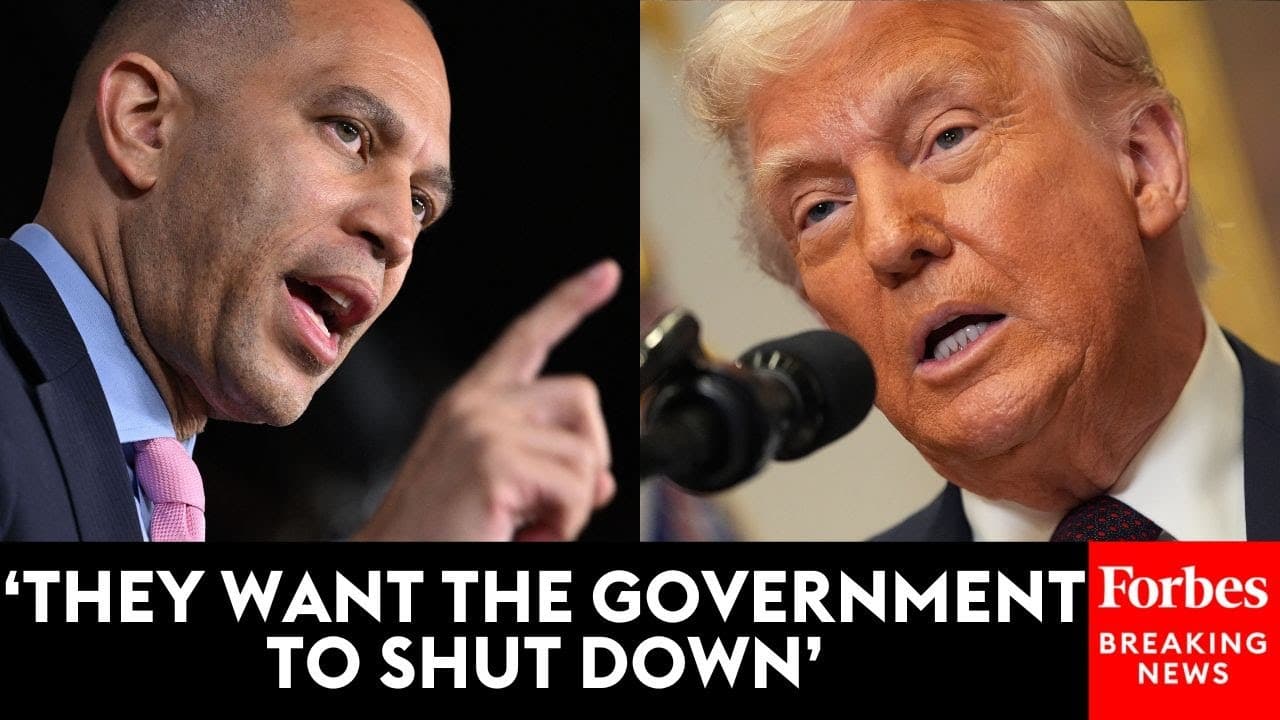
Why Is Hakeem Jeffries Opposing the Spending Bill and Condemning Trump’s Threats to Fire Federal Workers During a Shutdown?
TL;DR
Hakeem Jeffries opposes the seven-week spending extension because it lacks Democratic support and, in his account, leaves major health care cuts and rising costs unresolved. He also rejects Trump administration threats to fire federal workers, calling them intimidation and promising to defend civil service protections. His briefing connects the shutdown fight to Medicaid, Medicare, Affordable Care Act tax credits, and medical research, making the details of his negotiating position worth examining.
Transcript
Good afternoon everyone. Good afternoon. We're just 5 days away from a government shutdown because Republicans have decided that they don't want to fund the government in a bipartisan way and are determined to continue to gut the health care of the American people. The Republican healthc care crisis visited upon everyday Americans has been unrelent... Read More
Key Insights
- Shutdown responsibility follows control: Jeffries repeatedly points to Republican control of the House, Senate, and presidency. From that premise, he argues that any shutdown would reflect a Republican decision rather than Democratic obstruction. His reasoning also relies on Republicans canceling votes, leaving Washington, and declining discussions while Democrats say they remain available to negotiate.
- The deadline is immediate: The briefing occurs with only five days remaining before a possible government shutdown. Jeffries uses that narrow window to challenge the decision to cancel House votes on the following Monday and Tuesday. The timing supports his claim that leaders should be negotiating immediately rather than postponing discussions until after a seven-week funding extension.
- Medicaid cuts affect providers: Jeffries does not describe Medicaid policy only through enrollment figures. He links what he calls the largest Medicaid cut in American history to closures of hospitals, nursing homes, and community-based health clinics. By mentioning rural areas represented by Republicans, he argues that the effects cross political and geographic divisions.
- ACA credits support workers: Jeffries says 90% of Affordable Care Act tax credits go to people earning less than $63,000 per year, whom he identifies as working-class Americans. This figure supports his rejection of delaying the subsidy discussion. In his framing, extension of the credits is an immediate affordability issue, not a separate policy question that can wait.
- Twenty million face increases: At least 20 million Americans are about to experience dramatic increases in premiums, co-pays, and deductibles, according to Jeffries. He attributes that risk to Republicans refusing to extend Affordable Care Act tax credits. The claim explains why health care costs occupy the center of his response to a question about a temporary spending extension.
- Medicare action has consequences: Jeffries warns that Medicare faces a $536 billion cut at the end of the year unless Congress acts. He connects that outcome to the Republican bill he calls the "one big ugly bill." By placing a specific year-end consequence beside the shutdown deadline, he presents several health care issues as requiring congressional action.
- Medical research joins dispute: Jeffries says Republicans have effectively shut down medical research in the United States, including research for children with cancer. This expands his case beyond insurance coverage and personal medical bills. His stated negotiating concerns therefore include the institutions and research programs that support health care, not only Medicaid, Medicare, and Affordable Care Act assistance.
- Civil servants face pressure: The OMB memo is presented as part of a broader pattern rather than an isolated warning. Jeffries says the administration has already engaged in mass firings that Democrats consider illegal. He promises to oppose further efforts to weaken federal civil service protections, directly addressing workers concerned that they could lose their jobs during the political confrontation.
- Democrats reject intimidation: Jeffries names OMB Director Russ Vought while dismissing the administration’s threats. His response is that Democrats will not change their negotiating position because federal employees might be fired. He treats the memo as evidence that the administration intends to hurt people, while maintaining that threats cannot replace bipartisan talks over government funding.
- The Senate bill lacks support: Jeffries says the defeated spending proposal has no Democratic support and is therefore dead on arrival. That assessment is central to his practical argument for negotiations. If the bill cannot advance with its existing coalition, he contends that Republicans must seek common ground instead of insisting on their preferred measure.
- Three demands organize negotiations: "Cancel the cuts. Lower the cost. Save healthcare" is Jeffries’ concise description of the Democratic position. Each part corresponds to concerns raised in the briefing, including Medicaid reductions, rising premiums and cost-sharing, expiring tax credits, Medicare exposure, provider closures, and diminished medical research. The formulation explains both the desired policy direction and the reason Democrats oppose the extension.
- Trump canceled direct talks: Jeffries says President Trump first agreed to a White House meeting intended to find a bipartisan resolution, then canceled it through a social media statement. Jeffries contrasts that decision with his own presence in Washington and willingness to meet. The episode becomes evidence for his accusation that Republicans do not even want a conversation about a bipartisan agreement.
Install to Summarize YouTube Videos and Get Transcripts
Explore YouTube Video Summarizer or Get YouTube Transcript Extractor
Questions & Answers
Q: Why is Hakeem Jeffries opposing the seven-week spending bill?
Jeffries says the seven-week extension lacks Democratic support and does not confront the health care policies at the center of the dispute. He wants negotiations to address cuts, rising costs, Affordable Care Act tax credits, Medicare, Medicaid, and medical research. He rejects the idea of funding the government first and discussing the ACA later because he believes Republicans have already shown their intentions. His stated formula is to cancel the cuts, lower the cost, and save health care.
Q: What did Hakeem Jeffries say about Trump’s threats to fire federal workers during a shutdown?
Jeffries treats the threats as intimidation and says Democrats will not back down because of them. He says the Trump administration has already conducted mass firings that Democrats deem illegal. He promises continued resistance to efforts that undermine federal civil service protections. His response reflects the view that threatening workers is not a substitute for negotiating a bipartisan funding agreement.
Q: Who does Jeffries blame for the possible government shutdown?
Jeffries blames Republicans because they control the House, Senate, and presidency. He says House Republicans left Washington and canceled votes for Monday and Tuesday even though government funding was about to expire. He also says President Trump canceled a planned White House meeting that could have pursued a bipartisan resolution. Because Democrats remained available to meet, Jeffries argues that a shutdown would occur because Republicans wanted it.
Q: Why are Affordable Care Act tax credits part of the funding fight?
Jeffries says Republicans have refused to extend the Affordable Care Act tax credits. He states that 90% of the credits benefit people earning less than $63,000 annually, whom he describes as working-class Americans. Without action, he says at least 20 million people are about to experience dramatic increases in premiums, co-pays, and deductibles. These expected increases are why he refuses to postpone the ACA discussion until after a temporary extension.
Q: What health care damage does Jeffries attribute to Republican policies?
Jeffries cites what he calls the largest Medicaid cut in American history, affecting millions across the country. He says hospitals, nursing homes, and community-based health clinics are closing, including facilities in rural Republican districts. He also warns of a $536 billion Medicare cut at year’s end if Congress does not act. In addition, he says medical research has effectively been shut down, including work involving children with cancer.
Q: What did Jeffries tell federal workers worried about losing their jobs?
Jeffries acknowledges the administration’s history of mass firings, which Democrats regard as illegal. He says Democrats will continue pushing back against attempts to undermine existing federal civil service protections. He refuses to let the possibility of additional firings force Democrats to abandon their negotiating position. His message is that workers’ protections should be defended while Congress seeks a bipartisan spending resolution.
Q: What solution does Jeffries propose for avoiding the shutdown?
Jeffries proposes immediate bipartisan negotiations aimed at finding common ground on a spending agreement. He says Democrats will meet anytime, anywhere, and with anyone, including the president. He argues that talks are necessary because the Senate bill lacks Democratic support and cannot resolve the dispute as written. The desired agreement should fund the government while addressing health care cuts, affordability, and the needs of the American people.
Q: Why does Jeffries criticize Trump and House Republicans for leaving negotiations?
Jeffries says House Republicans fled Washington and canceled votes immediately before government funding was due to expire. He also says Trump agreed to a White House meeting and then withdrew through a social media statement. Meanwhile, Jeffries presents himself and other Democrats as ready, willing, and able to negotiate in Washington. He uses this contrast to argue that Republicans chose a "my way or the highway" position instead of pursuing bipartisan agreement.
Summary & Key Takeaways
-
Five days before shutdown: Jeffries opens by blaming Republicans for the approaching government shutdown, saying they control the House, Senate, and presidency but refuse to fund the government through a bipartisan agreement. He argues that their funding stance continues an unrelenting health care crisis affecting everyday Americans. His opening frames the dispute as more than a short-term budget deadline, connecting government funding directly to health care access, costs, and Republican policy choices made throughout the year.
-
Health care drives opposition: Jeffries cites what he calls the largest Medicaid cut in American history and says hospitals, nursing homes, and community-based clinics are closing, including in Republican rural districts. He says the failure to extend Affordable Care Act tax credits could sharply increase premiums, co-pays, and deductibles for at least 20 million Americans. He also warns of a $536 billion Medicare cut at year’s end and says medical research has effectively been shut down.
-
Rejecting administration threats: Asked about the OMB memo, Jeffries describes it as an attempt at intimidation and says Democrats will not back down. He accuses the Trump administration of illegally shutting down parts of the government and conducting mass firings during the year. Addressing worried federal workers, he promises continued resistance to attempts to undermine federal civil service protections. His blunt response to OMB Director Russ Vought as a negotiating tactic is simply, "Get lost."
-
Seven-week extension rejected: Jeffries says the Senate spending bill is dead on arrival because it lacks Democratic support. He rejects postponing Affordable Care Act negotiations until after accepting another seven weeks of funding, arguing that Republicans have already demonstrated their intentions toward health care. He summarizes the Democratic position as canceling the cuts, lowering costs, and saving health care. For Jeffries, accepting the extension would mean abandoning an immediate opportunity to confront those policies.
-
Calling for bipartisan talks: Jeffries questions why House Republicans left Washington and canceled votes scheduled for Monday and Tuesday as government funding was about to expire. He also criticizes President Trump for agreeing to a White House meeting and then canceling it through a social media statement. Jeffries says Democrats remain in Washington and are ready to meet anytime and anywhere to seek common ground on a bipartisan spending agreement serving the health, safety, and economic well-being of Americans.
Read in Other Languages (beta)
Share This Summary 📚
Summarize YouTube Videos and Get Video Transcripts with 1-Click
Try YouTube Summary with ChatGPT & Claude or YouTube Transcript Generator
Explore More Summaries from Forbes Breaking News 📚
Summarize YouTube Videos and Get Video Transcripts with 1-Click
Try YouTube Summary with ChatGPT & Claude or YouTube Transcript Generator