How Does Gold Wire Bonding Work in Semiconductor Packaging?
TL;DR
Gold wire bonding is an interconnection method in semiconductor packaging that connects the die to the substrate using gold wire. The process involves forming a Free Air Ball, making initial and secondary bonds using ultrasonic and thermal energy, and completing multiple loops. It's widely used in various semiconductor applications due to its reliability and effectiveness.
Transcript
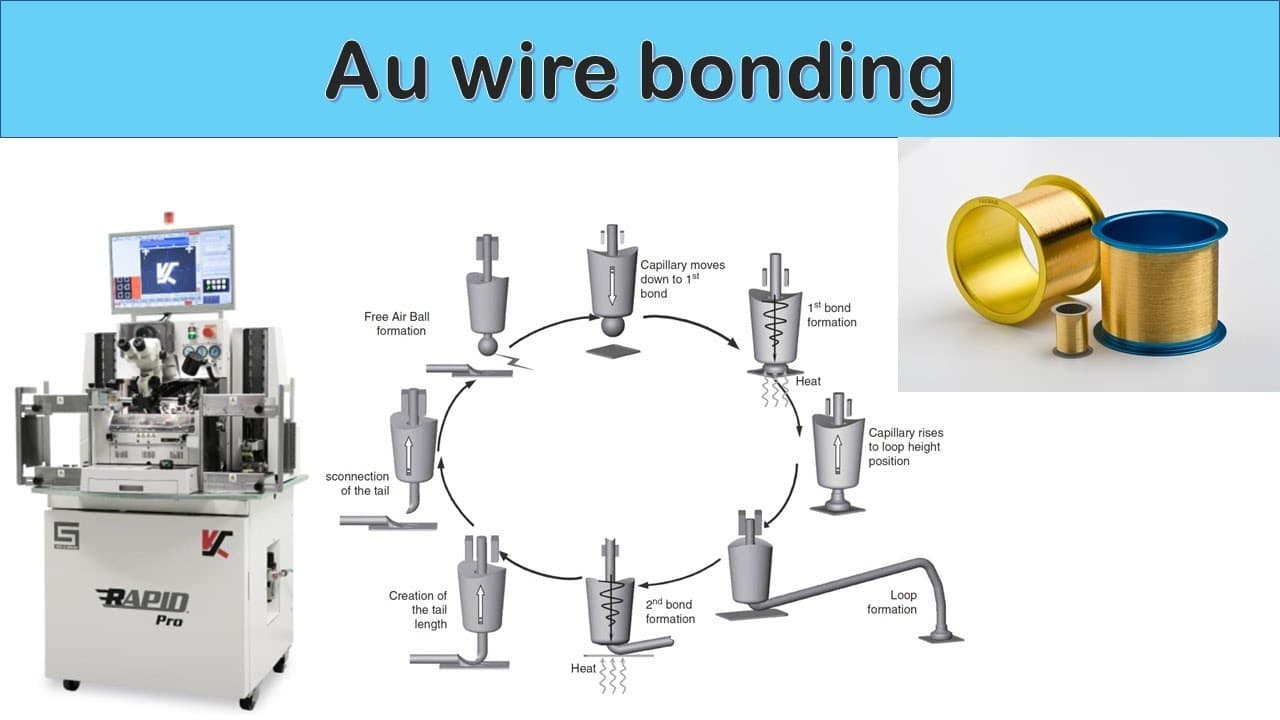
Today I would like to talk about wire bonding process especially gold wire bonding. Wire bonding is interconnection technology in semiconductor packaging and it connects die and package substrate using wire. Wire bonding machine and process look similar with sewing machine. For wire bonding, there are 4 key elements. Wire bonding machine, window ... Read More
Key Insights
- Wire bonding is a critical process in semiconductor packaging, connecting the die to the package substrate using gold wire.
- The process involves a wire bonding machine, window clamp, heater block, capillary, and gold wire to complete the connections.
- The wire bonding machine functions similarly to a sewing machine, feeding wire from a spool to the capillary tip.
- The process begins with Free Air Ball formation, where an Electronic Flame Off (EFO) discharge creates a molten ball at the wire tip.
- Ultrasonic energy from the capillary and heat from the heater block facilitate the bonding at the die pad.
- A complex series of sub-steps allows the capillary to form a loop, moving in X-Y directions over the die and substrate.
- The second bond formation occurs at the substrate pad, completing the wire bonding cycle with tail length creation and cutting.
- Gold wire bonding is widely used in various packages like lead frame, memory, MEMS, and image sensor packages.
Install to Summarize YouTube Videos and Get Transcripts
Explore YouTube Video Summarizer or Get YouTube Transcript Extractor
Questions & Answers
Q: What is the purpose of wire bonding in semiconductor packaging?
Wire bonding is a crucial process in semiconductor packaging that connects the die to the package substrate using wire. This interconnection technology ensures that electrical signals can be transmitted from the semiconductor die to the external circuitry, enabling the functionality of the semiconductor device.
Q: How does the wire bonding machine operate?
The wire bonding machine operates similarly to a sewing machine, where it feeds wire from a spool to the tip of the capillary. It consists of various components, including a bond head, XY table system, and material handling system, which facilitate the precise movement and positioning required for effective wire bonding.
Q: What role does the capillary play in the wire bonding process?
The capillary in the wire bonding process functions like a needle, guiding the gold wire to form bonds. It moves to the die pad to create the first bond using ultrasonic energy and heat, then forms a loop and moves to the substrate pad to complete the second bond, ensuring a secure connection between the die and substrate.
Q: What is Free Air Ball formation in wire bonding?
Free Air Ball formation is the initial step in the wire bonding process, where an Electronic Flame Off (EFO) discharge creates a molten ball at the wire's tip. The heat generated by the EFO discharge melts the wire, and the surface tension of the molten wire forms a spherical ball, which is essential for the first bond.
Q: Why is gold wire commonly used in wire bonding?
Gold wire is commonly used in wire bonding due to its excellent electrical conductivity, corrosion resistance, and malleability, which allow for reliable and durable connections. Its properties make it suitable for various semiconductor packages, including lead frame, memory, MEMS, and image sensor packages, where dependable performance is critical.
Q: What are the key components required for wire bonding?
The key components required for wire bonding include a wire bonding machine, window clamp, heater block, capillary, and gold wire. These components work together to facilitate the precise bonding process, ensuring that the die and substrate are securely connected with minimal electrical resistance and maximum reliability.
Q: How does the wire bonding cycle progress after the first bond?
After the first bond is made at the die pad, the capillary moves to a loop height position and forms a loop by moving in X-Y directions over the die and substrate. This step involves complex sub-steps, after which the second bond is formed at the substrate pad, completing the wire bonding cycle.
Q: In what applications is gold wire bonding most commonly used?
Gold wire bonding is most commonly used in applications such as lead frame packages, memory packages, MEMS packages, and image sensor packages. Its reliability and efficiency make it a preferred choice for these applications, where secure and dependable electrical connections are essential for device performance.
Summary & Key Takeaways
-
Wire bonding is a key interconnection technology in semiconductor packaging, utilizing gold wire to connect the die and substrate. The process involves several components, including a wire bonding machine, capillary, and heater block. Gold wire bonding is prevalent in many applications due to its reliability and effectiveness.
-
The wire bonding process starts with the formation of a Free Air Ball using an Electronic Flame Off discharge, which creates a molten ball at the wire's tip. The capillary then moves to the die pad, forming the first bond with ultrasonic and thermal energy, followed by a complex loop formation.
-
After loop formation, the second bond is made at the substrate pad, completing the bonding cycle. This process is essential for various semiconductor packages, including lead frame, memory, MEMS, and image sensor packages. Gold wire bonding remains a popular choice due to its versatility and efficiency.
Read in Other Languages (beta)
Share This Summary 📚
Summarize YouTube Videos and Get Video Transcripts with 1-Click
Try YouTube Summary with ChatGPT & Claude or YouTube Transcript Generator
Explore More Summaries from Semicon Talk 📚
Summarize YouTube Videos and Get Video Transcripts with 1-Click
Try YouTube Summary with ChatGPT & Claude or YouTube Transcript Generator