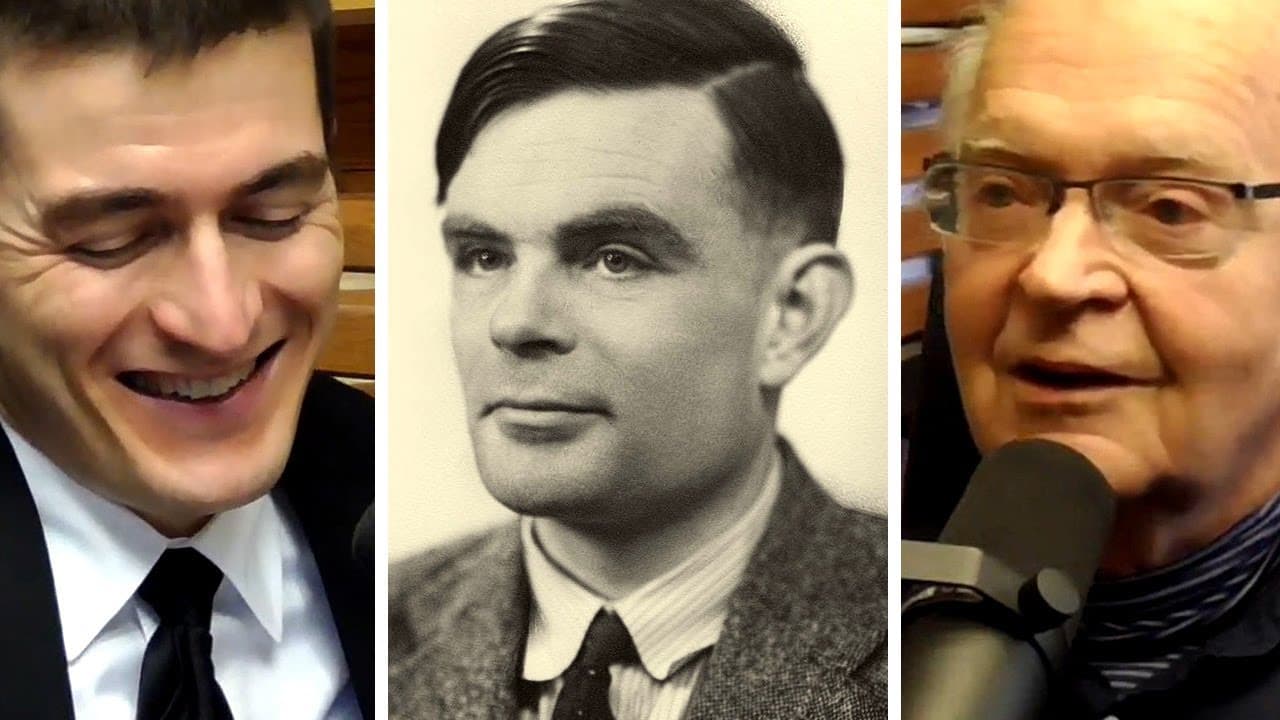
Donald Knuth: Alan Turing was the First 100% Geek | AI Podcast Clips
TL;DR
Geeks possess the ability to jump between levels of abstraction and handle non-uniformity, making them skilled at solving complex problems and comfortable with intricate systems.
Transcript
so you refer to people including yourself who gravitate toward a kind of computational thinking as geeks for at least I've heard you use that terminology it true that I think there's something that happened to me as I was growing up that made my brain structure in a certain way that that resonates with with computers so there's this space of people... Read More
Key Insights
- 🤔 Geeks have a natural inclination towards computational thinking and possess unique cognitive abilities.
- 👻 The ability to jump between levels of abstraction allows for a deeper understanding of complex problems and efficient problem-solving.
- 🤓 Geeks' comfort with non-uniformity enables them to work with intricate systems that may be overwhelming to others.
- 🤓 Alan Turing, with his theoretical breakthroughs and practical contributions, embodied the qualities of a geek.
- 👻 Geeks often mix low-level and high-level concepts, allowing for a more comprehensive understanding of a subject.
- 🤔 Geeks' thinking abilities can be cultivated by actively practicing and training oneself to jump between different levels of abstraction.
- 🤓 Geeks may sometimes overcomplicate systems due to their willingness to work with non-uniformity.
Install to Summarize YouTube Videos and Get Transcripts
Explore YouTube Video Summarizer or Get YouTube Transcript Extractor
Questions & Answers
Q: What are the two main qualities that define geeks' thinking abilities?
Geeks excel at jumping between levels of abstraction, effortlessly moving between the big picture and the fine details. They also possess a talent for dealing with non-uniformity, allowing them to handle complex systems with ease.
Q: How does mixing different levels of abstraction affect problem-solving?
By combining both high-level and low-level concepts, geeks gain a deeper understanding of the subject matter. This practice enables them to solve problems more effectively and creatively.
Q: Why is geeks' ability to handle non-uniformity important in their work?
Geeks thrive in situations where there are multiple cases with different rules. They are comfortable with complexity and can navigate intricate systems without feeling overwhelmed, allowing them to find innovative solutions.
Q: How did Alan Turing's work exhibit the qualities of a geek?
Turing's work demonstrated his ability to mix different levels of abstraction, as seen in his theories of computability and the invention of Turing machines. He also embraced non-uniformity, creating subroutines and writing numbers backward to accommodate computer processing.
Key Insights:
- Geeks have a natural inclination towards computational thinking and possess unique cognitive abilities.
- The ability to jump between levels of abstraction allows for a deeper understanding of complex problems and efficient problem-solving.
- Geeks' comfort with non-uniformity enables them to work with intricate systems that may be overwhelming to others.
- Alan Turing, with his theoretical breakthroughs and practical contributions, embodied the qualities of a geek.
- Geeks often mix low-level and high-level concepts, allowing for a more comprehensive understanding of a subject.
- Geeks' thinking abilities can be cultivated by actively practicing and training oneself to jump between different levels of abstraction.
- Geeks may sometimes overcomplicate systems due to their willingness to work with non-uniformity.
- Geeks possess a certain talent for seeing patterns and connections that others may overlook.
Summary & Key Takeaways
-
Geeks have a unique way of thinking that allows them to seamlessly move between different levels of abstraction, making problem-solving more efficient.
-
Their ability to handle non-uniformity, where different cases require different rules, allows geeks to work with complex systems without feeling overwhelmed.
-
Alan Turing, the pioneer of computer science, was the epitome of a geek, displaying both abstraction and non-uniformity in his work.
Read in Other Languages (beta)
Share This Summary 📚
Summarize YouTube Videos and Get Video Transcripts with 1-Click
Try YouTube Summary with ChatGPT & Claude or YouTube Transcript Generator
Explore More Summaries from Lex Fridman 📚





Summarize YouTube Videos and Get Video Transcripts with 1-Click
Try YouTube Summary with ChatGPT & Claude or YouTube Transcript Generator