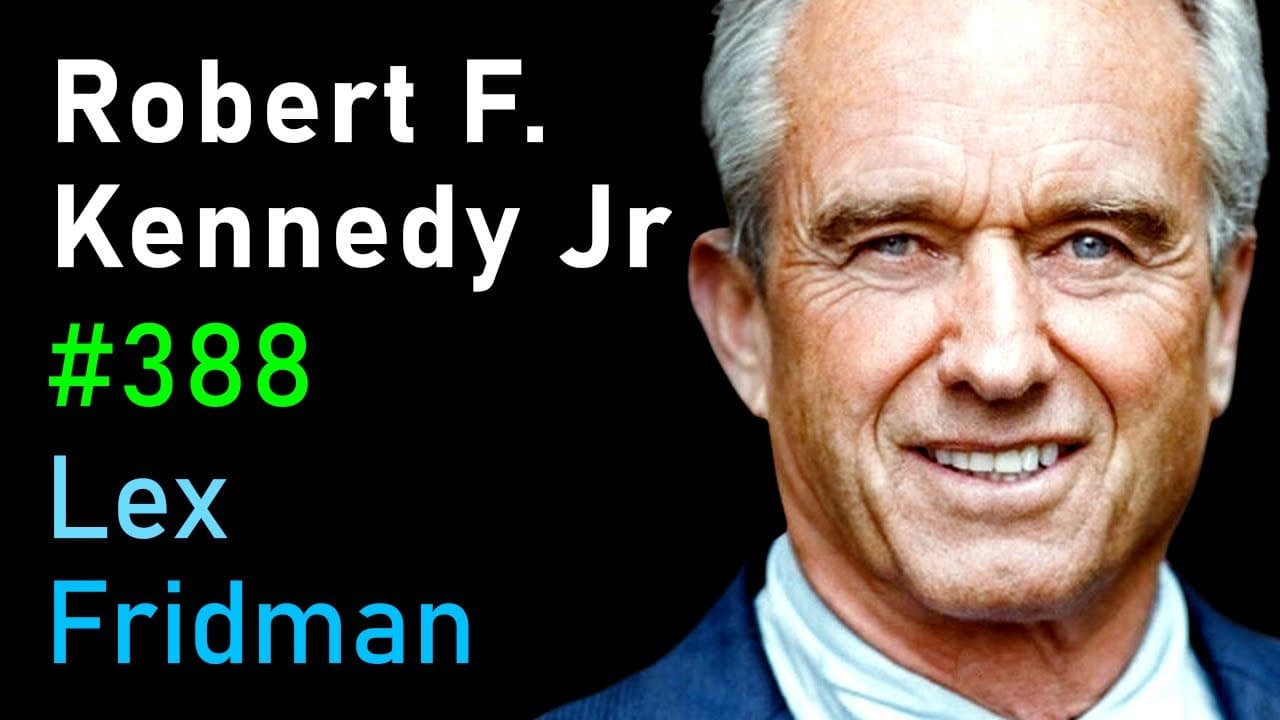
Robert F. Kennedy Jr: CIA, Power, Corruption, War, Freedom, and Meaning | Lex Fridman Podcast #388
TL;DR
Diplomacy and leadership are crucial in addressing global threats like nuclear war and advanced technologies such as artificial intelligence. Open communication and negotiation between nations can prevent conflicts and regulate dangerous technologies.
Transcript
- It's not our business to change the Russian government. And anybody who thinks it's a good idea to do regime change, in Russia, which has more nuclear weapons than we do, is, I think, irresponsible. And, you know, Vladimir Putin himself has had, you know, we will not live in a world without Russia. And it was clear when he said that, that he was ... Read More
Key Insights
- ⏰ Regime change in nuclear-armed states like Russia should be avoided due to the risk of destabilization and nuclear conflict.
- 🌐 The decisions of leaders during critical moments in history, like the Cuban Missile Crisis, can prevent catastrophic global events.
- 📖 The content highlights the importance of diplomacy, open communication, and empathy to resolve conflicts and address global threats effectively.
Install to Summarize YouTube Videos and Get Transcripts
Explore YouTube Video Summarizer or Get YouTube Transcript Extractor
Questions & Answers
Q: Why does the content stress the importance of avoiding regime change in Russia?
Changing the Russian regime could lead to a destabilized nuclear power, potentially resulting in catastrophic consequences for global security. Instead, fostering friendly relations and constructive dialogue with Russia is advocated.
Q: How did the Cuban Missile Crisis demonstrate the impact of leadership decisions?
During the crisis, President Kennedy's decisions to negotiate and find common ground with Soviet leader Khrushchev prevented a nuclear war. His willingness to understand the perspective of the Soviet Union and make peace efforts played a crucial role in averting disaster.
Q: What technologies are highlighted as potential threats in the content?
Advanced technologies such as artificial intelligence and biological weapons are mentioned as potential existential threats to humanity. The need for international regulation and cooperation in handling these technologies is emphasized.
Q: Why is open communication and negotiation important in addressing global threats?
Open communication and negotiation allow countries to understand and address each other's concerns, preventing conflicts and promoting peaceful resolutions. It is vital to have direct lines of communication, similar to the red phone between Kennedy and Khrushchev, to avoid misunderstandings and escalate tensions.
Key Insights:
- Regime change in nuclear-armed states like Russia should be avoided due to the risk of destabilization and nuclear conflict.
- The decisions of leaders during critical moments in history, like the Cuban Missile Crisis, can prevent catastrophic global events.
- The content highlights the importance of diplomacy, open communication, and empathy to resolve conflicts and address global threats effectively.
- Advanced technologies, such as artificial intelligence and biological weapons, require transparent and regulated approaches to prevent unintended consequences.
Summary
In this video, Robert F. Kennedy Jr., a candidate for the President of the United States, discusses various topics including the relationship between the US and Russia, the concept of freedom, the human nature of power, the meaning of life, and the lessons he learned from his father. He highlights the importance of empathy, dialogue, and the need to avoid engaging in unnecessary wars, especially with a nuclear power like Russia. Kennedy emphasizes the need for understanding and respect between nations and the dangers of pushing Russia into the camp of China. He also expresses concerns about the possibility of nuclear war and the importance of safeguarding peace.
Questions & Answers
Q: Why does Kennedy believe it is not the US' job to change the regime in Russia?
Kennedy argues that it is irresponsible for the US to attempt regime change in Russia, considering it has more nuclear weapons than the US. He believes it is important to make friends with Russia and treat them as a friend rather than an enemy. Pushing Russia into the camp of China would not benefit the US, and the current actions against Russia do not seem to weaken Putin at all.
Q: What does freedom mean to Kennedy?
Kennedy believes that freedom, accompanied by self-restraint, allows individuals to exercise and fulfill their creative energies unrestrained by the government. He sees freedom as the capacity for human beings to pursue their goals and aspirations with minimal government intervention.
Q: According to Kennedy, why does freedom die unless it's used?
Kennedy agrees with Hunter S. Thompson's statement that freedom dies unless it's used. He explains that we cannot rely on past victories or the laurels of the American Revolution to protect our freedom. It is the responsibility of each generation to safeguard and protect the freedoms we enjoy.
Q: What does Kennedy learn from Albert Camus and stoicism?
Kennedy finds inspiration in Camus' philosophy of embracing and enjoying life despite its absurdity. He sees the importance of doing good, being of service to others, and finding meaning in the chaos of existence. Embracing our duties and being of service can bring order to the universe and make us happy.
Q: What does Kennedy learn about human nature from Adolf Hitler?
Kennedy acknowledges Hitler's ability to captivate the minds of millions, rise to power, and lead the world into a global war. He emphasizes his father's belief that all humans are just inches away from barbarity and not to judge ourselves solely by our intentions, but by our actions. Kennedy questions how he would respond if faced with a totalitarian system and the moral courage it takes to resist.
Q: What did Kennedy learn from his father, Robert F. Kennedy?
Kennedy recalls his father's emphasis on moral courage as the most important quality in a human being. He believes that his father's curiosity and ability to put himself in the shoes of others allowed him to see the world from different perspectives and make wise decisions. Kennedy also mentions his father challenging him and his siblings to consider their actions in a totalitarian regime.
Q: What does Kennedy love about the United States of America?
Kennedy expresses his pride in the United States as an example of democracy for the rest of the world. He credits the American democratic experience as a model for other nations and believes in the importance of the collective knowledge and wisdom that democracy can bring.
Q: What does Kennedy think about the war in Ukraine and the US' involvement?
Kennedy states that the US' involvement in the war in Ukraine is unnecessary and illegal. He believes that the US has been provoking Russia since 1997 and that the war is a proxy war desired by the neocons in the White House. Kennedy argues that it is not the US' business to change the Russian government and that the situation in Ukraine cannot be resolved through military operations.
Q: Does Kennedy worry about nuclear war?
Yes, Kennedy expresses concerns about nuclear war and believes that people often underestimate the possibility of it happening. He mentions the Cuban Missile Crisis and the 13 days when the world came close to nuclear war. Kennedy emphasizes the need to engage in dialogue and avoid pushing Russia too far to prevent a potential nuclear conflict.
Q: Would Kennedy be willing to sit down and negotiate peace with Putin and Zelensky?
Yes, Kennedy states that he would be willing to sit down with Putin and Zelensky separately and together to negotiate peace. He believes the US can play a crucial role in easing tensions, fostering positive relationships, and working towards peace.
Q: Does Kennedy think the war in Ukraine can be resolved purely through military operations?
No, Kennedy believes that it is impossible for Ukraine to win the war against Russia through military operations. He cites Russia's military superiority, the Ukrainians' lack of military strength, and the absence of international appetite for troops to be sent to Ukraine. Kennedy sees a negotiated settlement as the only viable solution.
Takeaways
In this video, Robert F. Kennedy Jr. discusses various topics, including the relationship between the US and Russia, the concept of freedom, the human nature of power, the meaning of life, and the lessons he learned from his father. He emphasizes the importance of empathy, dialogue, and the need to avoid unnecessary wars, especially with a nuclear power like Russia. Kennedy expresses concerns about nuclear war and the urgency of safeguarding peace. He believes in the power of negotiation and the importance of friendship between nations.
Summary & Key Takeaways
-
The content emphasizes the importance of avoiding regime change in Russia and instead fostering friendship and dialogue with the country.
-
It discusses the Cuban Missile Crisis as an example where the decisions of a single leader (John F. Kennedy) prevented a potential nuclear war.
-
The content highlights the need for leaders who prioritize peace and engage in open communication to address global threats effectively.
Read in Other Languages (beta)
Share This Summary 📚
Summarize YouTube Videos and Get Video Transcripts with 1-Click
Try YouTube Summary with ChatGPT & Claude or YouTube Transcript Generator
Explore More Summaries from Lex Fridman Podcast 📚

Summarize YouTube Videos and Get Video Transcripts with 1-Click
Try YouTube Summary with ChatGPT & Claude or YouTube Transcript Generator