How AlphaFold Revolutionizes Protein Structure Prediction
TL;DR
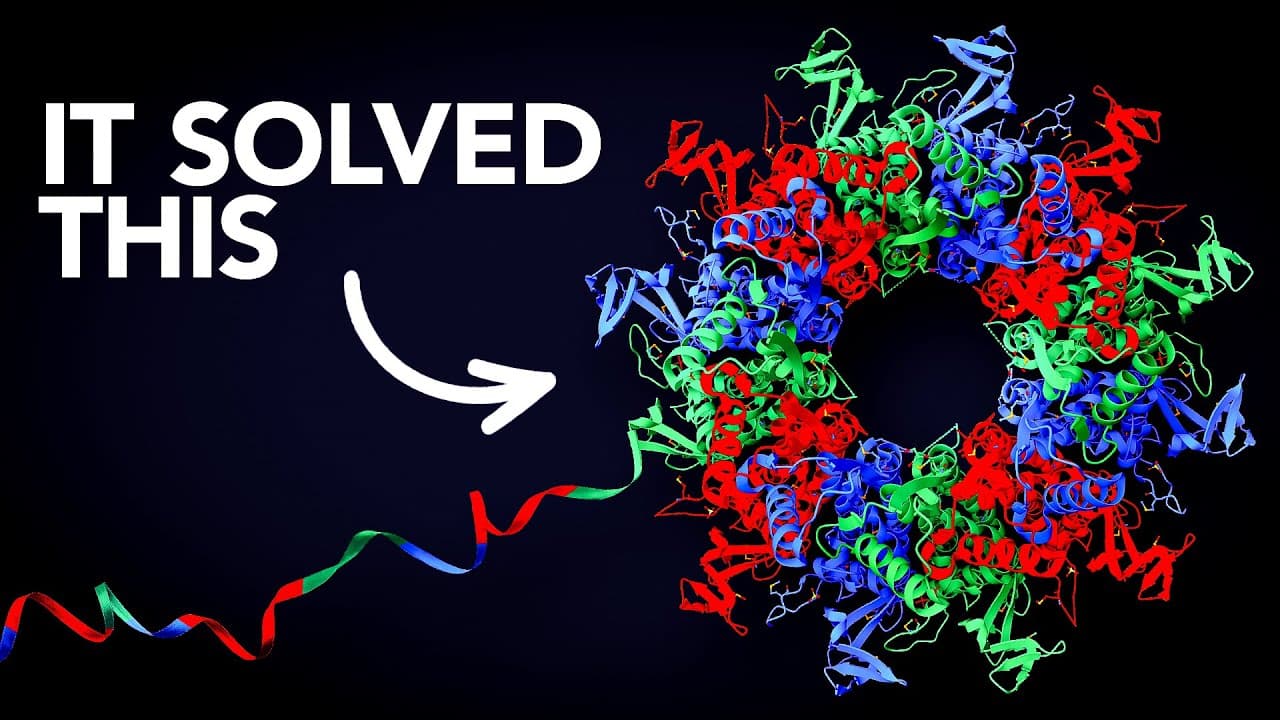
AlphaFold, an AI system developed by DeepMind, has revolutionized the field of protein structure prediction by determining the structures of over 200 million proteins. This breakthrough has accelerated scientific research and has potential applications in medicine, environmental science, and biotechnology. The AI's ability to predict protein structures with high accuracy opens new avenues for drug discovery and understanding biological processes.
Transcript
What if, all of the world's biggest problems from climate change, to curing diseases, to disposal of plastic waste, what if they all had the same solution? A solution so tiny it would be invisible. I'm inclined to believe this is possible, thanks to a recent breakthrough that solved one of the biggest problems of the last century. How to determine ... Read More
Key Insights
- AlphaFold is an AI system developed by DeepMind that predicts protein structures.
- It has determined the structures of over 200 million proteins, covering nearly all known proteins.
- Protein folding is crucial for understanding biological functions and developing new drugs.
- AlphaFold uses deep learning and evolutionary data to predict protein structures accurately.
- The AI's success has accelerated research in medicine, environmental science, and biotechnology.
- AlphaFold's predictions have contributed to vaccine development and understanding diseases.
- The system has been recognized with a Nobel Prize for its impact on protein science.
- AI advancements like AlphaFold are transforming scientific research and problem-solving.
Install to Summarize YouTube Videos and Get Transcripts
Explore YouTube Video Summarizer or Get YouTube Transcript Extractor
Questions & Answers
Q: How does AlphaFold predict protein structures?
AlphaFold predicts protein structures by using deep learning techniques and evolutionary data. It analyzes amino acid sequences and evolutionary patterns to determine the 3D structure of proteins. The AI system employs a neural network architecture to predict pairwise distances between amino acids, which are then used to construct the protein's structure. This method allows AlphaFold to achieve high accuracy in its predictions.
Q: What impact has AlphaFold had on scientific research?
AlphaFold has significantly impacted scientific research by providing accurate predictions of protein structures, which are essential for understanding biological functions and developing new drugs. Its predictions have accelerated research in medicine, environmental science, and biotechnology, enabling scientists to explore new avenues for drug discovery and disease understanding. The AI's success has been recognized with a Nobel Prize, underscoring its transformative effect on protein science.
Q: Why is protein folding important in biology?
Protein folding is crucial in biology because the 3D structure of a protein determines its function. Proper folding is necessary for proteins to perform their biological roles, such as catalyzing reactions, transporting molecules, and providing structural support. Misfolded proteins can lead to diseases, making understanding protein folding essential for developing treatments and understanding biological processes at a molecular level.
Q: How has AlphaFold contributed to vaccine development?
AlphaFold has contributed to vaccine development by providing accurate protein structure predictions, which are essential for designing effective vaccines. By understanding the structure of proteins involved in pathogens, researchers can identify targets for vaccine development and design molecules that elicit a strong immune response. AlphaFold's predictions have accelerated this process, aiding in the development of vaccines for diseases such as malaria.
Q: What are the future applications of AlphaFold in biotechnology?
Future applications of AlphaFold in biotechnology include drug discovery, designing novel proteins for industrial use, and understanding complex biological systems. Its accurate protein structure predictions can lead to the development of new therapeutics, enzymes for industrial processes, and solutions for environmental challenges such as plastic degradation and greenhouse gas capture. AlphaFold's capabilities open new possibilities for innovation in biotechnology.
Q: How does AlphaFold use evolutionary data in its predictions?
AlphaFold uses evolutionary data by analyzing patterns of mutations in amino acid sequences across different species. This information helps identify conserved regions and co-evolutionary relationships between amino acids, which are crucial for maintaining protein structure and function. By incorporating this evolutionary insight, AlphaFold enhances its ability to predict accurate protein structures, even for proteins with little experimental data available.
Q: What challenges did scientists face before AlphaFold in protein structure determination?
Before AlphaFold, scientists faced significant challenges in determining protein structures due to the complexity and variability of protein folding. Traditional methods like X-ray crystallography and NMR spectroscopy were time-consuming, expensive, and often limited to small or stable proteins. These methods required extensive experimental work, and many protein structures remained unsolved, hindering scientific progress in understanding biological functions and developing new therapeutics.
Q: How has AlphaFold advanced the field of protein science?
AlphaFold has advanced the field of protein science by providing a computational method to predict protein structures with high accuracy. Its ability to determine the structures of nearly all known proteins has accelerated research, enabling scientists to explore new biological questions and develop innovative solutions in medicine and biotechnology. AlphaFold's success has set a new standard for protein structure prediction, transforming how researchers approach protein science.
Summary & Key Takeaways
-
AlphaFold, developed by DeepMind, has transformed protein science by accurately predicting the structures of over 200 million proteins. This AI breakthrough has accelerated research in fields like medicine and environmental science, offering new opportunities for drug discovery and understanding biological processes. AlphaFold's success demonstrates the potential of AI to solve complex scientific problems.
-
The AI system uses deep learning and evolutionary data to predict protein structures with high accuracy. Its ability to determine the structure of nearly all known proteins has been recognized with a Nobel Prize, highlighting its significant impact on scientific research. AlphaFold's predictions have already contributed to vaccine development and understanding diseases.
-
AlphaFold's development marks a major advancement in the field of protein folding, enabling researchers to explore new avenues in biotechnology and medicine. By solving a problem that has challenged scientists for decades, AlphaFold exemplifies how AI can drive transformative changes in science and technology, pushing the boundaries of human knowledge.
Read in Other Languages (beta)
Share This Summary 📚
Summarize YouTube Videos and Get Video Transcripts with 1-Click
Try YouTube Summary with ChatGPT & Claude or YouTube Transcript Generator
Explore More Summaries from Veritasium 📚





Summarize YouTube Videos and Get Video Transcripts with 1-Click
Try YouTube Summary with ChatGPT & Claude or YouTube Transcript Generator