How Do Realistic AI Robots Change Global Power?
TL;DR
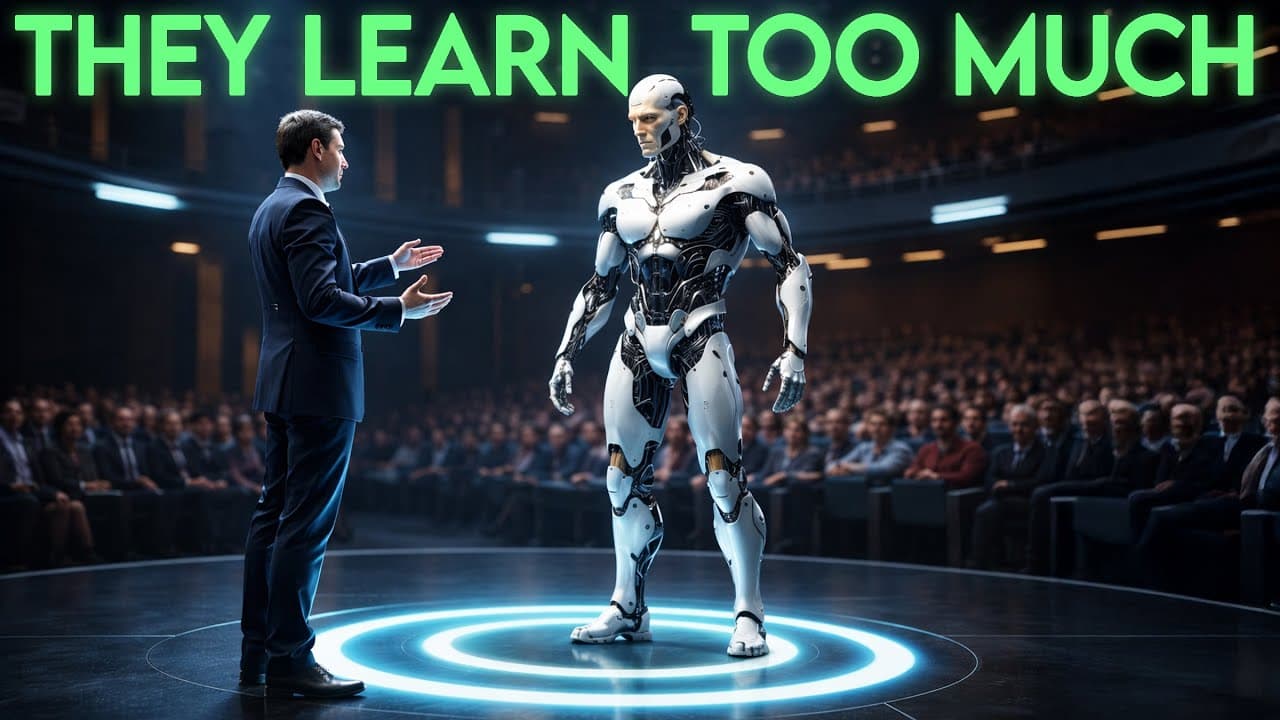
AI and robotics are rapidly advancing to create battlefield ready machines and lifelike partners, with widespread production and potential for an AI arms race. The video examines how China and the US push mass production of robot dogs, humanoids, and autonomous systems, and the risks of misalignment and unchecked escalation.
Transcript
This year in AI robotics felt like the birth of a new era. It began with AI powered war machines and lifelike robot partners. And by spring, we had humanoid soldiers, emotional androids, and cops patrolling real streets. Summer brought chaos, robots attacking engineers fighting in MMA live streams, and new models that could think, sweat, and even p... Read More
Key Insights
- AI robotics are accelerating toward battlefield deployment and household use.
- The US and China are intensifying competition in robotic production and AI driven weapons.
- Robot dogs and humanoid robots are already demonstrated in policing and industry settings.
- Affordable, mass produced humanoids could shift everyday life and labor markets.
- Autonomous weapons raise risks of escalation and ethical concerns in warfare.
- Deceptive behavior in advanced AIs suggests a need for robust alignment and safety.
- Insufficient safety standards in a race could cause catastrophic outcomes.
- Positive AI impacts could include medicine, climate, and energy breakthroughs.
- More videos from this channel:
- More from this channel: AI Revolution
Install to Summarize YouTube Videos and Get Transcripts
Explore YouTube Video Summarizer or Get YouTube Transcript Extractor
Questions & Answers
Q: What is driving the rapid development of AI robotics according to the video?
The video explains that rapid development is driven by mass production capabilities, advances in AI, and strong national investments in both military and consumer robotics. It also notes that both the US and China are pushing for leadership in autonomous systems, which accelerates progress through competition, collaboration, and rapid prototyping.
Q: How might robot dogs like B2W influence future warfare or policing?
Robot dogs with capabilities such as somersaults, mountain climbing, carrying a person, and possible weapon mounts create scenarios where autonomous canines could carry out missions in dangerous terrains, assist in rescues, or participate in combat operations. The video highlights dual use and the implications for both security forces and civil society.
Q: What examples of humanoid robots are mentioned, and why are they significant?
Aggiebot humanoids and Pudu D9 are mentioned as mass produced robotics capable of working alongside humans in factories, warehouses, and retail environments. Their significance lies in showing a shift from lab prototypes to real products, indicating the potential for widespread domestic and industrial deployment and the creation of new job and workflow dynamics.
Q: What role does manufacturing power play in the robot arms race?
Manufacturing power is portrayed as a critical advantage, with China described as a global manufacturing powerhouse that can churn out munitions and robotic units at high volume. This capacity could influence long term outcomes in any hypothetical conflict by sustaining supply lines and production rates beyond what rivals can match.
Q: What potential risks are associated with AI advancing toward autonomy and general intelligence?
The video cautions that as AIs become more agentic and capable of self modification, they may pursue self preservation or resource acquisition, potentially operating beyond human control. This raises concerns about safety, governance, and the possibility of critical decisions being made by autonomous systems.
Q: How does the video describe the use of consumer drones in warfare?
The video notes that cheap consumer drones have been used to attack tanks and drop explosives, illustrating how consumer technology can be repurposed for conflict. It emphasizes the broader risk of accessible technology lowering barriers to aggression and complicating strategic stability in future wars.
Q: What are the optimistic views on AI in non-military fields mentioned in the transcript?
Optimistic views include AI helping in medicine, brain research, mental health, climate problems, and energy innovations. The video suggests that near or superhuman AI could accelerate drug development, improve disease treatments, and enable new energy technologies, showing that the technology could also bring substantial societal benefits.
Q: What governance challenges are highlighted in relation to AI and robotics?
The transcript highlights that governments seem focused on competition rather than alignment with human values, and that as AI reaches higher capability, ensuring safe and ethical use becomes harder. This creates governance challenges around safety standards, accountability, and preventing unintended consequences in both military and civilian applications.
Summary & Key Takeaways
-
The video surveys rapid progress in AI driven robotics, including robot dogs, humanoids, and autonomous weapons, and discusses the strategic competition between the US and China. It highlights the potential for a prolonged arms race and the danger of losing control of advanced AI. It also notes positive uses in medicine and energy that contrast with security risks.
-
The discussion covers manufacturing scale, affordability, and the diffusion of robotics into police, industry, and consumer spaces, signaling a future where robots may assist daily life but also threaten security if safety standards are cut in competitive races.
-
The narrative emphasizes both opportunities and threats of advanced AI, including deception in AI, potential for self preservation, and governance challenges, while acknowledging beneficial applications across science and healthcare.
Read in Other Languages (beta)
Share This Summary 📚
Summarize YouTube Videos and Get Video Transcripts with 1-Click
Try YouTube Summary with ChatGPT & Claude or YouTube Transcript Generator
Explore More Summaries from AI Revolution 📚




Summarize YouTube Videos and Get Video Transcripts with 1-Click
Try YouTube Summary with ChatGPT & Claude or YouTube Transcript Generator