How to Synthesize Mercury Thiocyanate Safely
TL;DR
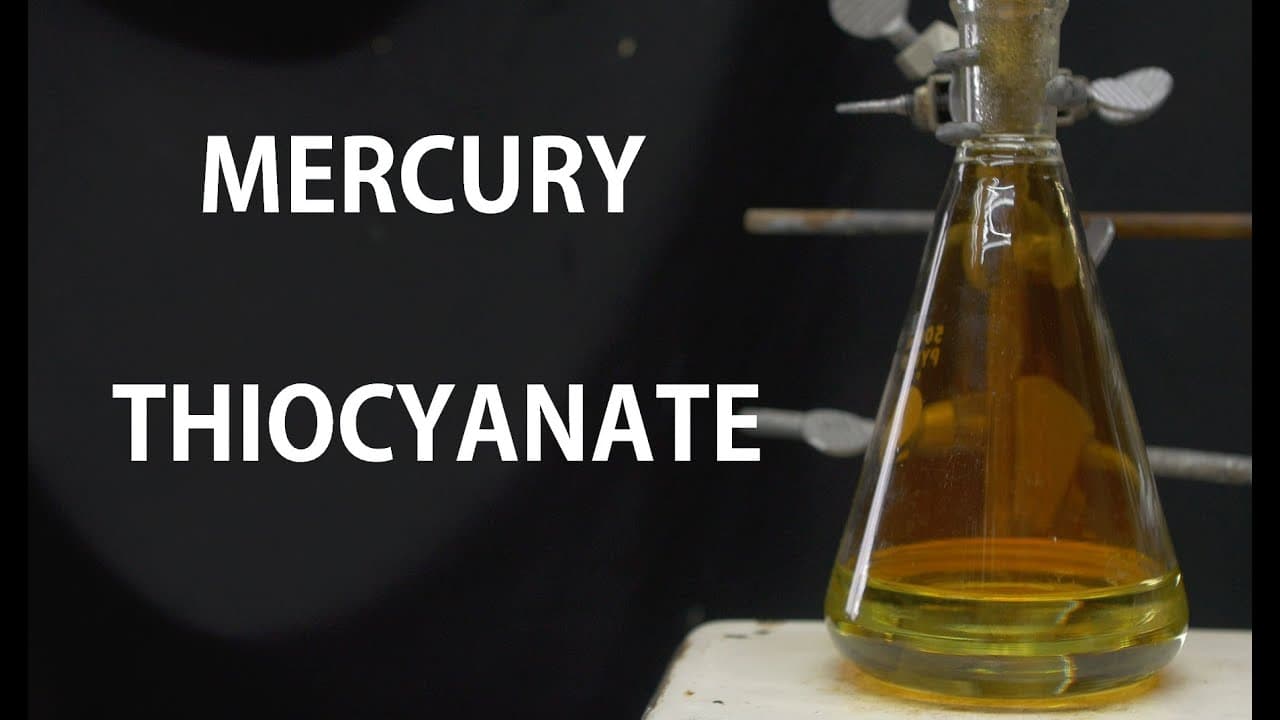
To synthesize mercury thiocyanate, react mercury with nitric acid to produce mercury nitrate, then add potassium thiocyanate for precipitation. Monitor the reaction closely to prevent foaming, and filter the final product while adhering to safety protocols for hazardous materials.
Transcript
today we're gonna be going back and revisiting the synthesis of mercury thiocyanate also known as the Ferro serpent it's actually one of the first videos that I made and it's my most popular video by far but I feel if I revisit it I can do a better job this time I don't know why but in my earlier videos I kind of sound like I hate everything that I... Read More
Key Insights
- ❓ The synthesis of mercury thiocyanate involves reacting mercury with nitric acid and potassium thiocyanate.
- 🥇 The content creator experienced a foaming reaction due to excess mercury, but successfully contained it using a container placed underneath.
- 🫢 Boiling the mercury nitrate solution converts it to mercury 2 nitrate and helps remove dissolved nitrogen dioxide gas.
- 💁 The diluted mercury nitrate solution is combined with potassium thiocyanate, resulting in the formation of mercury thiocyanate.
- ❓ The mercury thiocyanate is filtered and washed with hydrochloric acid to remove impurities.
- 🧂 Proper disposal methods must be followed due to the hazardous nature of mercury salts.
- 🌱 The content creator plans to release a separate video demonstrating the exciting properties of the mercury thiocyanate.
Install to Summarize YouTube Videos and Get Transcripts
Explore YouTube Video Summarizer or Get YouTube Transcript Extractor
Questions & Answers
Q: Why did the content creator decide to revisit the synthesis of mercury thiocyanate?
The content creator wanted to improve upon their initial video and demonstrate the process with more enthusiasm. They also scaled up the reaction for a larger yield.
Q: How does the content creator prevent the foaming reaction from overflowing?
The content creator placed a container underneath the reaction flask to catch any overflow. This precaution was necessary as the foaming reaction produced a significant amount of nitrogen dioxide gas.
Q: How does the content creator deal with the excess mercury 1 nitrate produced during the reaction?
The content creator demonstrates how the excess mercury 1 nitrate can be eliminated by swirling the solution, causing the drops of mercury to bounce and separate from the desired product.
Q: What is the final yield of the mercury thiocyanate?
The final yield of the mercury thiocyanate in this synthesis is approximately 328 grams, which is higher than the theoretical yield.
Summary & Key Takeaways
-
The content creator revisits the synthesis of mercury thiocyanate by reacting mercury with nitric acid and potassium thiocyanate.
-
The initial attempt results in a foaming reaction due to excessive mercury, but the situation is contained using a container placed underneath.
-
The process involves boiling the mercury nitrate solution to convert it to mercury 2 nitrate, diluting it, adding potassium thiocyanate, and filtering the resulting mercury thiocyanate.
Read in Other Languages (beta)
Share This Summary 📚
Summarize YouTube Videos and Get Video Transcripts with 1-Click
Try YouTube Summary with ChatGPT & Claude or YouTube Transcript Generator
Explore More Summaries from NileRed 📚
Summarize YouTube Videos and Get Video Transcripts with 1-Click
Try YouTube Summary with ChatGPT & Claude or YouTube Transcript Generator