How to Build a Claude Creative Strategy System
TL;DR
Build an effective Claude creative system by combining detailed brand context, proven domain knowledge, reusable skills, quality control, and recorded strategic reasoning. This shifts routine execution to AI while giving creative strategists more time for research, strategy, prioritization, and other high-leverage work, with every system measured against a clear business KPI or benchmark.
Transcript
Today on DC Diaries, we're doing a mastermind breaking down how we are using Claude right now across creative strategy. And this is by far our most asked for mastermind. Now, as we know, the AI ecosystem has fundamentally shifted in the last 6 months and a lot of people haven't necessarily caught up. Platforms are very much racing to commoditize ex... Read More
Key Insights
- Context engineering is the foundation of effective Claude use because a model cannot independently know a brand's performance data, customer language, internal insights, or operating nuances. Strong outputs depend on transferring the relevant intelligence from the team into the system before asking it to execute work.
- Brand context is the information that makes an AI workflow specific to a business. It includes the products being sold, intended buyers, brand identity documents, tone of voice, unique selling points, customer reviews, top-performing advertisements, and current performance data.
- Domain context is the broader expertise required to perform a creative task well. It can include industry best practices, scriptwriting principles, successful static advertisements, high-production and UGC examples, hook frameworks, and explanations of the patterns that may have contributed to strong performance.
- Strategic depth is becoming more valuable as AI platforms increasingly commoditize execution. Creative teams should transfer lower-leverage tasks, such as drafting static briefs after concepts are established, to well-contextualized systems while keeping people focused on research, strategy, quality control, and prioritization.
- A useful AI build is tied to a business case, KPI, or benchmark. Building Claude Code applications without defining the operational problem or measurement method can prioritize style over substance and create architecture that fails to produce better performance or meaningful process efficiency.
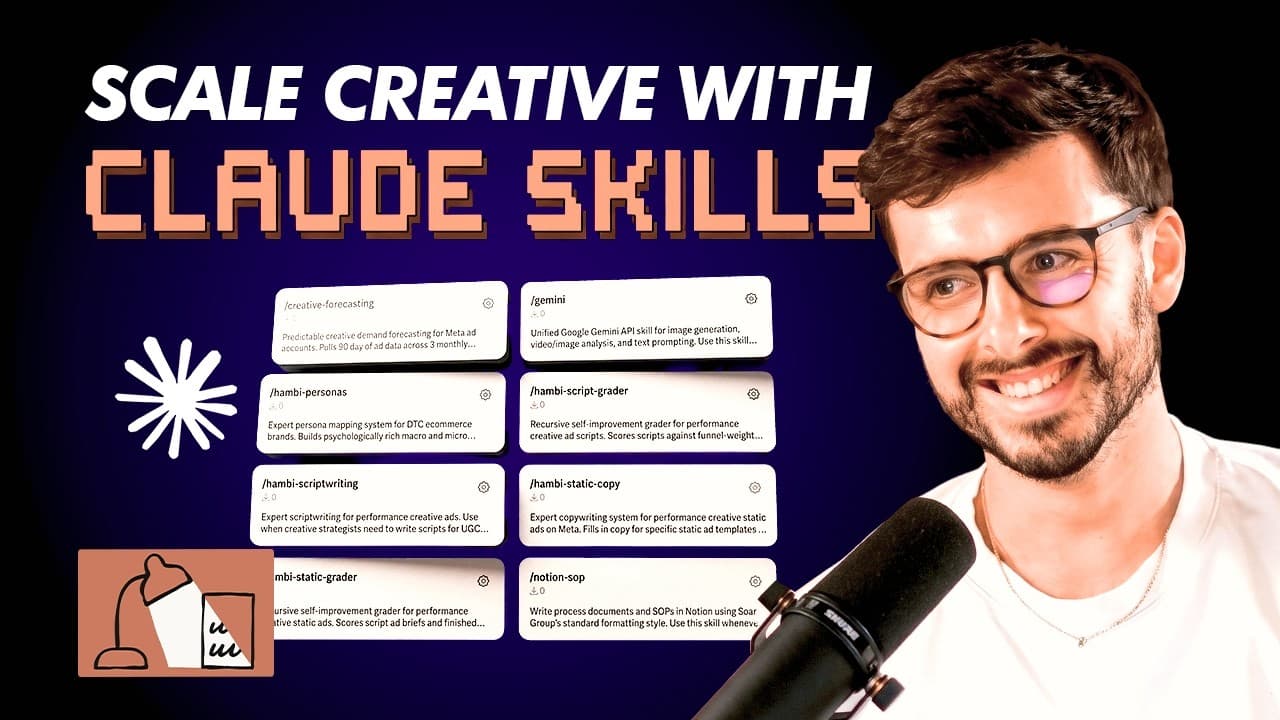
- Claude Skills are repeatable systems that encode a team's best thinking. The production examples described include an eight-phase scriptwriting skill, reporting and script quality-control skills, and a recursive grader that evaluates scripts against ten criteria and rewrites them until they are ready to ship.
- Reasoning traces are records of strategic decisions and the thinking behind them. Consistently logging these traces, applying feedback, and integrating them into a creative operating system can help an AI layer progress from junior-level support toward behavior resembling a senior strategist.
- AI infrastructure is most valuable when skills, context, agents, and Claude Code operate together. This combination moves work beyond isolated chat interactions and toward an agentic operating system that can support a creative organization producing more than 6,000 advertisements per month.
- More videos from this channel:
- More from this channel: D2C Diaries
Install to Summarize YouTube Videos and Get Transcripts
Explore YouTube Video Summarizer or Get YouTube Transcript Extractor
Questions & Answers
Q: How do you build a Claude creative strategy system?
Start by organizing the information Claude needs into brand context and domain context. Then encode repeatable team methods as Claude Skills for tasks such as scriptwriting, reporting, and quality control. Combine those foundations with Claude Code and agents only after defining a clear business case. Measure each build against a KPI or benchmark, and preserve feedback and reasoning traces so the system can improve over time.
Q: What is context engineering for creative strategy?
Context engineering is the process of supplying Claude with the knowledge required to produce relevant work. Instead of relying on a polished prompt alone, the team provides customer language, performance data, internal insights, brand nuances, and task-specific expertise. The approach treats people as the source of business intelligence and the model as the processing capability that applies that intelligence at scale.
Q: What is the difference between brand context and domain context?
Brand context describes the specific business, including its products, buyers, identity, tone of voice, unique selling points, reviews, winning advertisements, and current data. Domain context describes how to perform the broader discipline well, including creative strategy practices, script and hook principles, effective formats, successful examples, and hypotheses about why particular patterns work across advertisements or accounts.
Q: Why do prompts matter less than context in Claude?
A prompt can request an output, but it does not automatically give Claude access to a company's customer language, performance results, internal discoveries, or strategic nuances. Without those inputs, the model must depend on broad existing knowledge. Supplying structured business and domain context closes that gap, allowing the model's processing power to work with the team's actual intelligence instead of generic assumptions.
Q: How should creative strategists divide work between people and AI?
Creative strategists should assess tasks by leverage. Once concepts and the required context are available, routine execution such as drafting a static advertisement brief can be assigned to a system capable of performing it effectively. People can then devote more time to research, strategy, prioritization, and quality control, which become increasingly important as platforms make basic execution easier to obtain.
Q: How can Claude Skills improve scriptwriting and quality control?
Claude Skills can preserve a team's scriptwriting and evaluation methods as repeatable workflows rather than requiring the process to be reconstructed in every chat. The system described uses an eight-phase production skill and a recursive script grader. The grader scores every script against ten criteria and rewrites it until it reaches the standard required for shipping, creating a more consistent quality-control process.
Q: Why should an AI workflow be connected to a KPI?
A KPI or benchmark establishes whether an AI build creates better performance or operational efficiency. Before developing a feature, the team should identify its business case and decide how improvement will be measured. This prevents effort from being spent on applications that appear sophisticated but solve no meaningful problem, while also revealing whether the resulting architecture improves the process it was designed to support.
Q: How does a self-learning creative operating system improve over time?
A self-learning creative operating system improves by capturing feedback, reasoning traces, and strategic decisions instead of treating each interaction as an isolated request. These records preserve why choices were made and give the system additional context for later work. In the described implementation, the intelligence layer began as a junior strategist and developed behavior resembling a senior strategist as feedback and decision-logging systems were added.
Summary & Key Takeaways
-
Effective AI adoption begins with context engineering, not isolated prompts or premature software builds. Teams must supply Claude with the performance data, customer language, internal insights, brand identity, and strategic expertise that it cannot infer from a generic request. Human intelligence and AI processing power become more useful when combined systematically.
-
Creative teams should separate context into brand and domain categories. Brand context includes products, customers, positioning, reviews, tone of voice, current performance data, and successful advertisements. Domain context includes creative best practices, effective scripts, hooks, formats, market examples, and hypotheses about why particular creative approaches produce strong results.
-
Reusable Claude Skills can compress a team's methods into repeatable workflows for scriptwriting, reporting, and quality control. When these skills are combined with Claude Code, agents, recursive grading, and reasoning traces, they form an operating system that can learn from feedback and support higher creative volume without abandoning strategic judgment.
Read in Other Languages (beta)
Share This Summary 📚
Summarize YouTube Videos and Get Video Transcripts with 1-Click
Try YouTube Summary with ChatGPT & Claude or YouTube Transcript Generator
Explore More Summaries from D2C Diaries 📚




Summarize YouTube Videos and Get Video Transcripts with 1-Click
Try YouTube Summary with ChatGPT & Claude or YouTube Transcript Generator