How to Eliminate Left Recursion in CFGs Step-by-Step
TL;DR
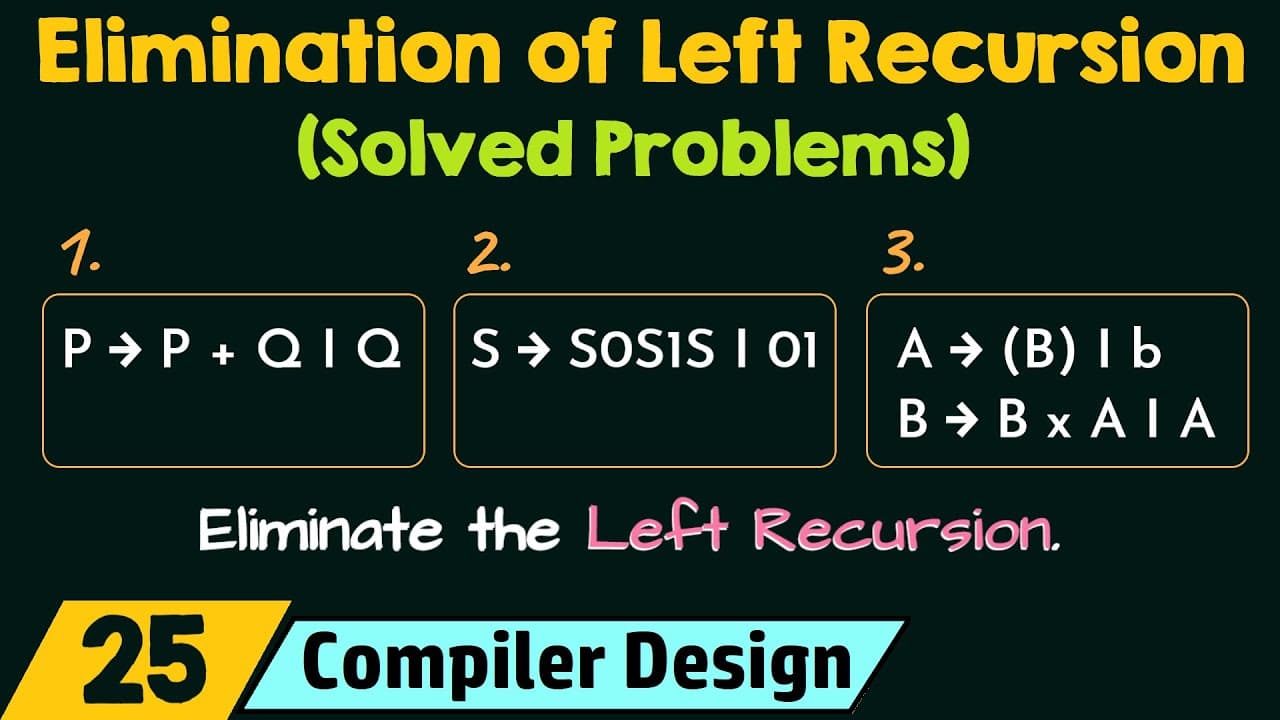
Left recursion is removed by converting left recursive productions into non left recursive forms using a beta a prime pattern, creating a new nonterminal for recursion, and rewriting rules so the recursion becomes right recursive or optional. The method is illustrated through four solved examples, showing beta and alpha differences and how to end recursion with epsilon.
Transcript
Hello everyone and welcome back. In this session, we will observe some solved problems on elimination of left recussion. So without any further ado, let's get to learning. Coming to the outcome of today's session. Today we will observe four solved examples on eliminating left recussion. Consider the first example. Observe this production. P can be ... Read More
Key Insights
- Left recursion occurs when a nonterminal is the leftmost symbol in its own production, causing potential parsing problems for top-down parsers.
- The standard cure introduces a new nonterminal, often called primed, to capture recursion separate from the initial derivation.
- Each left recursive production is rewritten into a form where a beta portion precedes the recursion via the new nonterminal, enabling a safe termination point via epsilon or end of input.
- The beta portion represents the non-recursive base cases, which the parser can generate before resorting to recursion.
- The alpha portion represents the recursive step that shifts control into the new nonterminal, enabling repetitive application without left factoring.
- The resulting grammar is right recursive or epsilon, preserving language while improving parser compatibility.
- The method is demonstrated across four concrete examples, highlighting variations in how betas and alphas are chosen for different grammar structures.
- Elimination of left recursion is essential for improving compatibility with top-down parsing strategies and reducing parser backtracking.
Install to Summarize YouTube Videos and Get Transcripts
Explore YouTube Video Summarizer or Get YouTube Transcript Extractor
Questions & Answers
Q: How to identify left recursion in a grammar used for CFGs
Left recursion is identified when a nonterminal A appears at the leftmost position of one of its productions, as in A -> A alpha or A -> A beta. This pattern causes top-down parsers to loop indefinitely on A. The video shows four solved examples illustrating this situation and how to rewrite each rule to remove that leftmost self-reference, often by introducing a new nonterminal A prime or similar and reorganizing the derivations so the beta portion precedes the recursive call.
Q: What is the general form used to eliminate left recursion
The general form converts A -> A alpha | beta into A -> beta A prime and A prime -> alpha A prime | epsilon. This structure moves the recursion to the right side via the new nonterminal A prime, allowing the parser to generate a base beta first and then optionally repeat alpha sequences through A prime, ending with epsilon when recursion stops. The video demonstrates this approach in multiple examples.
Q: How does introducing a new nonterminal help
Introducing a new nonterminal, often called A prime, separates the recursive and non recursive portions of the production. The nonterminal holds the recursive suffix alpha, allowing the initial beta to terminate the derivation. This change converts left recursion into right recursion or an optional repetition, which is far more friendly to top down parsers and avoids infinite recursion during parsing.
Q: What is beta in the left recursion elimination technique
Beta represents the non recursive part of a production, the base case that begins a derivation without performing any recursion. In the rewritten grammar, beta appears first, followed by the new nonterminal that handles the recursion. The examples in the video show various betas such as 01 or parentheses constructs that start the derived strings before any recursive steps occur.
Q: What is alpha in the left recursion elimination technique
Alpha is the recursive portion that follows the new nonterminal in the right recursive form. It captures the repeated pattern that was originally left recursive, such as plus q or additional S constructs. The alpha is used in the rule for the new nonterminal, enabling the continued derivation of the language while preserving the ability to terminate with epsilon.
Q: How is epsilon used in the rewritten grammar
Epsilon is used to allow termination of the recursion. In the rewritten grammar, the new nonterminal can produce epsilon, giving the parser a way to stop applying the recursive rule after any number of iterations. This ensures that the grammar can generate finite strings and prevents infinite derivation sequences in top down parsing.
Q: Are there patterns where left recursion is not present
Yes, some grammars do not exhibit left recursion, where the leftmost symbol is not the same nonterminal on the right hand side of its own production. The video notes this by highlighting instances where the base non left recursive production is already in a form that does not begin with the same nonterminal, requiring no changes. Such grammars can be parsed by top down methods without modification.
Q: What is the practical takeaway from the examples shown
The practical takeaway is a repeatable method to convert any left recursive grammar to a right recursive one using a beta plus new nonterminal approach. By identifying A, beta, and alpha, and applying A -> beta A prime and A prime -> alpha A prime | epsilon, you can transform four solved problems into a uniform, parser friendly form, improving compatibility with top down parsing.
Summary & Key Takeaways
-
Left recursion is identified when a nonterminal appears as the leftmost symbol on the right side of a production. This video demonstrates four solved problems and converts each left recursive rule into a non left recursive form using beta and alpha patterns.
-
The process introduces a new nonterminal (prime) to collect recursion, rewrites productions as beta followed by this new nonterminal, and allows termination with epsilon to prevent infinite derivations.
-
The examples cover different grammar shapes, including cases with S, A, and B nonterminals, and show how to systematically derive right recursive equivalents that are friendly to top-down parsers.
Read in Other Languages (beta)
Share This Summary 📚
Summarize YouTube Videos and Get Video Transcripts with 1-Click
Try YouTube Summary with ChatGPT & Claude or YouTube Transcript Generator
Explore More Summaries from Neso Academy 📚




Summarize YouTube Videos and Get Video Transcripts with 1-Click
Try YouTube Summary with ChatGPT & Claude or YouTube Transcript Generator