How to Make Hydrazine Sulfate Safely at Home
TL;DR
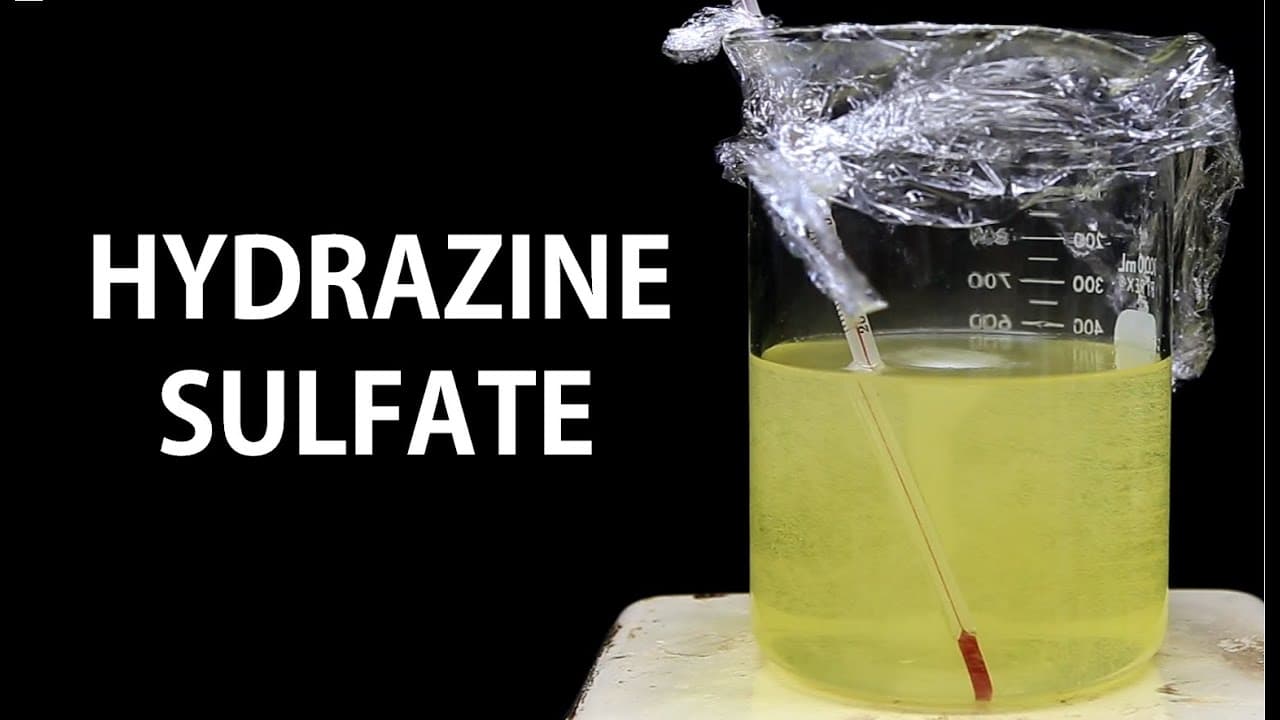
To make hydrazine sulfate safely, combine urea, gelatin, sodium hydroxide, and bleach while maintaining a cool temperature to avoid volatility. This compound is a safer alternative to pure hydrazine, used as a precursor in reactions like the synthesis of luminol, which is valuable in pharmaceuticals and forensic science. Proper control of temperatures and careful reagent addition is crucial for a successful reaction.
Transcript
to start things off we're first going to have to talk about what hydrazine sulfate is and why we're even making it hydrazine sulfate is the salt version of hydrazine and on the left we can see the free base hydrazine and on the right we can see what the hydrogen sulfate looks like there is a reason why we're making hydrazine sulfate and not the pur... Read More
Key Insights
- 🦺 Hydrazine sulfate is a safer alternative to pure hydrazine, as it is not volatile, explosive, and less toxic.
- 🛟 It can be used in various reactions and serves as a precursor for the synthesis of luminol and other pharmaceuticals.
- ❓ The synthesis of hydrazine sulfate involves neutralizing sodium hydroxide, sodium carbonate, and hydrazine with sulfuric acid.
- 😑 Gelatin is added to chelate metal ions that could degrade the hydrazine.
- 💁 The Hoffman rearrangement is the main reaction occurring, forming isocyanate, carbamic acid, and ultimately hydrazine.
- ✋ Careful control of temperature, stirring, and addition of reagents is essential to avoid accidents and achieve a high yield.
- ❓ The final product of hydrazine sulfate can be contaminated with sodium sulfate, but it does not significantly affect its usability.
Install to Summarize YouTube Videos and Get Transcripts
Explore YouTube Video Summarizer or Get YouTube Transcript Extractor
Questions & Answers
Q: What is the difference between hydrazine sulfate and pure hydrazine?
Hydrazine sulfate is a salt form of hydrazine that is safer to handle due to its powder form, reduced volatility, and toxicity. Pure hydrazine, on the other hand, is a liquid that is explosive and highly toxic.
Q: Why is hydrazine sulfate used as a precursor for luminol synthesis?
Hydrazine sulfate is used in the reaction with three nitrothalic acid to form three nitrothal hydrozide, which is one step away from the final luminol product. The NO2 group in the three nitrothal hydrozide needs to be reduced to an NH2 group to complete the luminol synthesis.
Q: What is the purpose of gelatin in the synthesis of hydrazine sulfate?
Gelatin functions as a metal ion chelator, preventing metal ions from breaking down the hydrazine. This is crucial for the reaction's success, as metal ion contamination can hinder the production of hydrazine sulfate.
Q: Can tap water be used in the synthesis process?
Tap water should be avoided due to its high metal ion contamination. Metal ions can interfere with the reaction and reduce the yield of hydrazine sulfate. It is recommended to use distilled water to minimize metal ion contamination.
Summary & Key Takeaways
-
Hydrazine sulfate is the salt version of hydrazine and is safer to work with due to its powder form and reduced volatility and toxicity.
-
It can be used in the same reactions as freebase hydrazine, and its synthesis involves neutralizing sodium hydroxide, sodium carbonate, and hydrazine with sulfuric acid.
-
The resulting hydrazine sulfate is a precursor for the synthesis of luminol, a compound used in forensic science, and other pharmaceuticals.
Read in Other Languages (beta)
Share This Summary 📚
Summarize YouTube Videos and Get Video Transcripts with 1-Click
Try YouTube Summary with ChatGPT & Claude or YouTube Transcript Generator
Explore More Summaries from NileRed 📚
Summarize YouTube Videos and Get Video Transcripts with 1-Click
Try YouTube Summary with ChatGPT & Claude or YouTube Transcript Generator